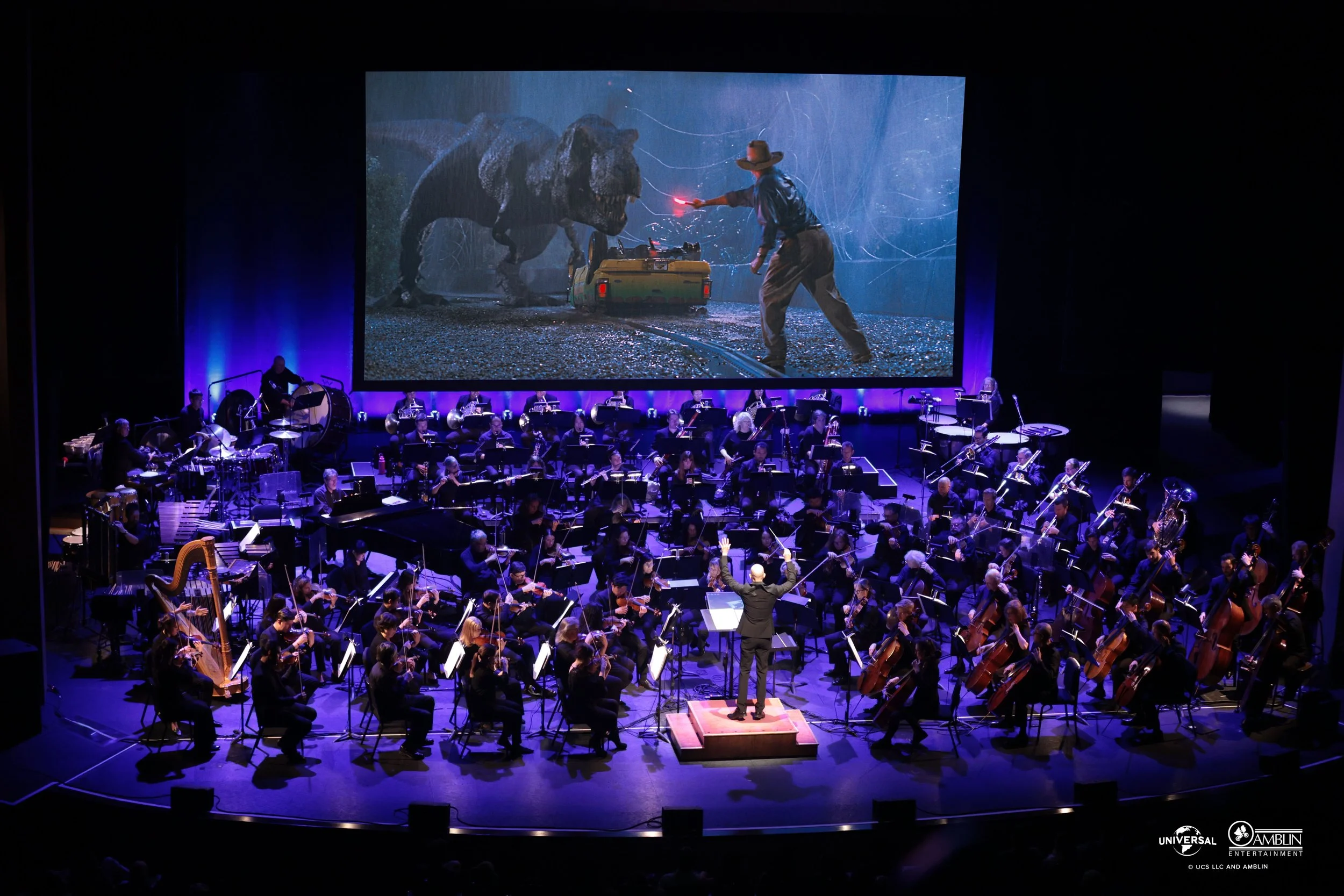
Star Wars: Return of the Jedi
May 31, 2024 at 7:30 pm
June 1, 2024 at 2:00 pm
Modesto Symphony Orchestra
Star Wars: The Empire Strikes Back in Concert
Friday, May 31, 2024 at 7:30 pm
Saturday, June 1, 2024 at 2:00 pm
Gallo Center for the Arts, Mary Stuart Rogers Theater

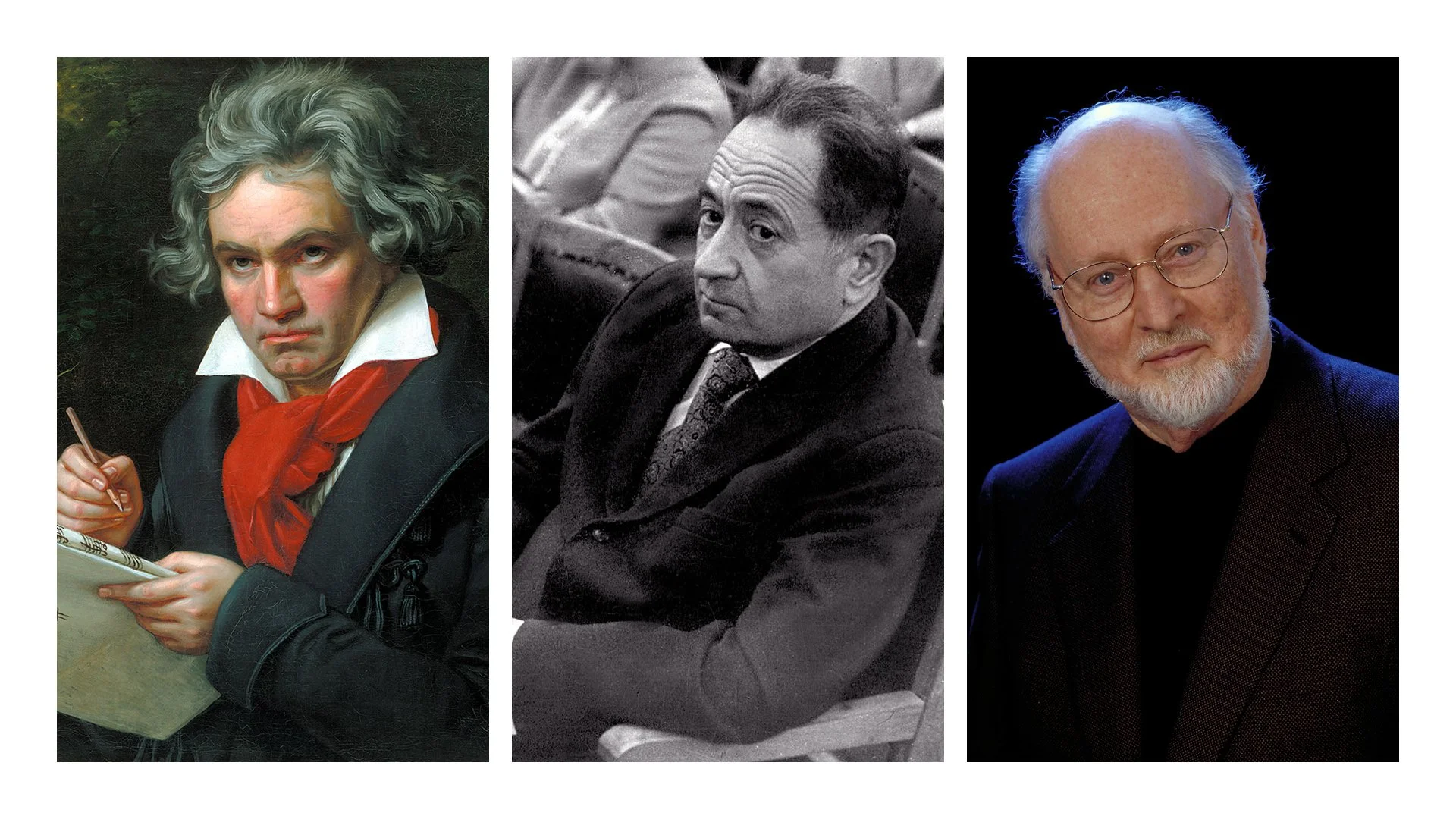
John Williams (b. 1932)
Star Wars: Return of the Jedi in Concert
Feature Film with Orchestra
There will be one intermission.
Presentation licensed by Disney Concerts in association with 20th Century Fox, Lucasfilm Ltd., and Warner/Chappell Music. All rights reserved.
Star Wars Film Concert Series
Star Wars: Return of the Jedi
Twentieth Century Fox Presents
A Lucasfilm Ltd. production
Starring
Mark Hamill
Harrison Ford
Carrie Fisher
Billy Dee Williams
Anthony Daniels as C-3PO
Co-Starring
David Prowse
Kenny Baker
Peter Mayhew
Frank Oz
Directed by
Richard Marquand
Produced by
Howard Kazanjian
Screenplay by
Lawrence Kasdan and George Lucas
Story by
George Lucas
Executive Producer
George Lucas
Music by
John Williams

Original Motion Picture Soundtrack available at Disneymusicemporium.com
Join Mobile MSO!
Text “JEDI” to (209) 780-0424
to receive a link to the concert program & text message updates prior to this performance!
By texting to this number, you may receive messages that pertain to the Modesto Symphony Orchestra and its performances. msg&data rates may apply. Reply HELP for help, STOP to cancel.
About this Performance



MSYO Season Finale
May 11, 2024 at 2 pm
Modesto Symphony Youth Orchestra
Season Finale Concert
Saturday, May 11, 2024, 2:00pm
Gallo Center for the Arts, Mary Stuart Rogers Theater

Program
Concert Orchestra
Donald C. Grishaw, conductor
Antonin Dvorak (1841-1904) arr. Meyer
New World Symphony
iv. Finale
Georges Bizet (1838-1875) arr. Meyer
Habanera from Carmen
Klaus Badelt (b. 1967) arr. Ricketts
Pirates of the Caribbean: The Curse of the Black Pearl
Percussion Ensemble
Ella webb, coach
Joseph Haydn (1732-1809) arr. Marlatt
St. Anthony Chorale
Traditional arr. Ostling
Sourwood Mountain
Percussion Ensemble
Joel Maki, coach
Nathan Daughtrey
On the Spectrum
Intermission
Symphony Orchestra
Elisha wells, conductor
Pascual Marquina (1873-1948) arr. Albert Wang
Espana Cani
Michael Giacchino (b. 1967) arr. James Kazik
Remember Me (from Coco)
Edvard Grieg(1843-1907) arr. Victor Lopez
The Holberg Suite
Wolfgang Amadeus Mozart (1756-1791)
Violin Concerto in A major, K. 219, No. 5
i. Allegro Aperto
Samuel Kraus, violin - 2023-2024 MSYO Concerto Competition Winner
A carmen celebration
Georges Bizet (1838-1875) arr. J. Bullock
Carmen Suite for Orchestra
ii. La Garde Montante from Act II
Georges Bizet (1838-1875) arr. E. Guiraud
Chanson du Toreador
Escamillo’s introduction and aria from Act II
Georges Bizet (1838-1875) arr. J. Bullock
Carmen Suite for Orchestra
iv. Danse Boheme, entr’act to Act II
Join Mobile MSO!
Text “PROGRAM” to (209) 780-0424
to receive a link to the concert program & text message updates prior to this performance!
By texting to this number, you may receive messages that pertain to the Modesto Symphony Orchestra and its performances. msg&data rates may apply. Reply HELP for help, STOP to cancel.
About this Performance


Beethoven's Symphony No. 9
May 10 & 11, 2024 at 7:30 pm
VISIT MOBILE PROGRAM →
READ OUR PROGRAM NOTES →
DOWNLOAD PRINTABLE VERSION →
Modesto Symphony Orchestra
Beethoven’s Symphony No. 9
Friday, May 10, 2024 at 7:30 pm
Saturday, May 11, 2024 at 7:30 pm
Gallo Center for the Arts, Mary Stuart Rogers Theater
Nicholas Hersh, conductor
MSO Chorus
Daniel R. Afonso Jr., chorus director
Georgiana Adams, soprano
Kindra Scharich, mezzo-soprano
Alex Boyer, tenor
Matt Boehler, bass

Program
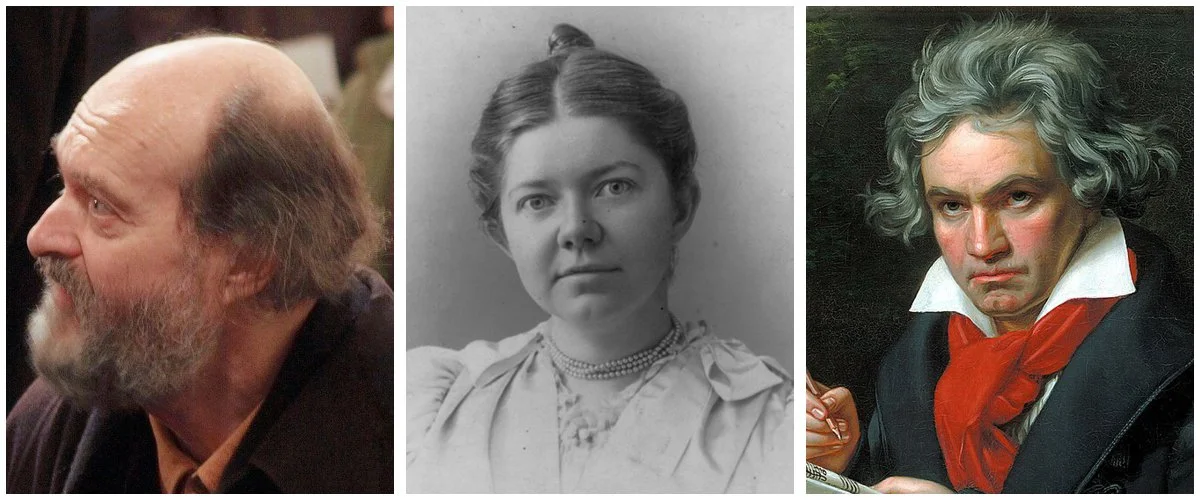
Arvo Pärt (b. 1935)
Fratres (1977)
Amy Beach (1867-1944)
Peace I Leave With You (1891)
Ludwig van Beethoven (1770-1827)
Symphony No. 9 in D minor (1824)
i.Allegro ma non troppo, un poco maestoso
ii.Molto Vivace—Presto
iii.Adagio molto e cantabile
iv.Finale—Ode to Joy
Join Mobile MSO!
Text “PROGRAM” to (209) 780-0424
to receive a link to the concert program & text message updates prior to this performance!
By texting to this number, you may receive messages that pertain to the Modesto Symphony Orchestra and its performances. msg&data rates may apply. Reply HELP for help, STOP to cancel.
About this Performance
Program Notes: Beethoven's Symphony No. 9
Notes about:
Pärt’s Fratres
Beach’s Peace I Leave With You
Beethoven’s Symphony No. 9 in D minor, Op. 125 “Choral”
Program Notes for MAy 10 & 11, 2024
Beethoven’s Symphony No. 9

Arvo pärt
Fratres
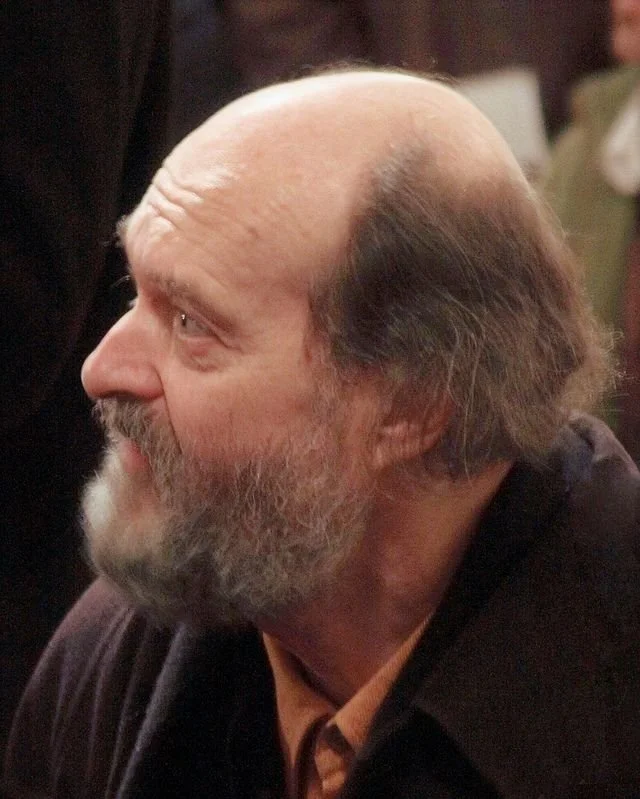
Composer: born September 11, 1935, Paide, Estonia
Work composed: 1977
World premiere: undocumented
Instrumentation: string orchestra
Estimated duration: 6 minutes
The crystalline quality of Arvo Pärt’s music evokes the wintry climate of his native Estonia. Pärt achieves this shimmering transparency through single notes, a compositional style he named “tintinnabulation,” Latin for “little bells.” Pärt explains, “I have discovered that it is enough when a single note is beautifully played. This one note, or a silent beat, or a moment of silence, comforts me. I work with very few elements – with one voice, two voices. I build with primitive materials – with the triad, with one specific tonality. The three notes of a triad are like bells, and that is why I call it tintinnabulation.”
At the time Pärt composed Fratres, he was also immersing himself in the sound world of medieval and Renaissance music. Music from these periods did not often indicate which instruments or voice parts should be used, a practice Pärt employed with Fratres. This choice showcases notes and melodic phrases, rather than particular timbres, or sound colors.
Fratres features a series of variations on a simple stepwise theme, which reappears in several different octaves. Underneath the gently shimmering variations, the low strings maintain a steady drone. The overall effect is meditative, enveloping the listener in a mood of reflection.
AMy BEach
Peace I Leave With You
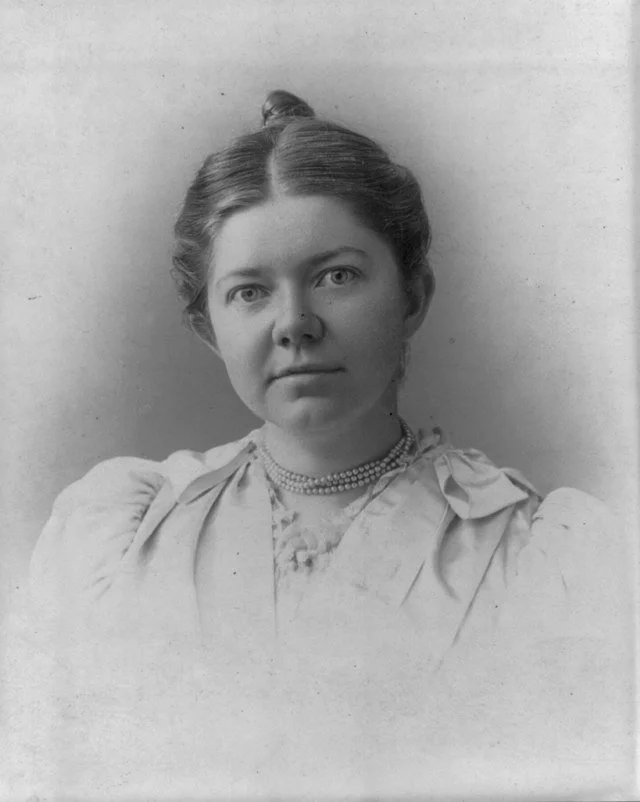
Composer: born September 5, 1867, Henniker, NH; died December 27, 1944, New York City
Work composed: 1891
World premiere: undocumented
Instrumentation: a cappella SATB chorus
Estimated duration: 1.5 minutes
Amy Beach’s musical accomplishments include several firsts: the first American woman to compose and publish a symphony – and the first American woman to have a symphony performed. She is also one of the first American composers – of any gender – whose musical training occurred wholly within the United States, rather than Europe. As such, Beach’s approach to composition and her aesthetics are uniquely American, and she did not measure the quality of her work by comparing it to music by European composers, unlike some of her contemporaries.
Beach’s prodigal musicality emerged as early as age two, as documented by her mother Clara: “Her gift for composition showed itself in babyhood before two years of age. She could, when being rocked to sleep in my arms, improvise a perfectly correct alto to any soprano air I might sing … She played the piano at four years, memorizing everything that she heard correctly ...” Clara was Beach’s first piano teacher; the young girl later studied piano in Boston. By the time she reached age 12, Beach’s parents were being lobbied by musical impresarios eager to launch their wunderkind daughter onto the concert stage. Beach’s parents declined, allowing Beach to refine her piano skills and pursue other musical studies through her teenage years. She made her concert debut at age 16, to great acclaim, and continued concertizing for the next two years, until her marriage to Dr. Henry Harris Aubrey Beach, 25 years her senior.
In 1930, Beach moved to New York, where she formed a close relationship with St. Bartholomew’s Episcopal Church, and wrote many liturgical choral works for their choir. It is likely her 1891 anthem, “Peace I Leave with You,” with text from the Gospel of John, was first sung there. The simple elegance of Beach’s homophonic setting emphasizes the clarity and meaning of the words to create a gentle benediction.
ludwig van beethoven
Symphony No. 9 in D minor, Op. 125 “Choral”
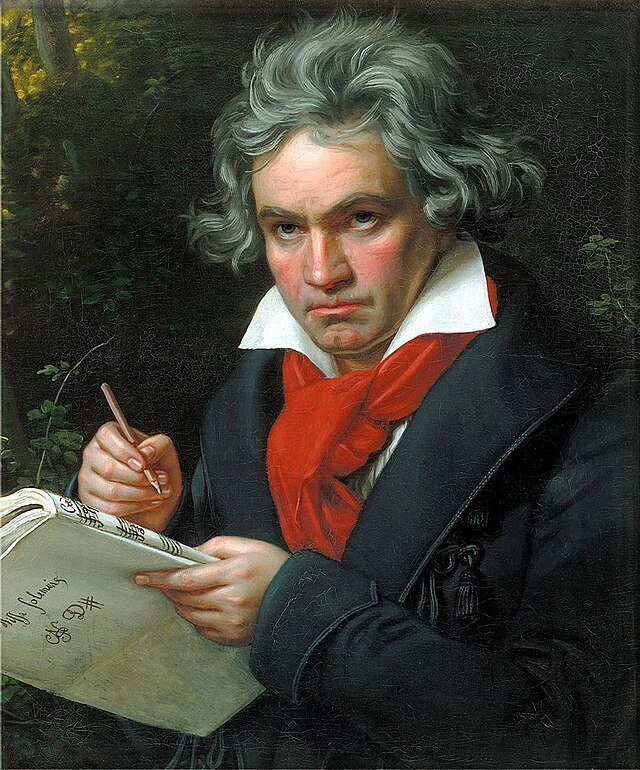
Composer: born December 16, 1770, Bonn, Germany; died March 26, 1827, Vienna
Work composed: Beethoven made preliminary sketches in 1817-18, but most of the music was composed between 1822–24. Beethoven finished his Ninth Symphony in February 1824, and dedicated it to King Frederick William III of Prussia.
World premiere: Beethoven conducted the first performance on May 7, 1824, at the Kärntnerthor Theater in Vienna.
Instrumentation: soprano, alto, tenor, and bass soloists, four-part mixed chorus, piccolo, 2 flutes, 2 oboes, 2 clarinets, 2 bassoons, contrabassoon, 4 horns, 2 trumpets, 3 trombones, timpani, bass drum, cymbals triangle and strings.
Estimated duration: 70 minutes
The Ninth Symphony extends beyond the realm of the concert hall and has permeated Western culture on many levels, including socio-political and commercial arenas. The music of the Ninth, particularly the “Ode to Joy” melody of the final movement, is so familiar to us that it has lost its unique character and taken on the quality of folk music; that is, it has shed its “composed” identity as a melody written by Ludwig van Beethoven and simply exists within the communal ear of our collective consciousness.
While some classical works are inextricably linked to the time in which they were written, Beethoven’s profound musical statements about freedom, equality, and humanity resonate just as powerfully today as they did at the Ninth’s premiere. This was evident to the entire world 35 years ago, when Leonard Bernstein conducted an international assembly of instrumentalists and singers in a historic performance of Beethoven’s Ninth at East Berlin’s Schauspielhaus (now Konzerthaus) on December 22, 1989, three days after the fall of the Berlin Wall. To emphasize the historic event, Bernstein substituted the word “freedom” for “joy” in the famous lyrics by the poet Friedrich Schiller in the final movement. The performance was broadcast on television worldwide, attracting more than 200 million viewers.
By 1822, Beethoven was completely deaf and emotionally isolated. Five years earlier, at the age of 47, he had written in his journal, “Before my departure for the Elysian fields I must leave behind me what the Eternal Spirit has infused into my soul and bids me complete.” Alone and embittered, Beethoven focused almost exclusively on his musical legacy.
The lofty salute to the human spirit expressed in Schiller’s poem An die Freude (To Joy) had resonated with Beethoven for many years; in 1790 he set a few lines in a cantata written to commemorate the death of Emperor Leopold II; he also included portions of Schiller’s poem in his opera Fidelio. “The search for a way to express joy,” as Beethoven described it, was the subject of his final symphony. To that end, Beethoven edited and arranged Schiller’s lines to suit his musical and dramatic needs, using a melody from the Choral Fantasy he had written 20 years earlier.
The symphony opens with the strings sounding a series of hollow open chords, neither major nor minor, which are harmonically ambiguous – what key is this? The fifths build into a massive statement featuring a weighty dotted rhythmic theme. The intensity of this movement foreshadows the finale.
As was his wont, Beethoven broke with symphonic convention by writing a second-movement scherzo. The music bursts forth with dramatic string octaves and pounding timpani. The main theme, a contrapuntal fugue, gives way to a demure wind melody. Underneath its playful simplicity, the barely contained agitation of the scherzo pulses in the strings, like a racehorse pawing at the starting gate.
In a symphony synonymous with innovation, Beethoven’s most significant departure from convention is the inclusion, for the first time, of a chorus and vocal soloists in a formerly exclusively instrumental genre. The cellos and basses play an instrumental recitative, later sung by the baritone, which is followed by the unaccompanied “Joy” melody. Beethoven then presents several instrumental variations, including a triumphal brass fanfare. The baritone soloist introduces Schiller’s poem with words of Beethoven’s: “O friends, not these tones; instead, let us strike up more pleasing and joyful ones.” The chorus repeats the last four lines of each stanza as a refrain, followed by the vocal quartet. A famous interlude, the Turkish March, follows (this music was considered “Turkish” because of the inclusion of the triangle, cymbals and bass drum, exotic additions to the orchestra of Beethoven’s time). After a number of variations, the chorus returns with a monumental concluding double fugue.
© Elizabeth Schwartz
NOTE: These program notes are published here by the Modesto Symphony Orchestra for its patrons and other interested readers. Any other use is forbidden without specific permission from the author, who may be contacted at www.classicalmusicprogramnotes.com


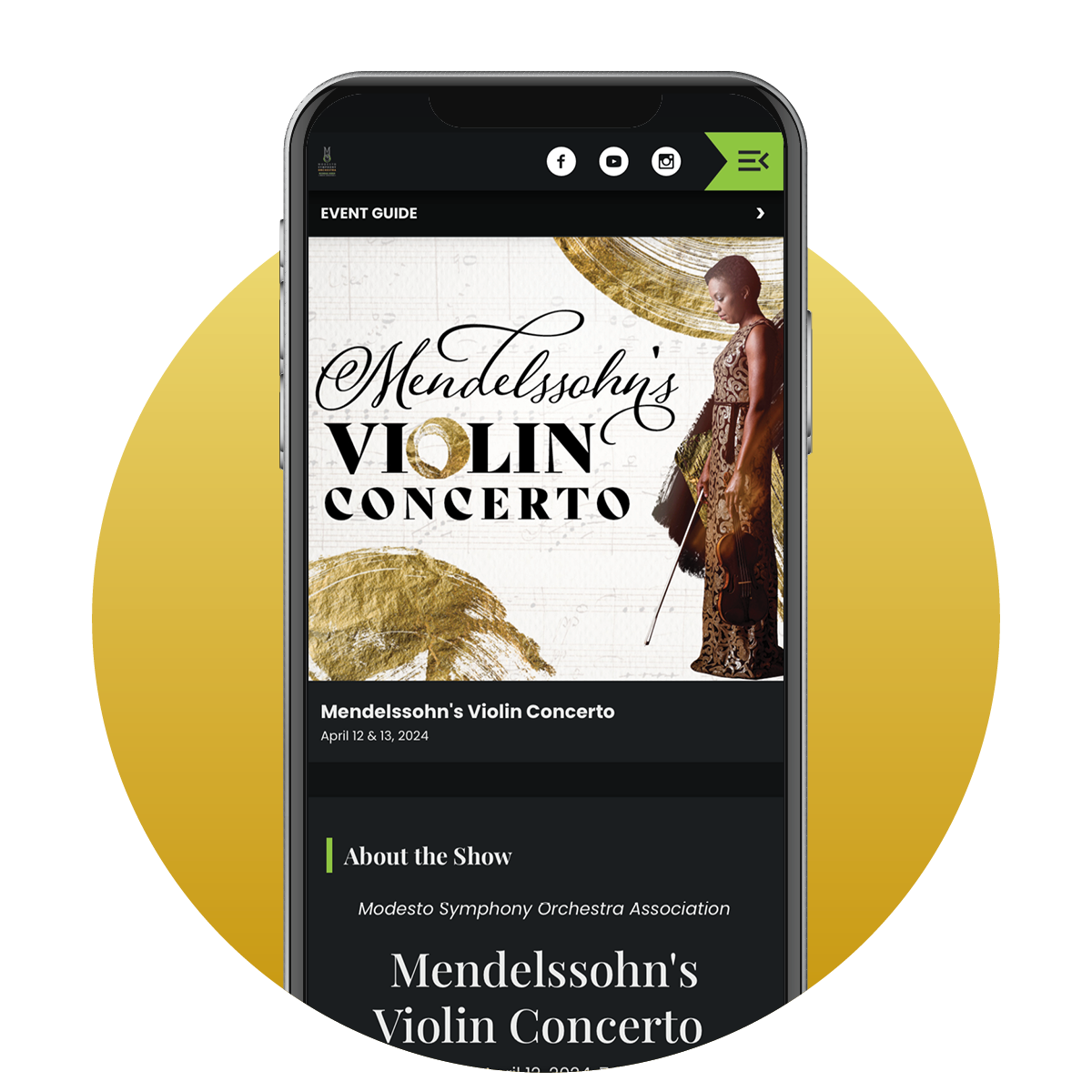
Mendelssohn's Violin Concerto
April 12 & 13, 2024 at 7:30 pm
VISIT MOBILE PROGRAM →
READ OUR PROGRAM NOTES →
DOWNLOAD PRINTABLE VERSION (pdf, 3mb) →
Modesto Symphony Orchestra
Mendelssohn’s Violin Concerto
Friday, April 12, 2024 at 7:30 pm
Saturday, April 13, 2024 at 7:30 pm
Gallo Center for the Arts, Mary Stuart Rogers Theater
Nicholas Hersh, conductor
Tai Murray, violin
Program
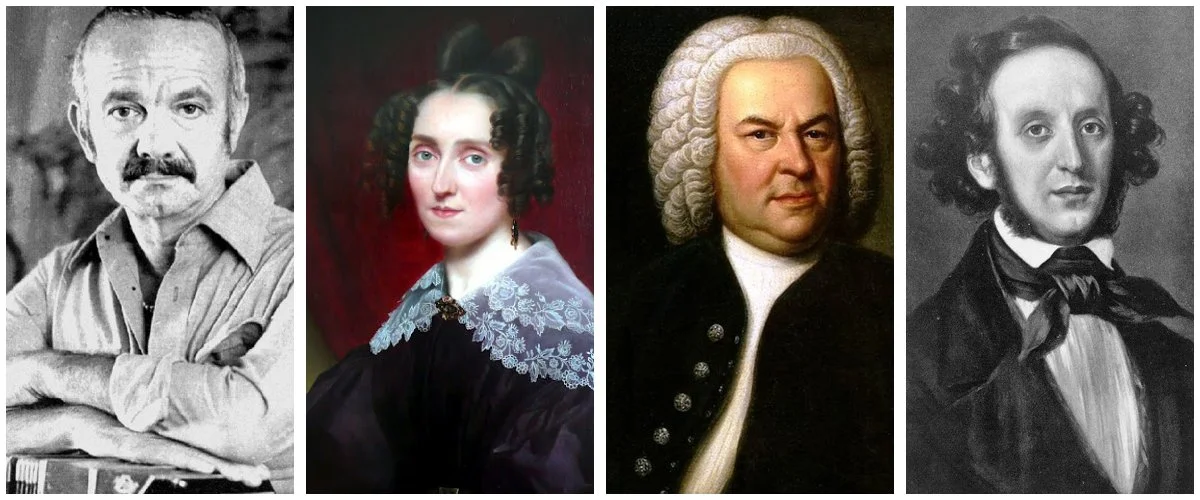
Astor Piazzolla (1921-1992)
Tangazo (Variations on Buenos Aires) (1969)
Louise Farrenc (1804-1875)
Symphony No. 3 in G minor (1847)
i.Adagio—Allegro
ii.Adagio cantabile
iii.Scherzo: Vivace
iv.Finale: Allegro
- INTERMISSION -
Johann Sebastian Bach (1685-1750) arr. Nicholas Hersh
Fugue in G minor BWV 578 “Little Fugue” (1918)
Felix Mendelssohn (1809-1847)
Violin Concerto in E minor, Op. 64 (1844)
Tai Murray, violin
i.Allegro molto appassionato
ii.Andante
iii.Allegretto non troppo—Allegro molto vivace
Join Mobile MSO!
Text “PROGRAM” to (209) 780-0424
to receive a link to the concert program & text message updates prior to this performance!
By texting to this number, you may receive messages that pertain to the Modesto Symphony Orchestra and its performances. msg&data rates may apply. Reply HELP for help, STOP to cancel.
About this Performance

Program Notes: Mendelssohn's Violin Concerto
Notes about:
Piazzolla’s Tangazo (Variations on Buenos Aires)
Farrenc’s Symphony No. 3 in G minor
Bach’s Fugue in G minor BWV 578 “Little Fugue”
Mendelssohn’s Violin Concerto in E minor, Op. 64
Program Notes for April 12 & 13, 2024
Mendelssohn’s Violin Concerto

Astor piazzolla
Tangazo (Variations on Buenos Aires)

Composer: born March 11, 1921, Mar del Plata, Argentina; died July 5, 1992, Buenos Aires
Work composed: 1969
World premiere: 1970 in Washington, D.C., by the Ensemble Musical de Buenos Aires
Instrumentation: 2 flutes, 2 oboes, 2 clarinets, 2 bassoons, 2 horns, cymbals, glockenspiel, guiro, tom-toms, triangle, xylophone, piano, and strings
Estimated duration: 15 minutes
“For me, tango was always for the ear rather than the feet.” – Astor Piazzolla
Astor Piazzolla is inextricably linked with tango. He took a dance from the back rooms of Argentinean brothels and blurred the lines between popular and “art” music to such an extent that, in the case of his music, such categories no longer apply.
Tangazo is a later composition, originally scored for solo bandoneon, piano, and strings. Piazzolla was a master of the bandoneón, a small button accordion of German origin, which originally served as a portable church organ. The distinctive sound of the bandoneón became a fundamental element of Piazzolla’s tangos; its insouciance and melancholy permeate Piazzolla’s music, even in works scored for other instruments.
Tangazo begins in the low strings, which murmur a slow introduction with more than a hint of menace. Harmonically, Tangazo often ranges beyond conventional tango tonalities to explore a modernist palette replete with unexpected detours. After the deliberate legato pace of the introduction, a solo oboe takes off with a skittish tango full of bounce and swagger. Legato interludes featuring pensive horn solos alternate with the agitated tango. Overall, Tangazo conveys restlessness, even as its last notes fade away.
Louise farrenc
Symphony No. 3 in G minor

Composer: born May 31, 1804, Paris; died September 15, 1875, Paris
Work composed: 1847
World premiere: 1849, by the Orchestre de la Société des concerts du Conservatoire in Paris
Instrumentation: 2 flutes, 2 oboes, 2 clarinets, 2 bassoons, 2 horns, timpani, and strings
Estimated duration: 33 minutes
During her lifetime, Louise Farrenc was well known as both a composer and outstanding pianist. Throughout the 19th century, she was also the first and only female professor of music on the faculty of the Paris Conservatory.
Farrenc grew up in a family of artists who encouraged their daughter’s musical interests. Young Louise displayed extraordinary talent at the piano in early childhood, and soon began composing her own music. When she was 15, her parents enrolled her at the Paris Conservatory to continue her composition studies, although she was tutored privately by its faculty because women were not admitted to the Conservatory’s composition program at the time..
At 18, Louise married a flutist, Aristede Farrenc, who later founded a music publishing house. By the 1830s, Farrenc was balancing a busy, multifaceted career as a teacher, composer, and pianist who concertized all over France. As a composer, Farrenc also began expanding her portfolio from solo piano music to larger forms such as symphonies, concert overtures, and a number chamber works, including piano quintets and trios. Farrenc, unlike many female composers whose music was discovered only long after their deaths, was able to hear the public performance of all three of her symphonies – which were well-reviewed – during her lifetime.
The symphonic format evolved from earlier German and Italian genres; by the mid-19th century, symphonies epitomized German style. In fervently nationalist France, particularly in Paris, symphonies and their composers faced aesthetic discrimination from those who deemed the symphony an exclusively German art form. Moreover, the idea of a woman writing symphonic music – in the eyes of some putting herself on par with symphonic greats such as Beethoven, Mendelssohn, Mozart, Schubert, and others – seemed an outrageous provocation.
After a brief Adagio for winds, a graceful Allegro ensues, featuring themes in the strings. This opening movement is full of vigor, artful melodies, and a sense of orchestral mastery. Farrenc follows this confident beginning with a serene Adagio cantabile, featuring a solo clarinet soaring over low winds and brasses, suggesting the intimacy of a woodwind quintet. An agitated Scherzo follows, full of quicksilver flashes of light and shadow that showcases the upper winds. The Finale bristles with dramatic energy and features several powerful statements that unleash the strings’ fiery virtuosity with a series of scalar passages. Minor-key symphonies of this period usually conclude in their corresponding major key, but Farrenc maintains the G-minor intensity right up to the closing notes.
Johann Sebastian Bach
Fugue in G minor BWV 578 “Little Fugue” arr. Hersh
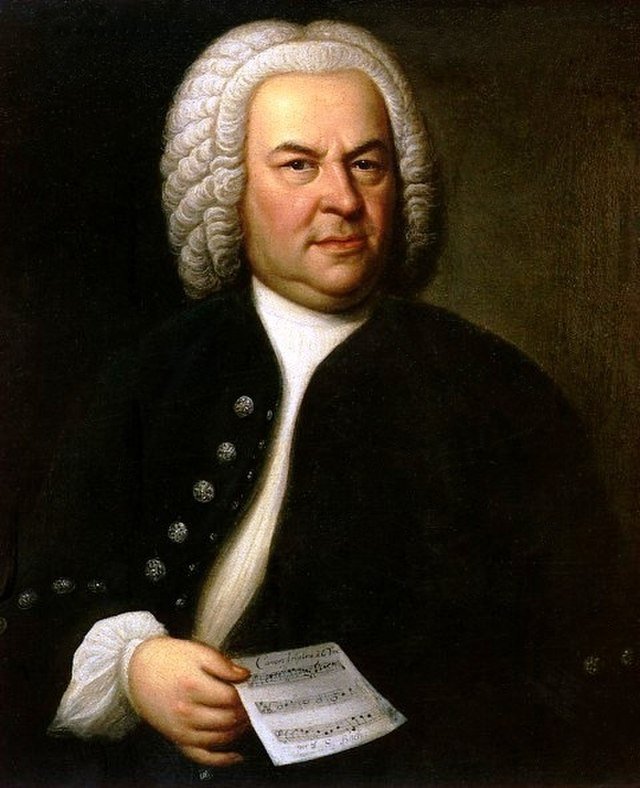
Composer: born March 21, 1685, Eisenach; died July 28, 1750, Leipzig
Work composed: c. 1703-07, written while Bach served as an organist in Arnstadt.
World premiere: undocumented
Instrumentation: flute, oboe, clarinet, bassoon, 2 horns, trumpet, chimes, vibraphone, and strings
Estimated duration: 3.5 minutes
Nicknames can be misleading. The only thing “little” about Johann Sebastian Bach’s Fugue in G minor, BWV 578, is its length. Just under four minutes long, this fugue features one of Bach’s best known and most recognizable fugue subjects, and it has been arranged for diverse ensembles, including Leopold Stowkowsi’s brass-heavy arrangement for full orchestra, and the Swingle Singers’ popular vocal jazz version.
Bach was renowned during his lifetime for his extraordinary ability to improvise at the keyboard. It is possible the distinctive fugue subject emerged first as an improvisation; at over four measures long, it is an unusually lengthy statement. Bach allows each voice to shine, including the basses (played by foot pedals on the organ). The opening three notes cut through the dense counterpoint, announcing the subject’s entrance clearly each time, as the music swirls and eddies towards a bold conclusion.
Felix Mendelssohn
Violin Concerto in E minor, Op. 64

Composer: born February 3, 1809, Hamburg; died November 4, 1847, Leipzig
Work composed: July 1838 – September 1844
World premiere: Niels Gade led the Gewandhaus Orchestra and violinist Ferdinand David in Leipzig on March 13, 1845
Instrumentation: solo violin, 2 flutes, 2 oboes, 2 clarinets, 2 bassoons, 2 horns, 2 trumpets, timpani, and strings
Estimated duration: 27 minutes
“I would like to write a violin concerto for you next winter,” wrote Felix Mendelssohn to his longtime friend and colleague Ferdinand David in the summer of 1838. “There’s one in E minor in my head, and its opening won’t leave me in peace.” Mendelssohn, then conductor of the Leipzig Gewandhaus Orchestra, had known David for years. The two prodigies met as teenagers; 15-year-old David was a budding violin virtuoso and 16-year-old Mendelssohn had just completed his Octet for Strings. Years later, when Mendelssohn was appointed director of the Gewandhaus concerts in 1835, he hired David as concertmaster. In 1843, Mendelssohn founded the Leipzig Conservatory and quickly appointed David to the violin faculty.
Mendelssohn had played the violin since childhood, and by all accounts was quite accomplished. However, the E minor Violin Concerto required a level of technical knowledge and skill beyond Mendelssohn’s abilities, so he turned to David for hands-on advice. During the composition of the E minor Concerto, Mendelssohn wrote the melodies and designed the overall structure, while David served as technical consultant.
In this concerto, the violin is always and indisputably the star, while the orchestra’s role provides what the late music critic Michael Steinberg called “accompaniment, punctuation, scaffolding and a bit of cheerleading.” Music this familiar can be difficult to hear as a “composed” work at all; instead, it seems to emerge sui generis, like Athena bursting fully formed from the head of Zeus.
In a break with convention, the solo violin rather than the full orchestra opens the Allegro molto appassionato with the main theme. Mendelssohn also defied expectations by placing the first movement cadenza, which David composed, between the development and return of the main theme, rather than at the end of the movement.
A solo bassoon holds the last note of the Allegro and pivots without interruption to the Andante. Here the soloist leads with a lyrical, singing melody full of tender poignancy. The gentle Andante flows almost without pause into the Allegro molto vivace. The exuberant quicksilver theme of the finale contrasts sharply with the intimate Andante, and demands all the soloist’s technical and artistic skill.
Op. 64 turned out to be Mendelssohn’s last completed orchestral work; he died two years after its premiere. Scholar Thomas Grey observed, “It seems fitting, if fortuitous, that [the Violin Concerto] should combine one of his most serious and personal orchestral movements (the opening Allegro) with a nostalgic return to the world of A Midsummer Night’s Dream in the finale – the world of Mendelssohn’s ‘enchanted youth’ and the music that, more than any other, epitomizes his contribution to the history of music.”
© Elizabeth Schwartz
NOTE: These program notes are published here by the Modesto Symphony Orchestra for its patrons and other interested readers. Any other use is forbidden without specific permission from the author, who may be contacted at www.classicalmusicprogramnotes.com

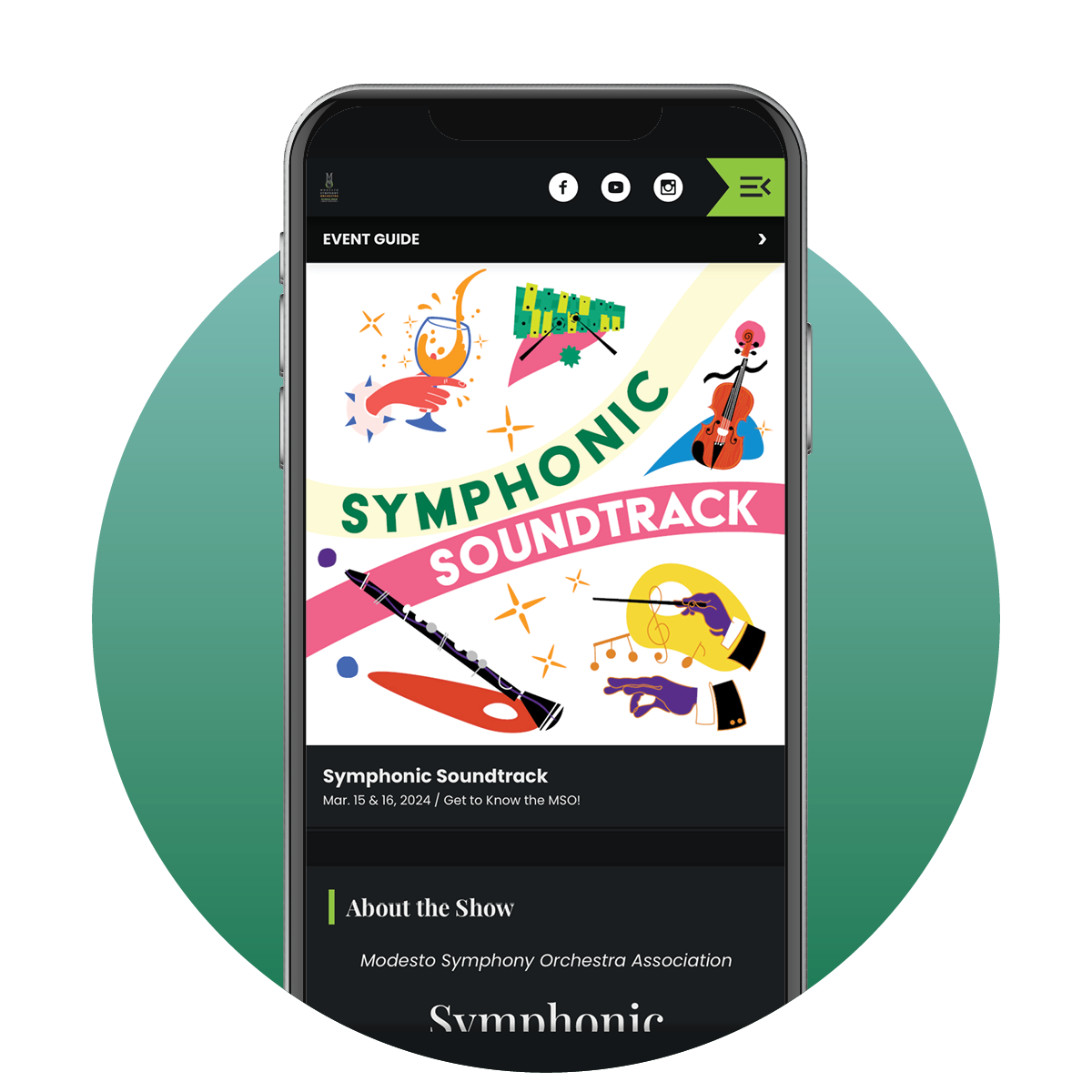
Symphonic Soundtrack
March 15 & 16, 2024 at 7:30 pm
VISIT MOBILE PROGRAM →
READ OUR PROGRAM NOTES →
DOWNLOAD PRINTABLE VERSION (pdf, 1mb) →
Modesto Symphony Orchestra
Symphonic Soundtrack
Friday, March 15, 2024 at 7:30 pm
Saturday, March 16, 2024 at 7:30 pm
Gallo Center for the Arts, Mary Stuart Rogers Theater
Nicholas Hersh, conductor
Rob Patterson, clarinet
Program
Giachino Rossini (1792-1868)
Overture to La Gazza Ladra (1817)
Giovanni Gabrieli (1554-1612)
Sonata pian’e forte (1597)
Jessie Montgomery (b. 1981)
Starburst (2012)
Aaron Copland (1900-1990)
Clarinet Concerto (1948)
Gabriel Faure (1845-1924)
Sicilienne from
Pelleas and Melisande Suite (1898)
Igor Stravinsky (1882-1971)
Suite from The Firebird (1919)
John Williams (b. 1932)
Princess Leia’s Theme from Star Wars

Join Mobile MSO!
Text “PROGRAM” to (209) 780-0424
to receive a link to the concert program & text message updates prior to this performance!
By texting to this number, you may receive messages that pertain to the Modesto Symphony Orchestra and its performances. msg&data rates may apply. Reply HELP for help, STOP to cancel.
About this Performance

Program Notes: Symphonic Soundtrack
Notes about:
Rossini’s Overture to La Gazza Ladra
Gabrieli’s Sonata pian’e forte
Montgomery’s Starburst
Copland’s Clarinet Concerto
Faure’s Sicilienne from Pelleas and Melisande Suite
Stravinsky’s Suite from The Firebird
William’s Princess Leia’s Theme from Star Wars
Program Notes for March 15 & 16, 2024
Symphonic Soundtrack

Gioachino rossini (1792-1868)
Overture to La Gazza Ladra (1817)
This piece was chosen by violinist Josephine Gray
"Who Is the wittiest composer? Mozart, Rossini or perhaps Berlioz? My first memory of the Thieving Magpie overture during my early childhood in the UK was it being a musical joke as the opening drum roll caused the entire audience to spring to their feet, mistaking it for God Save the Queen! Rossini was undoubtedly a master entertainer and a musical tease, showing off the virtuoso winds and strings, and the pompous brass and percussion. He sure knew how to build momentum and excitement and has scored the magpie protagonist perfectly with lilting, graceful, cheeky and mischievous themes and masterful orchestration."
Giovanni gabrieli (1554-1612)
Sonata pian’e forte (1597)
This piece was chosen by principal viola, Patricia Whaley
In addition to the many philosophical and scientific advancements brought on by the Italian Renaissance, music also saw significant innovation, including a standardization of notation to something very close to what we would recognize in modern sheet music. The prolific Venetian composer Giovanni Gabrieli gave remarkably clear instructions to performers in his written music while he served as maestro of St. Mark’s Basilica, including, in the case of his 1597 Sonata pian’ e forte, which passages should be played forte (loud) and which piano (soft)—indications we still use today. In St. Mark’s, the musicians were traditionally split into two groups in choir lofts facing one another, and Gabrieli wrote much of his music with this layout in mind, making extensive use of echoes and call-and-response; today, we can recreate this almost 500-year-old style to great effect with brass instruments laid out in a similar “antiphonal choir” setup.*
*Program Notes written by Nicholas Hersh, music director
jessie montgomery (b. 1981)
Starburst (2012)
This piece was chosen by principal viola, Patricia Whaley
"I love Starburst! I hope you will too. It’s full of wonderfully bright, propulsive energy, and it shows off the wealth of different sounds and colors that strings alone can produce, using all the different techniques we have at our disposal. Jessie Montgomery, a violinist herself, writes in a style that’s both distinctly modern and still welcoming for all listeners, as well as being challenging but eminently playable for us."
aARON COPLAND (1900-1990)
Clarinet Concerto (1948)
This piece was chosen by violinist Josephine Gray
"I suggested this piece because my late father played jazz clarinet and saxophone.For me the first movement has a heart rending plaintiff quality that reaches my soul in a poignant and nostalgic way. It's not particularly sad, but just very human. Pain and hope, serenity coupled with disquiet as it goes in harmonic directions that are unexpected. After a cadenza bridge which introduces the jaunty theme of the second movement, Copland uses slap bass and Latin American jazz themes to set up a kind of musical race that's bright, intricate and overwhelmingly fun ending with a Gershwin "smear" flourish."
Gabriel faure (1845-1924)
Sicilienne from Pelleas and Melisande Suite (1948)
This piece was chosen by Don Grishaw, violin
"I first heard it when I was in fourth or fifth grade, on the radio... It's a magical piece with a beautiful melody."
The slow, symbolism-laden words of Belgian playwright Maurice Maeterlinck’s 1893 Pelléas and Mélisande never saw much success until the play was set to music—multiple times, by musical luminaries like Claude Debussy, Arnold Schoenberg, and Gabriel Fauré. Fauré used a light touch: the play was staged in an English translation and Fauré only added incidental music (music usually played only during scene changes or in the background). Matching the moody story of forbidden love, the most well-known segment of music is the “Sicilienne,” which accompanies Mélisande playing the flute for her lover Pelléas by a well, the gentle lilt to its rhythm in a dreamy 6/8 time adding an air of antiquity.*
*Program Notes written by Nicholas Hersh, music director
Igor stravinsky (1882-1971)
Suite from The Firebird (1919)
This piece was chosen by principal viola, Patricia Whaley
Igor Stravinsky was a 20th-century chameleon—he explored several different musical styles over the course of his nearly one-hundred-year life, from experiments in modernist atonal music to a conservative “neo-Classical” style. Russian by birth, he soared to fame (and scandal) in Paris with his late-Romantic, folk-infused Ballets Russes, which included the infamous Rite of Spring, so avant-garde that it allegedly started a riot at its premiere. Among his earlier successes in Paris was the 1910 ballet The Firebird, a retelling of an ancient folk tale of a young warrior-prince defeating a monstrous sorcerer with the help of a magic bird. The music is immensely evocative and a tour-de-force of orchestration, from the low strings depicting a shadowy forest, to the frenetic xylophone and trombone glissandos of the sorcerer’s wild minions, and finally to the majestic horn call that marks the hero’s victory over evil.*
*Program Notes written by Nicholas Hersh, music director
John williams (b. 1932)
Princess Leia’s Theme from Star Wars (1977)
This piece was chosen by music director, Nicholas Hersh
"This is really one of the first pieces of music that I would have heard as a kid that used the orchestra in a huge and engaging way, and watching Star Wars as a kid is a fundamental part of my upbringing. This music is written so beautifully by John Williams with this soaring, beautiful melody, which really left a mark on me and may have even set me down a path to become the conductor I am today. Performing Williams's musicis always such a privilege because he just knows how to write for the orchestra to make it sound its absolute best. Every instrument is involved. Every instrument gets an interesting line to play. In addition to hearing these lush harmonies and soaring melodies that we instantly associate with our favorite characters from Star Wars."
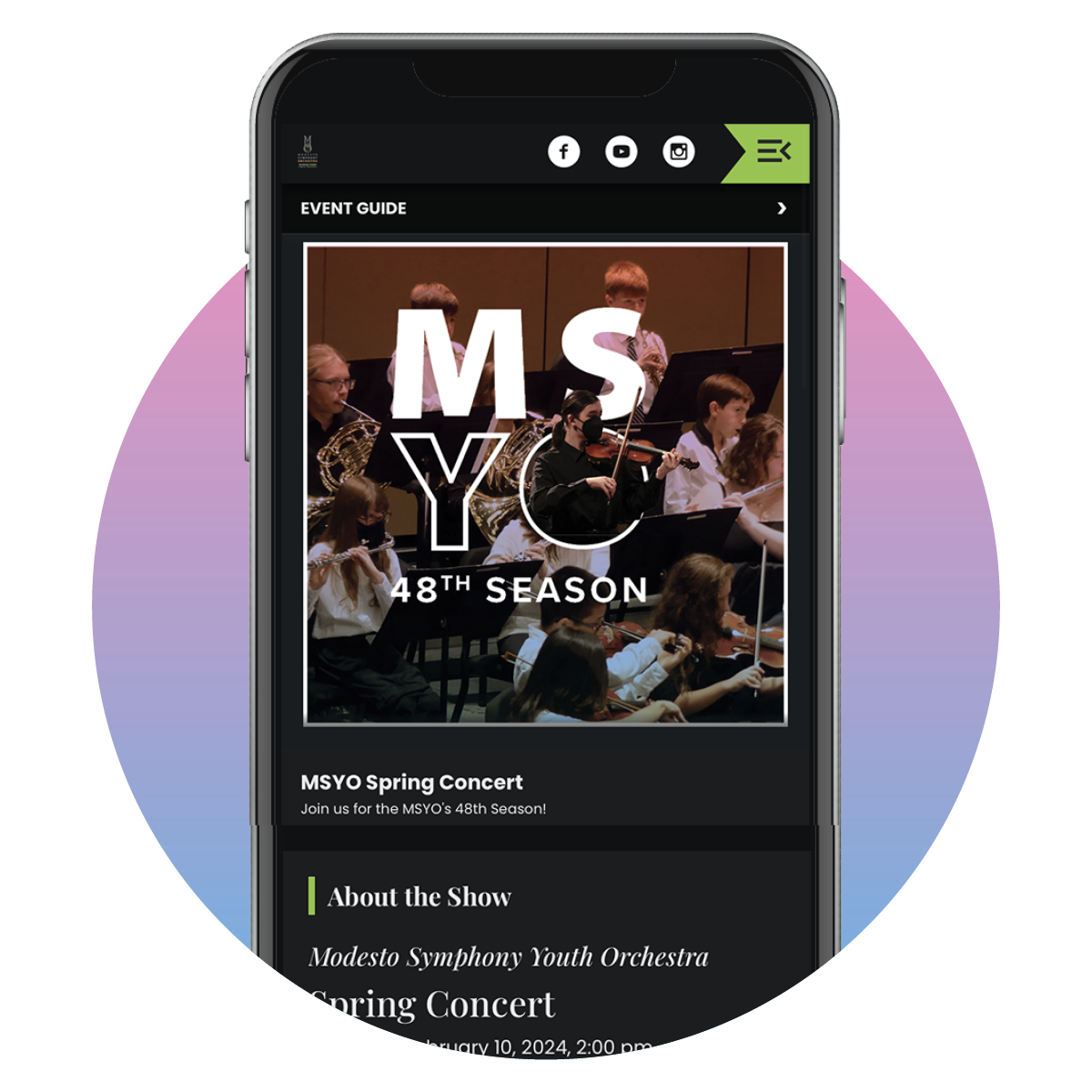
MSYO Spring Concert
February 10, 2024 at 2 pm
Modesto Symphony Youth Orchestra
Spring Concert
Saturday, February 10, 2024, 2:00pm
Gallo Center for the Arts, Mary Stuart Rogers Theater

Program
Concert Orchestra
Donald C. Grishaw, conductor
Wolfgang Amadeus Mozart (1756-1791) arr. Meyer
Overture from The Magic Flute
Nikolai Rimski-Korsakov (1844-1908) arr. Meyer
Themes from Scheherazade
John Philip Sousa (1854-1960) arr. Isaac
Stars and Stripes Forever
Percussion Ensemble
Joe Frank Williams
Crystalized
Intermission
Symphony Orchestra
Ryan Murray, conductor
Victor Lopez (b. 1950)
Danza Africana
Peter Ilyich Tchaikovsky (1840-1893) arr. Stafford
Pas de Deux from The Nutcracker, Op. 71
Viviana Alfaro, harp
Bella Davila, cello
Jules Massenet (1842-1912)
Selections from Le Cid Suite
IV. Finale
Join Mobile MSO!
Text “PROGRAM” to (209) 780-0424
to receive a link to the concert program & text message updates prior to this performance!
By texting to this number, you may receive messages that pertain to the Modesto Symphony Orchestra and its performances. msg&data rates may apply. Reply HELP for help, STOP to cancel.
About this Performance


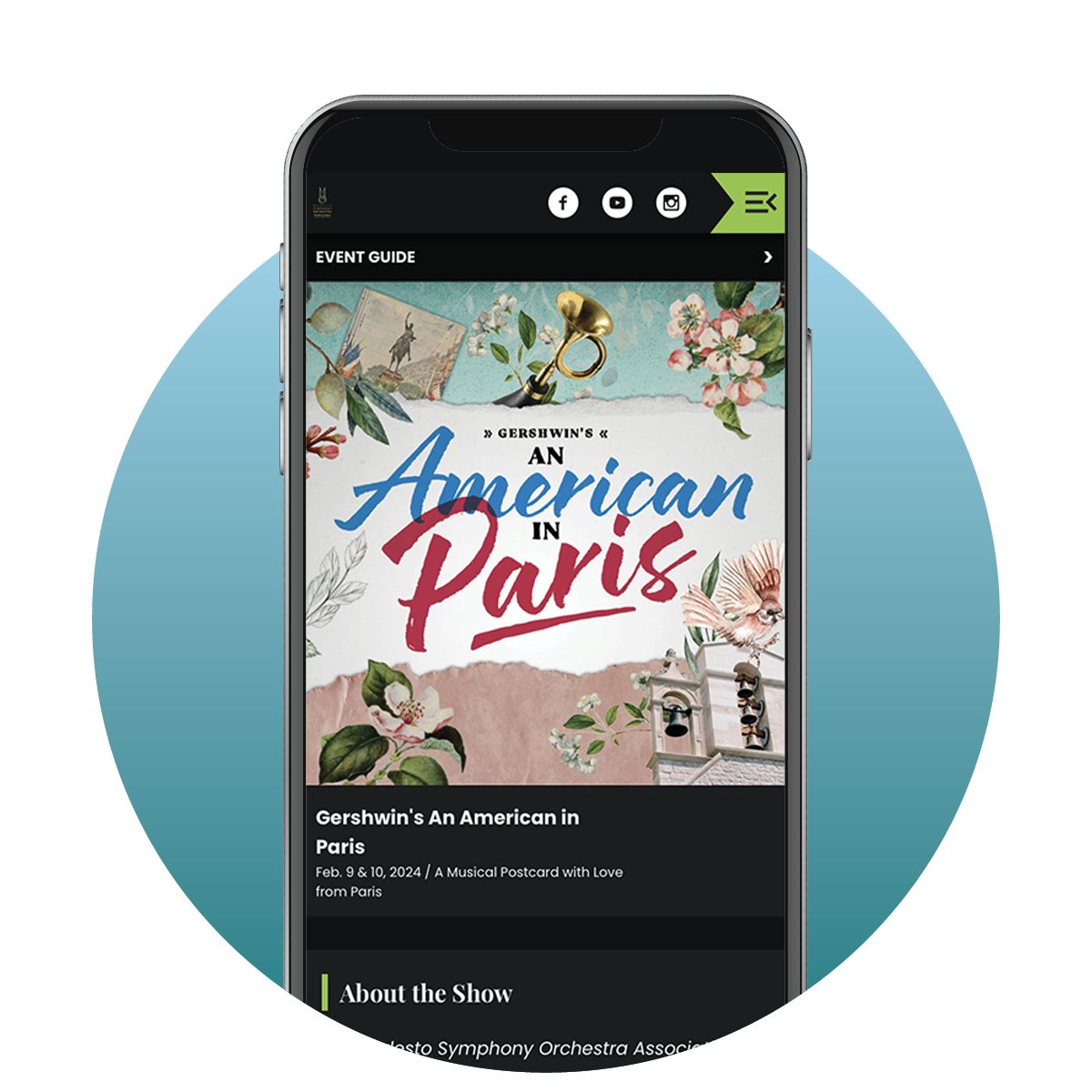
Gershwin's An American in Paris
February 9 & 10, 2024 at 7:30 pm
VISIT MOBILE PROGRAM →
READ OUR PROGRAM NOTES →
DOWNLOAD PRINTABLE VERSION (pdf, 3mb) →
Modesto Symphony Orchestra
Gershwin’s An American in Paris
Friday, February 9, 2024 at 7:30 pm
Saturday, February 10, 2024 at 7:30 pm
Gallo Center for the Arts, Mary Stuart Rogers Theater
Nicholas Hersh, conductor
Program
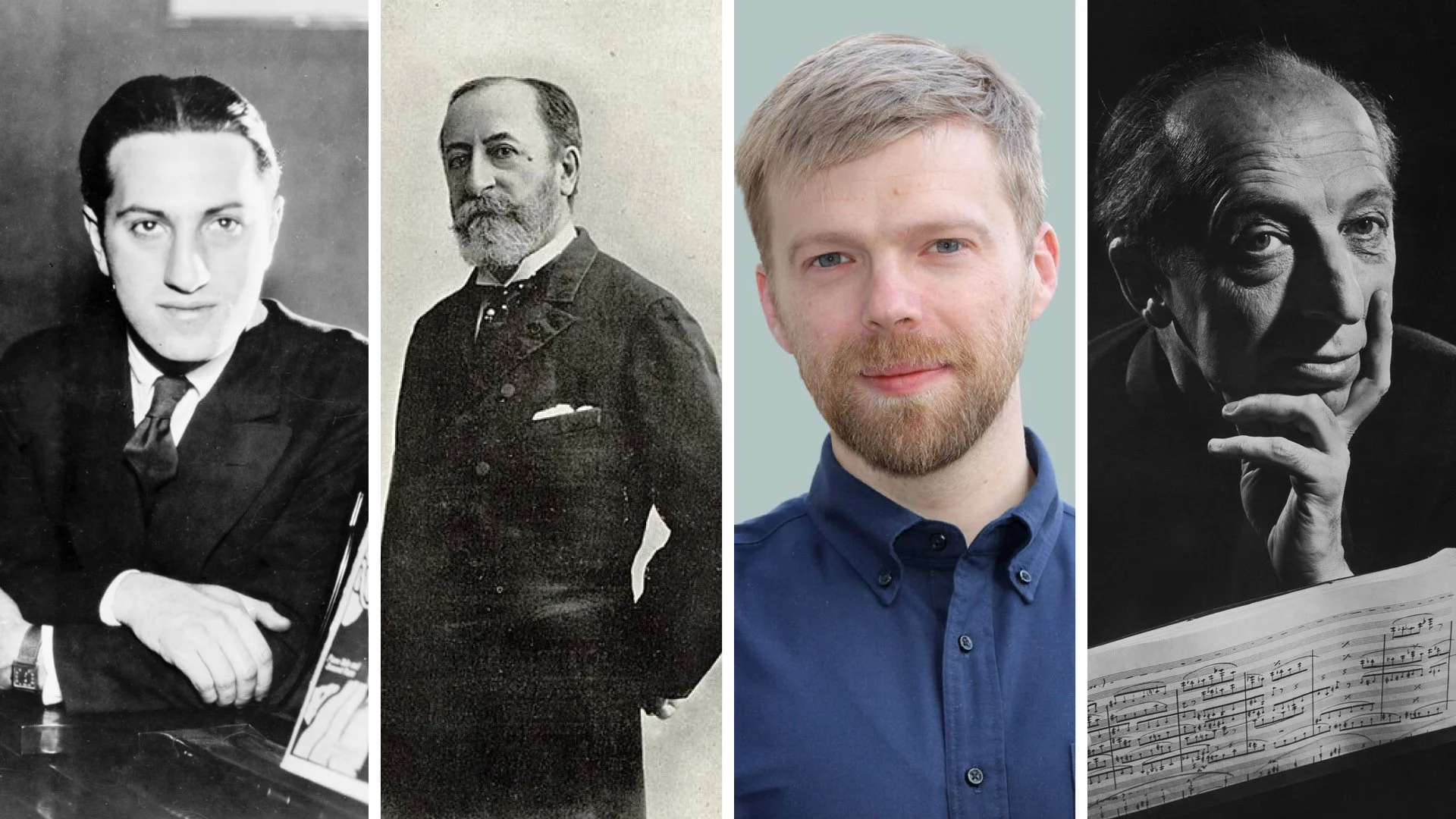
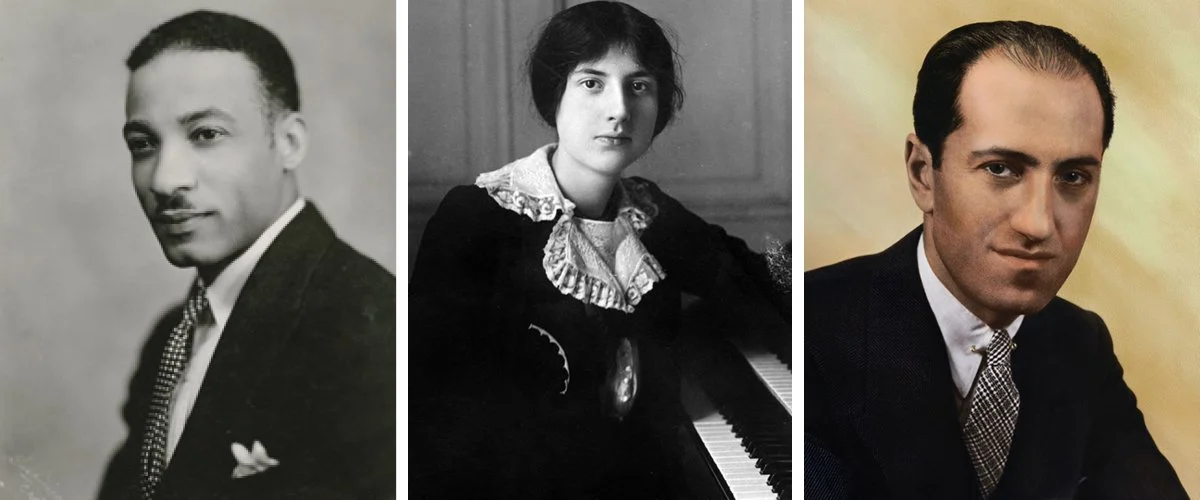
William L. Dawson (1899-1990)
Negro Folk Symphony (1934)
i.The Bond of Africa
ii.Hope in the Night
iii.O, Le’ Me Shine, Shine Like a Morning Star!
- INTERMISSION -
Lili Boulanger (1893-1918)
D’un Matin de Printemps (1918)
George Gershwin (1898-1937)
An American in Paris (1928)
Join Mobile MSO!
Text “PROGRAM” to (209) 780-0424
to receive a link to the concert program & text message updates prior to this performance!
By texting to this number, you may receive messages that pertain to the Modesto Symphony Orchestra and its performances. msg&data rates may apply. Reply HELP for help, STOP to cancel.
About this Performance

Program Notes: Gershwin's An American in Paris
Notes about:
Dawson’s Negro Folk Symphony
Boulanger’s D’un Matin de Printemps
Gershwin’s An American in Paris
Program Notes for February 9 & 10, 2024
Gershwin’s An American in Paris

William dawson
Negro Folk Symphony

Composer: born September 26, 1899, Anniston, AL; died May 2, 1990, Montgomery, AL
Work composed: 1934, rev. 1952
World premiere: Leopold Stokowski led the Philadelphia Orchestra on November 20, 1934, at Carnegie Hall in New York City
Instrumentation: piccolo, 2 flutes, 2 oboes, English horn, 3 clarinets, bass clarinet, 2 bassoons, contrabassoon, 4 horns, 3 trumpets, 3 trombones, tuba, timpani, adawura (Ghanaian bell), African clave, bass drum, chimes, cymbals, gong, snare drum, tenor drum, xylophone, harp, and strings
Estimated duration: 30 minutes
“I’ve not tried to imitate Beethoven or Brahms, Franck or Ravel – but to be just myself, a Negro,” William Dawson remarked in a 1932 interview. “To me, the finest compliment that could be paid my symphony when it has its premiere is that it unmistakably is not the work of a white man. I want the audience to say: ‘Only a Negro could have written that.’”
Two years later, Leopold Stokowski led the New York Philharmonic in the premiere of Dawson’s Negro Folk Symphony. Critics and audiences alike hailed it as a masterpiece. One reviewer declared it “the most distinctive and promising American symphonic proclamation which has so far been achieved,” and another enthused, “the immediate success of the symphony [did not] give rise to doubts as to its enduring qualities. One is eager to hear it again and yet again.” Given this overwhelmingly positive reception, Dawson’s Negro Folk Symphony, which at the time he thought of as the first of several future symphonies, should have been heard “again and yet again.” But it was not. Despite Stokowski’s advocacy for Dawson and the Negro Folk Symphony, and despite the stellar reviews it received at its premiere, within a few years both the music and its composer had faded into relative obscurity. Dawson never composed another symphony, although he did continue writing and arranging music – primarily spirituals, which he preferred to call “Negro folk songs” – for the rest of his long career.
In the current climate of racial reckoning, Dawson’s Negro Folk Symphony is enjoying a long-overdue revival, as is the music of other Black classical composers such as Florence Price, William Grant Still, Nathaniel Dett, and many others.
Dawson wrote that his symphony was “symbolic of the link uniting Africa and her rich heritage with her descendants in America,” and gave each of its three movements a descriptive title. Dawson explained in his own program note: “The themes are taken from what are popularly known as Negro Spirituals. In this composition, the composer has employed three themes taken from typical melodies over which he has brooded since childhood, having learned them at his mother’s knee.” Musicologist Gwynne Kuhner Brown observes, “The themes are handled with such virtuosic flexibility of rhythm and timbre that each movement seems to evolve organically,” creating a “persuasive musical bridge between the ‘Negro Folk’ and the ‘Symphony.’”
In “The Bond of Africa,” Dawson opens with a horn solo. The dialogue between the horn and the orchestra echoes the call-and-response format of most spirituals. The horn solo repeats, usually in abbreviated form, several times throughout this movement, and serves as a musical “bond” holding the work together. The central slow movement, “Hope in the Night,” also features a unifying solo. Here an English horn sounds Dawson’s own spiritual-inspired melody, which he described as an “atmosphere of the humdrum life of a people whose bodies were baked by the sun and lashed with the whip for two hundred and fifty years; whose lives were proscribed before they were born.” Underneath the plaintive tune, the orchestra provides a dirge-like accompaniment that builds to an ominous repetition of the solo for tutti orchestra. This episode is offset by an abrupt change of mood, and we hear a lighthearted, up-tempo reworking of the original tune (the “hope” of the movement’s title). These two contrasting interludes alternate throughout the rest of the movement. Towards the end, Dawson reworks the harmony, which has been grounded in minor keys up to this point, and tiptoes towards major tonalities without fully embracing them. Musically, this device works as a powerful metaphor for the importance and elusive nature of hope to sustain people through traumatic circumstances.
The closing section, “Oh, Le’ Me Shine, Shine Like A Morning Star!” imagines a world in which the hopes of the previous movement are fully realized. Dawson creates this musical utopia through rhythm. The central melody showcases accented off-beat exclamations from various solo instruments and sections throughout, as the rhythms layer increasingly complex parts over one another. Dawson revised this movement in the early 1950s after he encountered the intricate polyrhythms of West African music during a trip to Africa. The interlocking parts and the sounds of African percussion instruments captured Dawson’s ear; when he returned to America, he added these elements. Eventually all these rhythmic strands come together in a final buoyant exclamation.
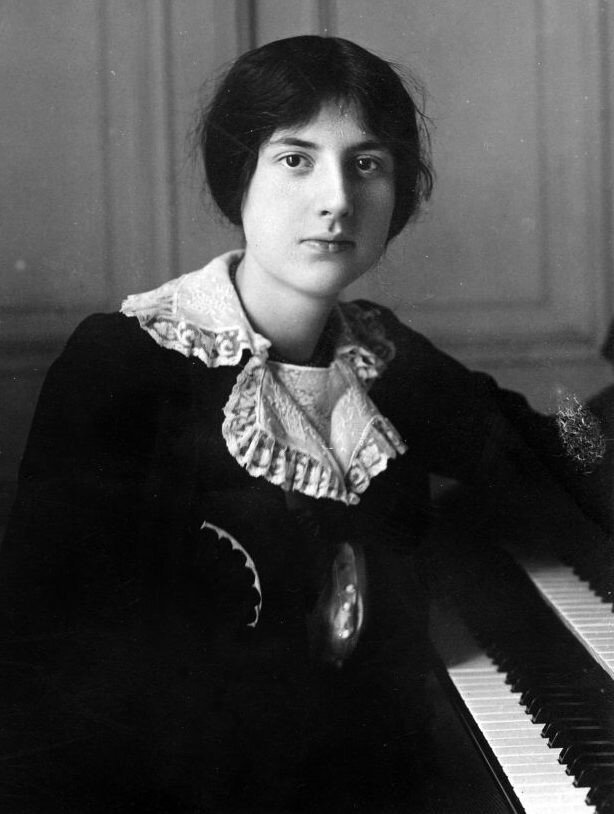
Lili Boulanger
D’un matin de printemps (From A Spring Morning)
Composer: born August 21, 1893, Paris; died March 15, 1918, Mézy-sur-Seine
Work composed: 1917-18. Boulanger made arrangements in multiple versions: for violin and piano, string trio, and full orchestra
World premiere: undocumented
Instrumentation: piccolo, 2 flutes, 2 oboes, English horn, 2 clarinets, bass clarinet, 2 bassoons, contrabassoon, 4 horns, 2 trumpets, 3 trombones, tuba, bass drum, castanets, cymbals, tambourine, tam-tam, timbales, triangle, celeste, harp, and strings
Estimated duration: 5 minutes
Women composers, like other female creative artists, have to fight battles their male counterparts do not. Even today, a female visual artist, writer, or composer is sometimes evaluated on criteria that have little or nothing to do with her work, and everything to do with her gender, her appearance, or her life circumstances. Lili Boulanger was no exception.
The younger sister of composer and pedagogue Nadia Boulanger, who taught composition to many of the 20th century’s most distinguished composers, Lili Boulanger revealed her enormous talent at a very young age. She was a musical prodigy born into a musical family; in 1913, at age 20, she became the first woman to win the coveted Prix de Rome, France’s most prestigious composition prize. Boulanger’s compositional style, while grounded in the prevailing impressionistic aesthetics associated with Claude Debussy, is nonetheless wholly her own. Her music features rich harmonic colors, hollow chords (open fifths and octaves), ostinato figures, running arpeggios, and static rhythms.
Along with her tremendous musical ability, Boulanger was born with a chronic, debilitating intestinal illness, probably Crohn’s disease. Today there are drugs and other therapies to manage this condition, but in Boulanger’s time the illness itself had neither name nor cure, and its treatment was likewise little understood. Throughout her short life, Boulanger suffered from acute abdominal pain, bouts of uncontrollable diarrhea, and constant fatigue; all these symptoms naturally impacted her stamina and her ability to write. Contemporary reviews of Boulanger’s work always emphasized her physical fragility, often in lieu of a thoughtful assessment of her music.
Despite illness, Boulanger continued composing, even on her deathbed. D’un matin printemps, the second half of a diptych that includes its shorter counterpart D’un soir triste (From a Sad Evening) are two of the last works she wrote. Both pieces treat the same opening melodic and rhythmic theme in different ways: in D’un soir triste, the tempo is slow and the mood elegiac, while the same melodic/rhythmic fragment receives a cheerful, puckish treatment in D’un matin printemps that sparkles with effervescence and youthful joy.
George gershwin
An American in Paris

Composer: born September 26, 1898, Brooklyn, NY; died July 11, 1937, Hollywood, CA
Work composed: March - June 1928, while Gershwin and his siblings were vacationing in Paris
World premiere: Walter Damrosch led the New York Philharmonic on December 13, 1928 in New York
Instrumentation: 3 flutes (1 doubling piccolo), 2 oboes, English horn, 2 clarinets, bass clarinet, 3 saxophones (alto, tenor, baritone), 2 bassoons, 4 horns, 3 trumpets, 3 trombones, tuba, timpani, bass drum, bells, cymbals, snare drum, taxi horns, tom-toms, triangle, xylophone, celesta, and strings
Estimated duration: 17 minutes
“My purpose here is to portray the impression of an American visitor in Paris, as he strolls about the city and listens to various street noises and absorbs the French atmosphere,” wrote George Gershwin about his tone poem, An American in Paris. “As in my other orchestral compositions, I’ve not endeavored to represent any definite scenes in this music. The rhapsody is programmatic only in a general impressionistic way, so that the individual listener can read into the music such as his imagination pictures for him,” This highly evocative, colorful symphonic music expertly captures the sights and sounds of Paris as its American protagonist wanders through the city streets. To illustrate the American’s journey, Gershwin included several of what he termed “walking themes,” which recur throughout the work. The trumpet sounds the most recognizable of these, the “homesick music,” in a bluesy solo. The “American” section concludes with an up-tempo Charleston played by a pair of trumpets, and the walking themes return. Finally, the orchestra winds up with a glittering exuberant finale as night falls on the City of Light.
An American in Paris marked a breakthrough for Gershwin as a composer, as the first symphonic piece for which he created his own orchestrations. When Rhapsody in Blue premiered in 1924, Gershwin was criticized because the Rhapsody’s orchestral version was created by Ferde Grofé. Four years after Rhapsody’s premiere, with An American In Paris, Gershwin demonstrated his growing command of orchestral colors, effectively silencing his detractors.
© Elizabeth Schwartz
NOTE: These program notes are published here by the Modesto Symphony Orchestra for its patrons and other interested readers. Any other use is forbidden without specific permission from the author, who may be contacted at www.classicalmusicprogramnotes.com
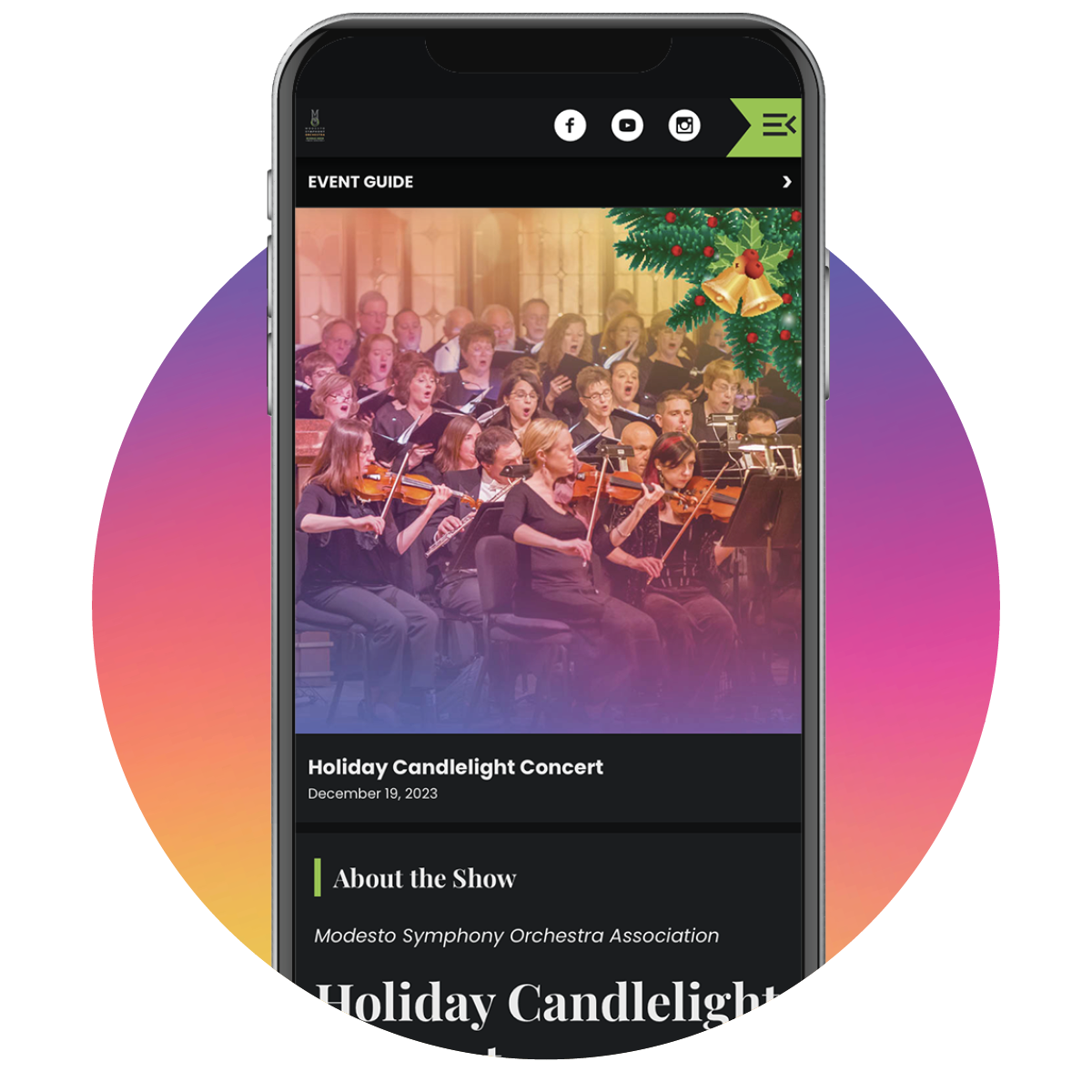
Holiday Candlelight Concert
Tuesday, December 19, 2023 at 8 pm
Modesto Symphony Orchestra
Holiday Candlelight Concert
Tuesday, December 19, 2023
Doors Open at 7 pm
Concert Starts at 8 pm
Our Lady of Fatima Church
505 W. Granger Avenue, Modesto

Program
Camille Saint-Saëns
Prelude (from Oratorio De Noel)
John Rutter
What Sweeter Music
Ludwig Van Beethoven arr. Andrew Duncan
Fanfare on Ode to Joy
- Opus Handbell Ensemble -
arr. Cathy Moklebust
The First Noel
arr. Tom Kennedy
Joy to the World
- Audience Sing-Along -
arr. Steven Pilkington
Coventry Carol
Gustav Holst
Christmas Day
Johann Sebastian Bach arr. Daniel R. Afonso Jr.
Contrapunctus (from Art of the Fugue)
Johann Sebastian Bach
Orchestral Suite No. 2 in B Minor
II. Rondeau
VII. Badinerie
arr. Tom Kennedy
O Little Town of Bethlehem
- Audience Sing-Along -
D. Kantor arr. J. Ferguson
Night of Silence
arr. Joel Raney, Arnold Sherman
An Angelic Celebration
- Opus Handbell Ensemble -
Cathy Moklebust
Vivacio
arr. Tom Kennedy
Silent Night
- Audience Sing-Along -
George Fredrick Handel
Messiah
For Unto Us A Child Is Born
Surely, He Hath Borne Our Griefs
Lift Up Your Heads, Ye Gates
Hallelujah
Join Mobile MSO!
Text “CANDLELIGHT” to (209) 780-0424
to receive a link to the concert program & text message updates prior to this performance!
By texting to this number, you may receive messages that pertain to the Modesto Symphony Orchestra and its performances. msg&data rates may apply. Reply HELP for help, STOP to cancel.
About this Performance


Holiday Pops!
December 1, 2023 at 7:30 pm
December 2, 2023 at 2 pm
Modesto Symphony Orchestra
Holiday Pops!
Friday, December 1, 2023 at 7:30 pm
Saturday, December 3, 2022 at 2 pm
Mary Stuart Rogers Theater, Gallo Center for the Arts

Program
Holiday Overture
Stephenson
O Come All Ye Faithful
arr. Forrest
It’s the Most Wonderful Time of the Year
Kessler
I Wonder as I Wander
Niles / arr. Reineke
Winter Wonderland
Bernard / arr. Berens
The Secret of Christmas
Van Heusen & Cahn / arr. Mann
Charleston Christmas
Stephenson
Holiday Hits Medley
Various Artists / arr. Shoup
Intermission -
Sing We Now of Christmas
arr. Bradford
Sing A Long
arr. Reineke
I’ll Be Home for Christmas
Gannon & Kent / arr. Reineke
Jingle Bell Rock
arr. Stephenson
Christmas, Why Can’t I Find You
Horner / arr. Reineke
Sleigh Ride
Anderson
Jingle, Jingle Bells
Traditional Arrangement / arr. Lai, Shirar
O Holy Night
Clydesdale
Join Mobile MSO!
Text “PROGRAM” to (209) 780-0424
to receive a link to the concert program & text message updates prior to this weekend’s performance!
By texting to this number, you may receive messages that pertain to the Modesto Symphony Orchestra and its performances. msg&data rates may apply. Reply HELP for help, STOP to cancel.
About this Performance

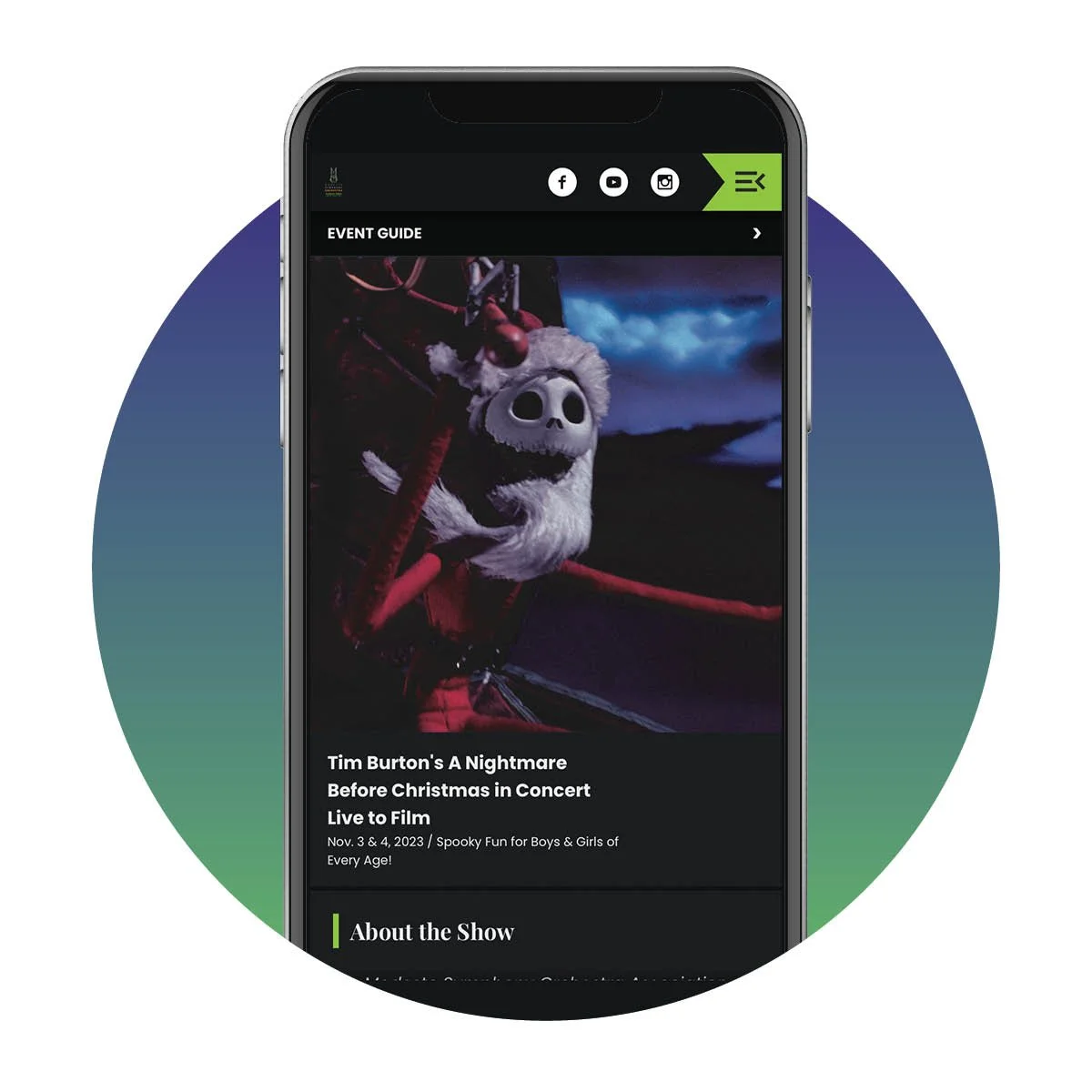
Tim Burton's The Nightmare Before Christmas In Concert Live to Film
November 3, 2023 at 7:30 pm
November 4, 2023 at 2:00 pm
Modesto Symphony Orchestra
Tim Burton’s “The Nightmare Before Christmas” in Concert
Friday, November 3, 2023 at 7:30 pm
Saturday, November 4, 2023 at 2:00 pm
Gallo Center for the Arts, Mary Stuart Rogers Theater

Tim Burton’s “The Nightmare Before Christmas” in Concert
Feature Film with Orchestra
Presentation licensed by Disney Concerts © All rights reserved.
Featuring the voice talents of:
Chris Sarandon
Catherine O’Hara
Ken Page
William Hickey
Glenn Shadix
Paul Reubens
A BURTON/DI NOVI Production
Music, Lyrics & Score by DANNY ELFMAN
Based on a Story and Characters by TIM BURTON
Adaptation by MICHAEL MCDOWELL
Screenplay by CAROLINE THOMPSON
Produced by TIM BURTON and DENISE DI NOVI
Directed by HENRY SELICK
Soundtrack available on WALT DISNEY RECORDS
This film is rated “PG.”
There will be one intermission
Join Mobile MSO!
Text “PROGRAM” to (209) 780-0424
to receive a link to the concert program & text message updates prior to this performance!
By texting to this number, you may receive messages that pertain to the Modesto Symphony Orchestra and its performances. msg&data rates may apply. Reply HELP for help, STOP to cancel.
About this Performance


Tchaikovsky & Copland
October 13 & 14, 2023 at 7:30 pm
VISIT MOBILE PROGRAM →
READ OUR PROGRAM NOTES →
DOWNLOAD PRINTABLE VERSION (pdf, 3mb) →
Modesto Symphony Orchestra
Tchaikovsky & Copland
Friday, October 13, 2023 at 7:30 pm
Saturday, October 14, 2023 at 7:30 pm
Gallo Center for the Arts, Mary Stuart Rogers Theater
Nicholas Hersh, conductor
Alessio Bax, piano

Program
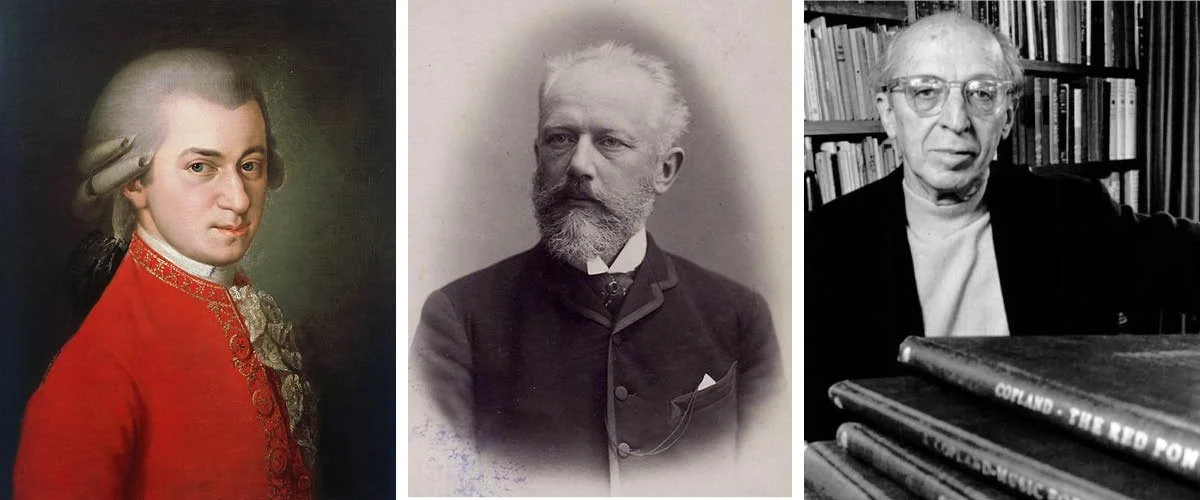
Wolfgang Amadeus Mozart (1756-1791)
Overture to The Marriage of Figaro KV492 (1786)
Pyotr Ilyich Tchaikovsky (1840-1893)
Piano Concerto No. 1 in B-flat minor, Op. 23 (1875)
Alessio Bax, piano
i.Allegro
ii.Andantino
iii.Allegro
- INTERMISSION -
Aaron Copland (1900-1990)
Symphony No. 3 (1946)
i.Molto moderato
ii.Allegro molto
iii.Andantino quasi allegretto
iv.Molto deliberato
Join Mobile MSO!
Text “PROGRAM” to (209) 780-0424
to receive a link to the concert program & text message updates prior to this performance!
By texting to this number, you may receive messages that pertain to the Modesto Symphony Orchestra and its performances. msg&data rates may apply. Reply HELP for help, STOP to cancel.
About this Performance

Program Notes: Tchaikovsky & Copland
Notes about:
Mozart’s Overture to The Marriage of Figaro KV492
Tchaikovsky’s Piano Concerto No.1 in B-flat minor, Op. 23
Copland’s Symphony No. 3
Program Notes for october 13 & 14, 2023
Tchaikovsky & Copland

Wolfgang Amadeus Mozart
Overture from Le nozze di Figaro, K. 492

Composer: born January 27, 1756, Salzburg, Austria; died December 5, 1791, Vienna
Work composed: May 28, 1786.
World premiere: Mozart conducted the first performance of Figaro at Vienna’s Burgtheater on May 1, 1786
Instrumentation: 2 flutes, 2 oboes, 2 clarinets, 2 bassoons, 2 horns, 2 trumpets, timpani, and strings
Estimated duration: 4 minutes
The best way to generate interest in something is to ban it. This holds as true today as it did in 1782, when King Louis XIV, after attending a private reading of a French comedy of manners written by Pierre Beaumarchais, declared it “detestable.” Beaumarchais’ play contained revolutionary ideas too dangerous for commoners to hear, as far as the rulers of Europe was concerned. Austria’s Emperor Joseph II agreed, and banned Beaumarchais’ play within Austria’s borders.
When Wolfgang Amadeus Mozart encountered Beaumarchais’ subversive play, he saw in it the perfect basis for an opera. With librettist Lorenzo da Ponte, Mozart relocated the story of Figaro, Susanna, Count Almaviva and Countess Rosina, and all their circle to Italy, and toned down the more obvious revolutionary elements.
The dizzyingly intricate plot of Le nozze di Figaro, Mozart’s most popular and frequently staged opera, is rife with twists, turns, reversals, misunderstandings, rumors, gossip, and deceptions. Such narrative complexity is mirrored in the Overture’s series of running notes, which generate the nonstop high energy needed to keep the story going over four acts. As was common at the time, none of the actual music in the opera appears in the Overture, but the anticipatory excitement of the music readies the audience for all the shenanigans to come.
Piotr ilyich tchaikovsky
Piano Concerto No.1 in B-flat minor, Op. 23

Composer: born May 7, 1840, Kamsko-Votinsk, Vitaka province, Russia; died November 6, 1893, St. Petersburg
Work composed: Tchaikovsky began composing his first piano concerto in November 1874 and finished it in February, 1875. He revised it in the summer of 1879 and again in December 1888; this final revision is the one usually performed. Tchaikovsky originally dedicated the concerto to his mentor Nicolai Rubinstein, but after Rubinstein declared it unplayable, Tchaikovsky removed his mentor’s name from the manuscript and dedicated it to pianist and conductor Hans von Bülow.
World premiere: Valter Poole led the Michigan WPA Symphony Orchestra (aka the Detroit Civic Symphony) on November 6, 1940
Instrumentation: solo piano, 2 flutes, 2 oboes, 2 clarinets, 2 bassoons, 4 horns, 2 trumpets, 3 trombones, timpani, and strings.
Estimated duration: 33 minutes
The first measures of Piotr Ilyich Tchaikovsky’s Piano Concerto No. 1 have assumed an identity all their own. Many people recognize the four-note descending horn theme and the iconic crashing chords of the pianist’s first entrance without knowing the work as a whole. Interestingly, this signature introduction to the Piano Concerto No. 1 is just that, an introduction; after approximately 100 measures it disappears and never returns. These opening bars have also become part of popular culture, as the theme to Orson Welles’ Mercury Theatre radio programs; in the 1971 cult film Harold and Maude; and in a Monty Python sketch.
Although the rest of the concerto is equally compelling, that was not the initial opinion of Tchaikovsky’s friend and mentor, Nikolai Rubinstein. Rubinstein, director of the Moscow Conservatory, had premiered many of Tchaikovsky’s works, including Romeo and Juliet. Tchaikovsky considered Rubinstein “the greatest pianist in Moscow,” and wanted Rubinstein’s help regarding the technical aspects of the solo piano part. In a letter to his patron Nadezhda von Meck, Tchaikovsky described his now-infamous meeting with Rubinstein on Christmas Eve, 1874: “I played the first movement. Not a single word, not a single comment!” After Tchaikovsky finished, as he explained to Mme. von Meck, “A torrent poured from Nikolai Gregorievich’s mouth … My concerto, it turned out, was worthless and unplayable – passages so fragmented, so clumsy, so badly written as to be beyond rescue – the music itself was bad, vulgar – only two or three pages were worth preserving – the rest must be thrown out or completely rewritten.”
It is true that this concerto is awkwardly constructed in places, with some abrupt musical transitions. The writing for the soloist is often exceedingly difficult, because Tchaikovsky was not a pianist and did not possess a player’s kinetic, idiomatic knowledge. However, Rubinstein’s excessively negative reaction seems disproportionate.
After the majestic introduction, which anticipates the harmonic language of the following movements, the Andante non troppo continues with a theme Tchaikovsky borrowed from a Ukrainian folk song. Woodwinds introduce a second theme, gentler and quieter, later echoed by the piano. The movement ends with a huge cadenza featuring a display of virtuoso solo fireworks.
In the Andantino semplice, Tchaikovsky also features a borrowed melody, “Il faut s'amuser, danser et rire” (You must enjoy yourself by dancing and laughing) from the French cabaret. Tchaikovsky likely meant this tune as a wistful tribute to the soprano Désirée Artôt, with whom he had been in love a few years previously. (In another musical compliment, Tchaikovsky used the letters of her name as the opening notes of a melody from the first movement).
The galloping melody of the Allegro con fuoco, another Ukrainian folk song, suggests a troika of horses racing over the steppes. A rhapsodic theme in the strings recalls the lush texture of the introduction. The two melodies alternate and overlap, dancing toward a monumental coda.
Aaron Copland
Symphony No. 3

Composer: born November 14, 1900, Brooklyn, NY; died December 2, 1990, North Tarrytown, NY
Work composed: 1944-46. Copland’s Third Symphony was commissioned by the Koussevitzky Foundation and Copland dedicated it “to the memory of my good friend, Natalie Koussevitzky.”
World premiere: Serge Koussevitzky led the Boston Symphony Orchestra on October 18, 1946.
Instrumentation: piccolo, 3 flutes (one doubling 2nd piccolo), 3 oboes (one doubling English horn), 2 clarinets, E-flat clarinet, bass clarinet, 2 bassoons, contrabassoon, 4 horns, 4 trumpets, 3 trombones, tuba, timpani, anvil, bass drum, chimes, claves, cymbals, glockenspiel, ratchet, slapstick, snare drum, suspended cymbal, tam tam, tenor drum, triangle, wood block, xylophone, celeste, piano, 2 harps, and strings.
Estimated duration: 38 minutes
In 1922, Nadia Boulanger, who taught composition to many of the 20th century’s greatest composers, introduced conductor Serge Koussevitzky to one of her young American students. From that moment, Koussevitzky and Aaron Copland forged a reciprocal collaboration that lasted until Koussevitzky’s death, in 1951. Koussevitzky championed Copland’s music and taught him the nuances of conducting; in turn, Copland encouraged Koussevitzky to focus on American composers, particularly at the Berkshire Music Center (now the Tanglewood Music center), which Koussevitzky established in 1940 in Lenox, MA.
In 1944, Copland received his last commission from Koussevitzky’s Foundation; this evolved into his most substantial orchestral work, the Third Symphony. Copland explained, “I knew exactly the kind of music he [Koussevitzky] enjoyed conducting and the sentiments he brought to it, and I knew the sound of his orchestra, so I had every reason to do my darndest to write a symphony in the grand manner.”
In his autobiography, Copland wrote, “If I forced myself, I could invent an ideological basis for the Third Symphony. But if I did, I’d be bluffing – or at any rate, adding something ex post facto, something that might or might not be true but that played no role at the moment of creation.” Nonetheless, one cannot help hearing Copland’s Third Symphony as the expression of a country emerging victorious from a devastating war. Copland acknowledged as much, noting that the Third Symphony “intended to reflect the euphoric spirit of the country at the time.”
Copland described the Molto moderato as “open and expansive.” Of particular note is the second theme, a singing melody for violas and oboes, which sounds like an inspirational moment from a film score.
The Andantino quasi allegretto contains the most abstract and introspective music in the symphony. High strings wander through an empty landscape, like soldiers stumbling upon a field after a bloody battle. A solo flute intones a melody that binds the rest of the movement together with, as Copland explains, “quiet singing nostalgia, then faster and heavier – almost dance-like; then more childlike and naïve, and finally more vigorous and forthright.” As the third movement’s various themes weave and coalesce, sounding much like sections of Copland’s ballet music, they produce a half-conscious sense of déjà vu – have we heard this before? Not quite, but almost, and as the third movement dissolves without pause into the final movement, we hear the woodwinds repeating a theme present in all three of the preceding sections. Now the theme shifts, the last jigsaw puzzle piece locks into place, and the Fanfare for the Common Man emerges.
Although the Fanfare is instantly recognizable today, at the time Copland was writing the Third Symphony it was little known. In 1942, Eugene Goossens, music director of the Cincinnati Symphony, commissioned Copland and eighteen other composers to write short, patriotic fanfares, for the orchestra to premiere during their 1942-43 season. Copland explained his choice of title: “It was the common man, after all, who was doing all the dirty work in the war and the army. He deserved a fanfare.”
Copland wanted a heroic finale to represent the Allied victory in WWII, and the Fanfare epitomized it. The flutes and clarinets introduce the basic theme, before the brasses and percussion burst forth with the version most familiar to audiences.
Reviews were enthusiastic, ranging from Koussevitzky’s categorical statement that it was the finest American symphony ever written to Leonard Bernstein’s declaration, “The Symphony has become an American monument, like the Washington Monument or the Lincoln Memorial.”
© Elizabeth Schwartz
NOTE: These program notes are published here by the Modesto Symphony Orchestra for its patrons and other interested readers. Any other use is forbidden without specific permission from the author, who may be contacted at www.classicalmusicprogramnotes.com
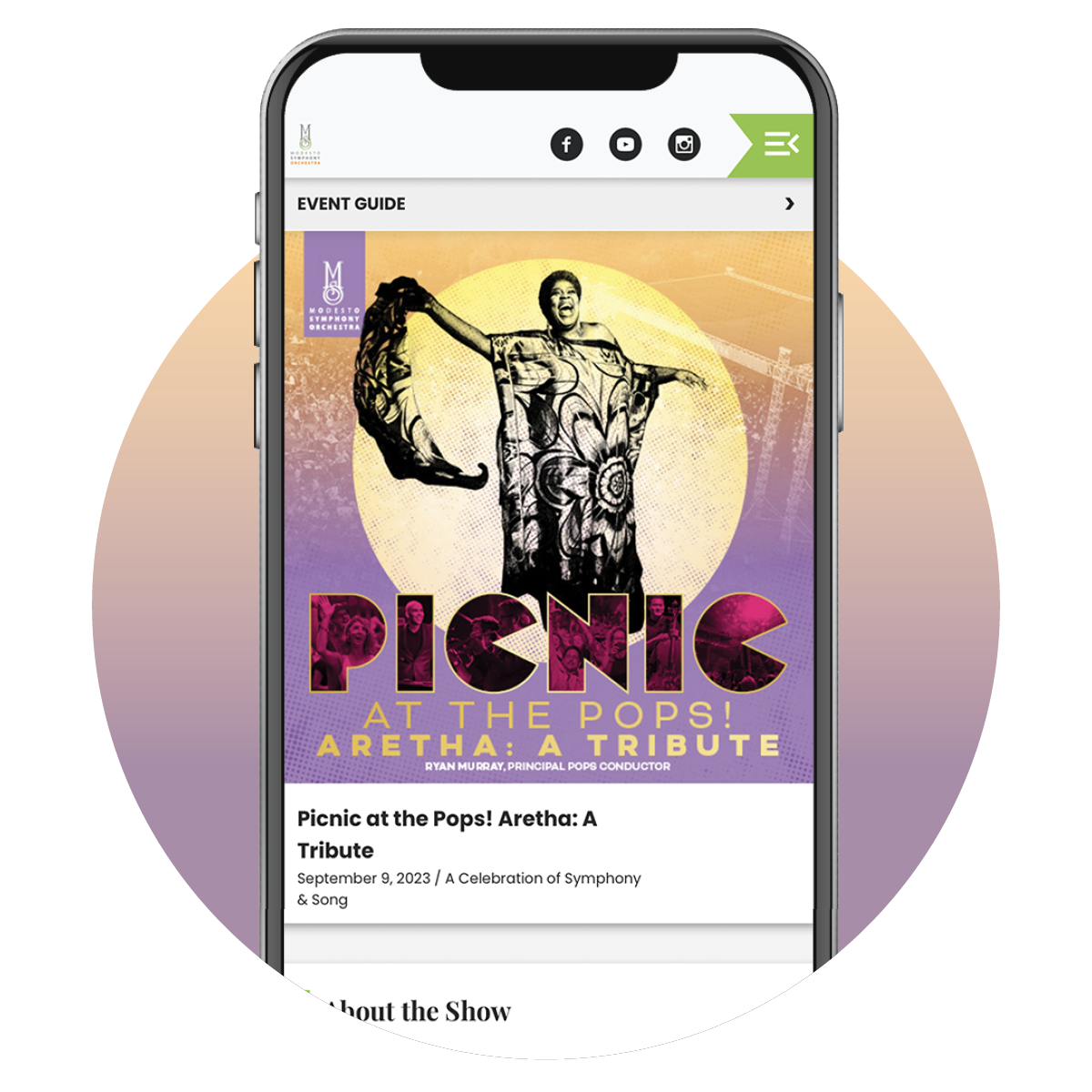
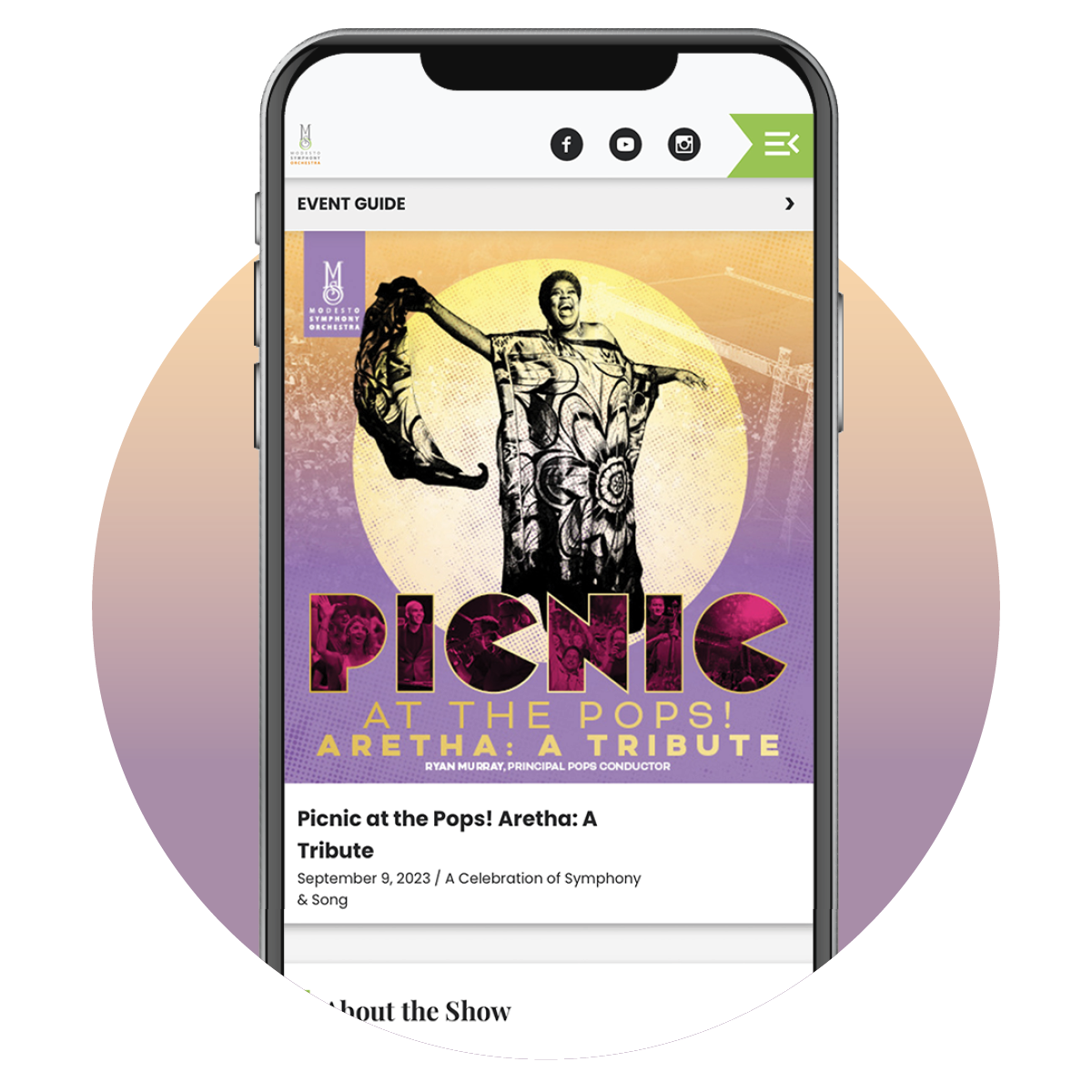
Picnic at the Pops! Aretha: A Tribute
September 9, 2023
Modesto Symphony Orchestra
Picnic at the Pops! Aretha: A Tribute
Saturday, September 9, 2023
Grounds Open: 5:00 pm
Concert Starts: 7:30 pm
E. & J. Gallo Winery Grounds
Program
All selections will be announced from the stage.
There will be one intermission.
About this Performance

Enrich Your Concert Experience