Program Notes: Carmina Burana
Notes about:
Giovanni Gabrieli, arr. Hersh: Canzon per sonar noni toni a 12
Mikhail Glinka: Ruslan and Ludmilla Overture
Carl Orff: Carmina Burana
Program Notes for May 8 & 9, 2026

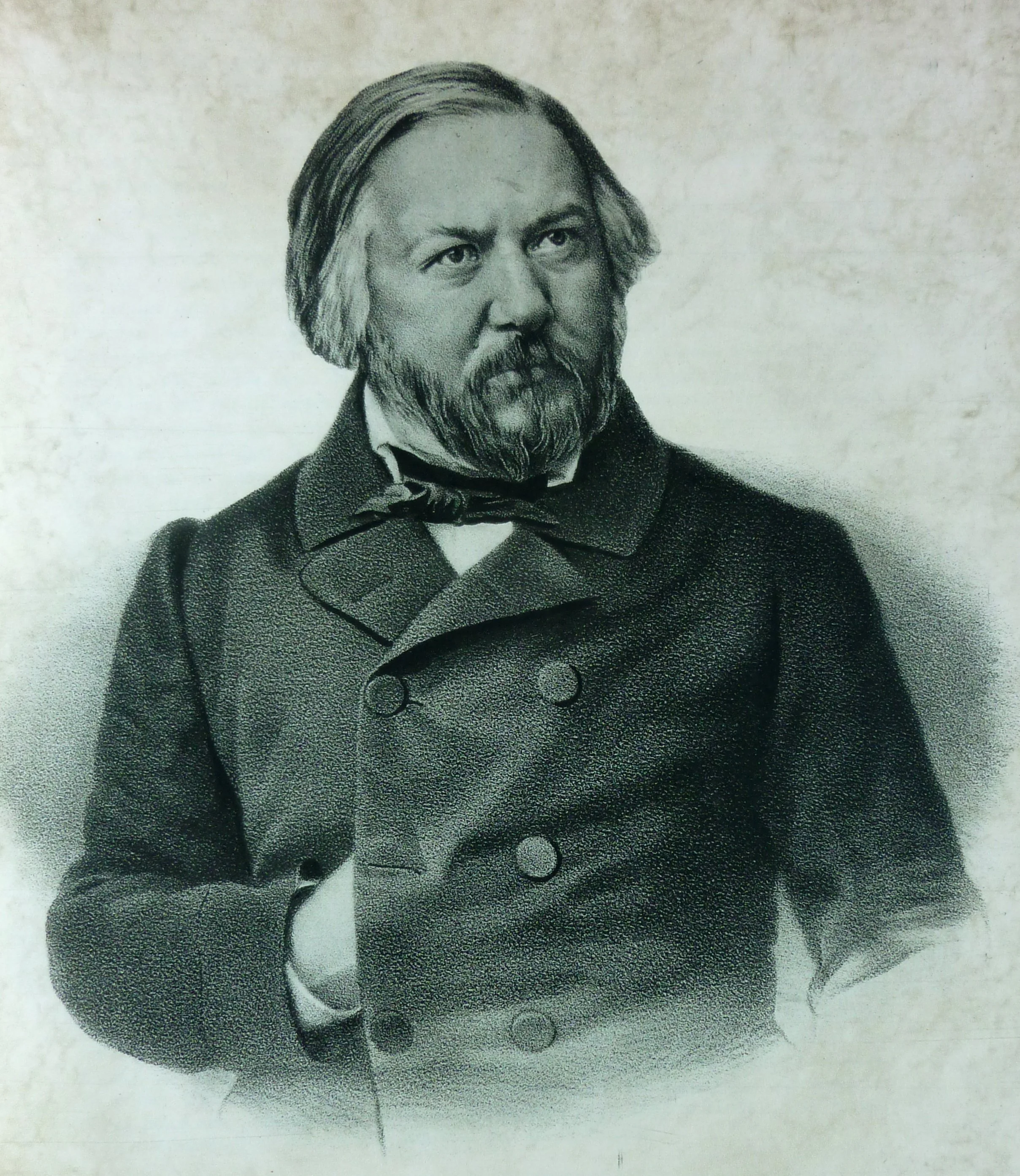
Mikhail Glinka
Overture to “Russlan and Ludmilla”
Composer: Born June 1, 1804. Novospasskoe, Russia; died February 15, 1857, Berlin, Germany.
Work composed: Completed in 1842.
World premiere: December 9, 1842 at the Bolshoi Theater in St. Petersburg.
Instrumentation: 2 flutes, 2 oboes, 2 clarinets, 2 bassoons, contrabassoon, 4 horns, 2 trumpets, 3 trombones, timpani, and strings.
Approximate duration: 5:00.
Background
Glinka, widely viewed as the founding father of Russian musical nationalism, is largely known today through two operas. The first of these, A Life for the Czar (1836), was a success both for its incorporation of elements from Russian folk music, and its contemporary plot, which resonated with burgeoning Russian political nationalism. For his second opera, Glinka turned to an epic poem by Pushkin. Pushkin ‘s Russlan and Ludmilla had secured his reputation when it was published in 1818, and it was widely known in Russian literary circles. The poem is a fairy-tale recreation of ancient Slavic epics: in this case, an extremely complicated version of the “sleeping beauty” legend. Glinka had originally planned to work with the poet in creating a libretto, but Pushkin died in a duel before he could collaborate on the opera. Glinka brought in a team of no fewer than five librettists, who turned Pushkin ‘s already convoluted storyline into an even more complicated series of tableaux. The confusing plot probably contributed to a rather lukewarm response at the premiere performance. Russlan and Ludmilla soon caught on, however, and became a recognized symbol of Russian music: the opera was performed over 300 times in St. Petersburg alone over the next half century, and was widely heard in other Russian cities. European and American audiences were a bit slower to accept the work (it was not performed in the US until 1942), but it is still heard occasionally today.
What You’ll Hear
Though the opera Russlan and Ludmilla is only rarely heard on today ‘s stages, its brilliant little overture has become a staple of the orchestral repertoire. The overture is set in classical sonata form. The opening melodies, accompanied by furious violin lines, are borrowed from the opera ‘s final victory scene. The contrasting theme, played by violas, cellos, and bassoons is a battlefield aria sung by the hero Russlan in the second act. Near the end, the trombones—as usual, relegated to the role of orchestral Bad Guy—play a descending whole-tone scale associated with the evil dwarf Chernomor, but this is soon drowned out in general rejoicing.
Carl Orff
Carmina Burana
Composer: Born July 10, 1895, Munich, Germany; died March 29, 1982, Munich, Germany.
World premiere: June 8, 1937 in a staged production by the Frankfurt Opera, in Frankfurt, Germany.
Instrumentation: Soprano, tenor, and baritone soloists, large chorus, 3 flutes (2 doubling piccolo), 3 oboes (1 doubling English horn), 2 bassoons, contrabassoon, 4 horns, 3 trumpets, 3 trombones, tuba, celeste, 2 pianos, timpani, xylophone, castanets, ratchet, sleigh, bells, triangle, crotales, cymbal, tamtam, chimes, tambourine, bass, drum, glockenspiel, suspended cymbals, and strings.
Approximate duration: 59:00.
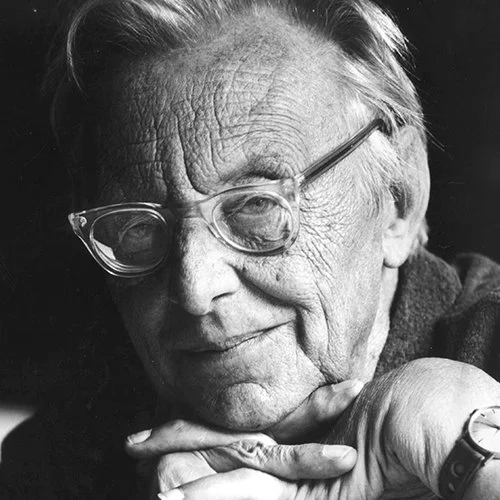
Orff-Zentrum München, CC BY-SA 4.0 <https://creativecommons.org/licenses/by-sa/4.0>, via Wikimedia Commons
Background
During the 12th and 13th centuries, a tremendous body of Latin and vernacular poetry was created by poets collectively known as “goliards.” To group them together under a single name is a bit misleading, however, for the goliards were drawn from every rank of society. The poets include prominent churchmen such as Walter of Châtillon (1135-1176) and Philip, Chancellor of the University of Paris (d.1236), as well as now-nameless monks, students, vagabonds, and minstrels. The poetry is just as variable: there are moralistic and fervidly religious poems, as well as secular lyrics that range from love songs (including worshipful courtly love lyrics, bawdy love songs, and frankly homosexual poetry) to humorous stories and raucous drinking songs. The most famous collection of goliard poetry is the Carmina Burana (literally “Songs of Beuren”), a 13th-century collection of over 200 poems that was compiled at the Benedictine monastery in Benediktbeueren, south of Orff ‘s hometown, Munich. This richly-illuminated manuscript was probably compiled for a wealthy abbot of the monastery. Most of its poems are written in Church Latin, but there are several poems in a Bavarian dialect of medieval German, and a few poems that are partially in French (for example, No. 16 in Orff ‘s setting).
Carl Orff ‘s “secular cantata” on texts from the Carmina Burana is certainly his best-known work. Orff is a familiar name to many music educators—he was the creator of a systematic method of music education for children, and the composer of an important body of Schulwerke, educational music. He enjoyed success as a composer in Germany, but aside from Carmina Burana, few of his concert or stage works are heard in this country.
The part of Orff ‘s biography that is most fraught with controversy is his relationship with the Nazis. Unlike German contemporaries like Schoenberg, Hindemith, and many others who fled the Nazi regime, Orff remained in Germany and thrived as a composer throughout the late 1930s and the war years. The spurious claim that he himself was a Nazi has been raised more than once. The stridently modernist music he had composed in the 1920s and early 1930s, and his close association with many leftists had, in fact, marked him as “dangerous” to the Nazis. Carmina Burana, composed in 1935-36, is the earliest of Orff ‘s acknowledged works—in 1937, he withdrew from publication everything else he had composed up to that time. He also seems to have suppressed any evidence of his previous ties with leftists and Communists. For example, he carefully soft-pedaled his collaboration with playwright Bertholt Brecht in the 1920s and early 1930s. As detailed in 2000 article by Kim Kowalke, Orff had assisted Brecht in several productions, and clearly considered Brecht a mentor. But in 1933, Brecht fled Germany and his works were considered suspicious. Carmina Burana represents a fairly new and simpler musical style that was perfectly in keeping with Nazi cultural policies promoting music that was uplifting and celebrated the spirit of the German Volk. Its texts were also in accord with the idealized view of medieval Germany promulgated by the Nazi Party. Most controversial of all, Orff agreed to compose a set of incidental pieces for a 1939 production of A Midsummer Night ‘s Dream in Frankfurt: music intended by the cultural authorities to replace the standard incidental pieces by the Jewish-born Felix Mendelssohn. (Orff later regretted this decision.) What most of Orff ‘s biographers agree upon is that, if he was guilty of anything during the Nazi regime, it was that he had a good sense of the cultural climate and successfully promoted himself. There is, however, no good evidence that Orff or any of his close associates ever actually became members of the Nazi Party, or subscribed to its ideology.
In speaking about his aesthetic philosophy, Orff remarked that:
I am often asked why I nearly always select old material, fairy tales, and legends for my stage works. I do not see this material as old, but rather as valid. The time element disappears, and only the spiritual element remains. My entire interest is in the expression of these spiritual realities. I write for the theater to convey a spiritual attitude.
This sensitivity to the underlying nature of the texts is clearly apparent in Carmina Burana. Orff ‘s choice of poems—all thoroughly secular—and his ordering of these texts reflects his understanding of the medieval spirit.
What You’ll Hear
The 25 movements of Carmina Burana are divided into three large sections, devoted respectively to springtime, drinking, and love (of all sorts). As a prologue and epilogue, Orff uses a text saluting the goddess Fortune, a symbol of the changeability and fickle nature of luck.
The musical style of Carmina Burana and much of Orff ‘s later work owes a great deal to the neoclassical music of Stravinsky, and echoes of Stravinsky ‘s Symphony of Psalms and Les Noces are clear. Orff ‘s style is harmonically simple, with ostinato rhythmic figures repeated over long static harmonies—the entire choral prologue, for example, is set above an unchanging D in the bass. The orchestration is simple, yet colorful: Orff shows a preference for percussive effects that highlight the accents of the text and his own rhythmic figures. Melodic figures are short and frequently repeated, with very little development. There are also moments of pure Romanticism, however, particularly in the baritone ‘s solo lines. The melodic material used in Carmina Burana is, without exception, Orff ‘s own: he did not use any of the relatively few extant melodies preserved with goliard poetry. His original settings of these 700-year-old lyrics are imbued with both freshness and mystery.
The texts are arranged into three large sections: I. Spring, II. In the Tavern, and III. The Court of Love, and each of these sections is further divided. The first two texts, serving as a prelude to Section I, deal with the most potent symbol of medieval life: the Wheel of Fortune. In countless manuscript illuminations, including a prominent page in the original Carmina Burana manuscript, the wheel is shown being manipulated by a capricious Lady Fortune, who raises and lowers the kings, churchmen, and peasants who cling to it. Section I, Spring, reflects an idealized and mythological view of Nature and Springtime. Spring was an important medieval metaphor—both for resurrection and for youth—but here the enjoyment of the season is purely sensuous. In a subsection, titled On the Green (Nos. 6-10), the outdoor spirit is directed towards thoughts of love and dancing. This subsection contains the only purely orchestral music in Carmina Burana: an instrumental Tanz that opens the section, and a Reie (round-dance) inserted before the chorus Swaz hie gat umbe. The four numbers set in the tavern give four different perspectives of medieval merrymaking: drunken musings, feasting (sung from the perspective of the “feastee,” a roasted swan!), a satire of a drunken clergyman (who invokes the spurious St. Decius, patron saint of gamblers), and finally the drunken and entirely democratic free-for-all of In taberna quando sumus. The third and longest section, “Court of Love,” reflects the twofold conception of love common in medieval thought. There is both the lofty ideal of courtly love—chaste longing for an unattainable lady heard in Dies, nox et omnia—and openly erotic love in Si puer cum puellula. In most of the texts, these two threads are cunningly woven together. This section ends with Blanchefleur and Helen (No. 24), praising Venus in the same terms often reserved for addresses to the Virgin Mary. A repeat of the opening chorus, O Fortuna, serves as a postlude. In returning, Orff neatly encircles Carmina Burana within Fortune ‘s Wheel.
Program notes ©2026 J. Michael Allsen
Program Notes: Scheherazade & Márquez’s Fandango
Notes about:
Margaret Bonds: Selections from The Montgomery Variations
Arturo Márquez: Fandango
Nikolai Rimsky-Korsakov: Scheherazade
Program Notes for February 13 & 14, 2026

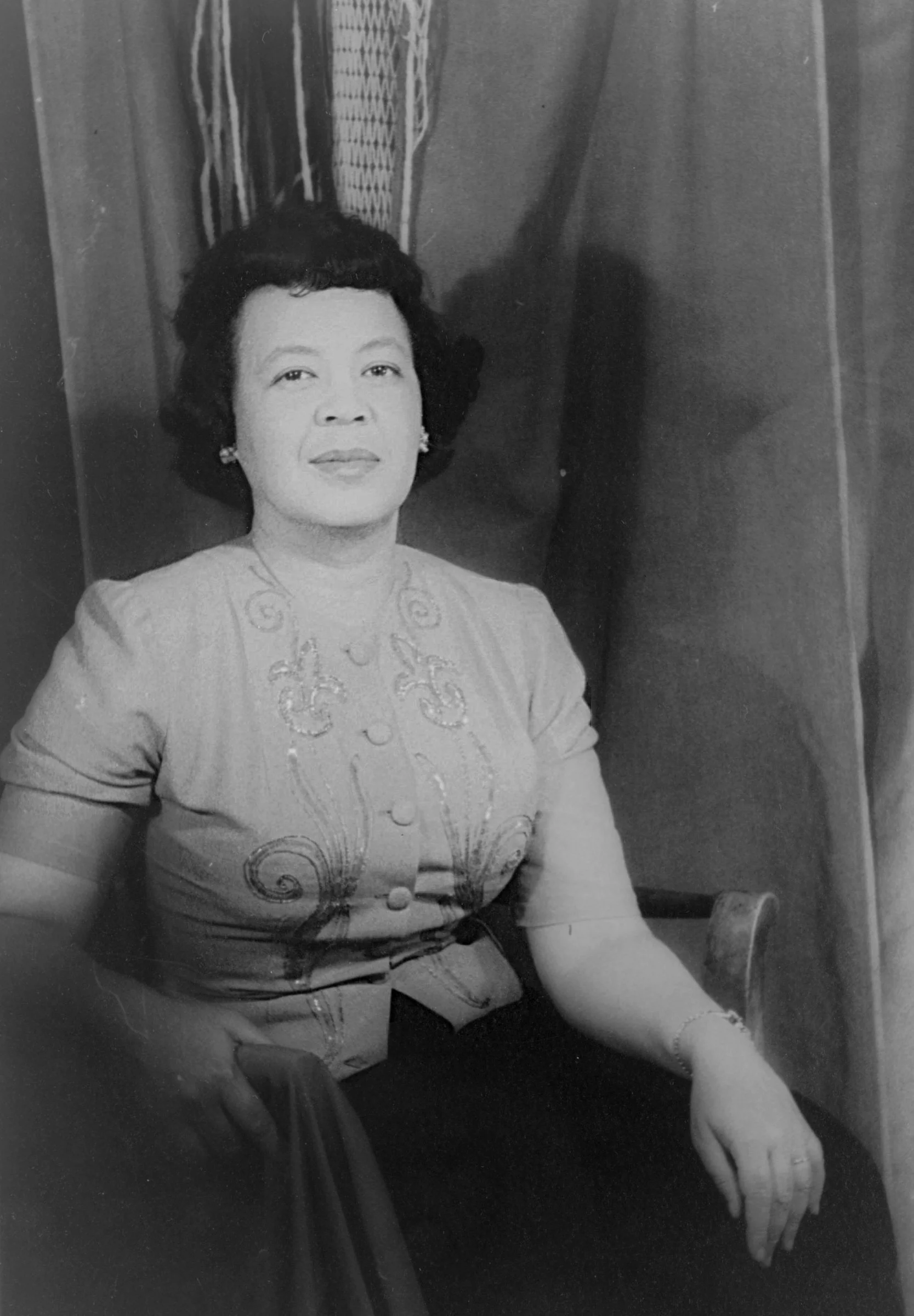
Margaret Bonds
The Montgomery Variations
Composer: Born March 3, 1913, Chicago, Illinois; died April 26, 1972, Los Angeles, California.
Composed: 1963-1964.
Premiere: Though there are some indications that it may have boon performed in 1967, the definitive world premiere was on December 6, 2018, by the University of Connecticut Symphony Orchestra. The Montgomery Variations was finally published in 2020.
Instrumentation: 3 flutes (1 doubling piccolo and alto flute), 2 oboes, 2 bassoons, contrabassoon, 4 horns, 3 trumpets, 3 trombones, tuba, timpani, triangle, cymbals, wood block, tambourine, large drum, harp, and strings
Duration: 15:00.
Background
Composer and pianist Margaret Bonds was born in Chicago, into a family prominent in the African American community. After her father, a well-respected physician, and mother divorced, she grew up in her mother’s house, surrounded by music...and by many of the leading Black intellectual figures and musicians of the day. In the 1920s and 1930s, there was a Chicago Renaissance in parallel to the well-known Harlem Renaissance, and the home of Margaret’s mother, Estelle Bonds, became a gathering-spot for prominent writers, artists, and musicians. Among the longterm houseguests was composer Florence Price, with whom Bonds later studied composition. She entered Northwestern University at age 16, and though she earned Bachelor’s and Master’s degrees there, she found the environment to be racist and hostile. According to Bonds, what saved her was encountering the poem The Negro Speaks of Rivers by Langston Hughes (1902-1967):
Because in that poem he tells how great the black man is. And if I had any misgivings, which I would have to have—here you are in a setup where the restaurants won’t serve you and you’re going to college, you’re sacrificing, trying to get through school—and I know that poem helped save me.
Bonds later struck up a close friendship with Hughes, and set several of his works to music, including a Christmas cantata, The Ballad of the Brown King (1960). While still at Northwestern, Bonds’s composition Sea Ghost won a national prize, and in 1933, she performed as a piano soloist with the Chicago Symphony Orchestra (the first Black soloist in the orchestra’s history). In 1939, she moved to New York City, where she would spend most of her career. Bonds studied piano and composition at the Julliard School, but was also obliged to earn a living, later recalling: “no job was too lousy; I played all sorts of gigs, wrote ensembles, played rehearsal music, and did any chief cook and bottle washer job just so I could be honest and do what I wanted.” What she wanted to do, clearly, was to make music, and over the next three decades she was successful as a composer, but also as a performer, promoter, educator, community leader, and advocate for Black music. The death of Langston Hughes in 1967 seems to have been an emotional turning-point for Bonds, and she moved to Los Angeles in 1968 to work as an educator. She died there in 1972, just a few weeks after the successful premiere of her Credo by the Los Angeles Philharmonic.
Montgomery, Alabama was one of the epicenters of the civil rights movement of the 1950s and 1960s. One of the defining events was the Montgomery bus boycott of 1955-56, sparked by activist Rosa Parks refusing to give up her seat to a white rider on a segregated Montgomery bus. This marked one of the first great victories of the movement, ending in the official desegregation of Montgomery’s buses. One of the leaders of the boycott was the pastor of Montgomery’s Dexter Avenue Baptist Church, Martin Luther King Jr. In 1957, King (to whom Bonds would later dedicate The Montgomery Variations) and other church leaders created the Southern Christian Leadership Conference (SCLC), which would become a major force in the nonviolent civil rights struggle.
In 1963, Bonds was on a concert tour to Montgomery and the surrounding area and was deeply inspired by King and the movement. She began work on The Montgomery Variations, one of her very few purely orchestral pieces almost immediately finishing after the dark day of September 15. She completed the orchestration in 1964. A noted scholar of African-American music, Tammy Kernodle, describes The Montgomery Variations as follows:
The thematic narrative of the work follows the chronology of 1955 to 1963, which correlates with the initiation of the Montgomery bus boycott, the rise of Dr. King, and the initiation of nonviolent direct-action campaigns throughout the South. Bonds ends the narrative framework with one of the seminal events of the Movement—the bombing of the 16th Street Baptist Church in Birmingham, Alabama, on September 15, 1963, which killed four little girls, and its aftermath of grief. Coming only two weeks following Dr. King’s iconic “I Have a Dream” speech at the March on Washington for Jobs and Freedom, the bombing signified the start of a period of overt violence that pervaded the movement during the late 1960s and early 1970s.
What You’ll Hear
The Montgomery Variations is in seven movements, four of which are played here. Black spirituals have been a touchstone for many African-American composers throughout the 20th and 21st centuries, and the primary musical theme, heard throughout, is the spiritual, I Want Jesus To Walk With Me.
Bonds describes the action in the opening movement, I. The Decision: “Under the leadership of Martin Luther King, Jr., and SCLC, Negroes in Montgomery decided to boycott the bus company and to fight for their rights as citizens.” After a dramatic pair of drum rolls, the spiritual theme is laid out by the brasses. The music of this brief introduction conveys a clear sense of resolve throughout. II. Prayer Meeting is much more hushed and fervent, throughout, climaxing in a subdued brass passage and a bluesy trombone solo. Describing III: March, Bonds wrote: “The Spirit of the Nazarene marching with them, the Negroes of Montgomery walked to their work rather than be segregated on the buses. The entire world, symbolically with them, marches.” This is quietly defiant music beginning with a solo bassoon above an insistent string rhythm, that swells inexorably at the end as ever more marchers join in. About the final movement, VII. Benediction, Bonds wrote: “A benign God, Father and Mother to all people, pours forth Love to His children—the good and the bad alike.” This final section starts quietly, almost wistfully, with a series of woodwind solos, eventually growing to a grand transformation of the spiritual theme, and a quiet prayerful ending.
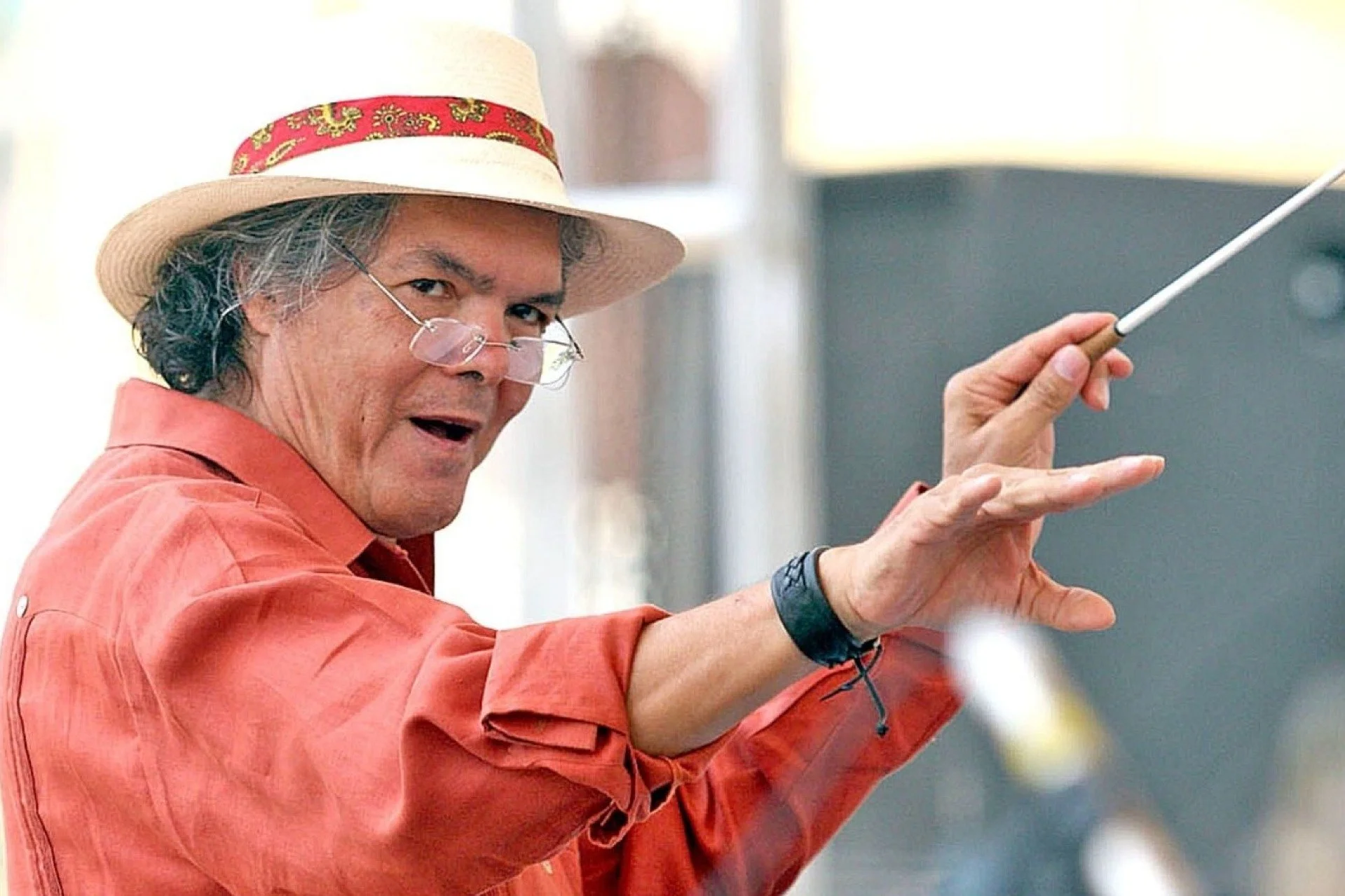
Arturo Márquez
Fandango
Composer: Born December 20, 1950, Álamos, Mexico.
Work composed: 2020. Commissioned for Anne Akiko Myers.
World premiere: In Los Angeles, on August 24, 2021, by violinist Anne Akiko Myers, with the Los Angeles, Philharmonic, led by Gustavo Dudamel.
Instrumentation: solo violin, piccolo, 2 flutes, 2 oboes, 2 clarinets, 2 bassoons, 4 horns, bass, trombone, tuba, timpani, snare drum, cymbals, bass drum, claves, cajon, güiro, harp, and strings.
Estimated duration: 30:00.
Background
Arturo Márquez, one of Mexico’s most successful contemporary composers, was born in the state of Sonora. When he was 12 years old, his family moved to a suburb of Los Angeles, where he studied piano, violin, and trombone. Márquez later recalled that “My adolescence was spent listening to Javier Solis [the famous Mexican singer/actor], sounds of mariachi, the Beatles, Doors, Carlos Santana and Chopin.” He later studied at the Conservatory of Music of Mexico, with the great French composer Jacques Castérède in Paris, and at the California Institute of the Arts. He is on the faculty of the National Autonomous University in Mexico City. Márquez frequently uses Mexican and other Latin folk influences in his works, and his best-known series of works are the Danzónes he began composing in the 1990s for orchestra and other ensembles.
Márquez notes regarding the Fandango that:
The Fandango is known worldwide as a popular Spanish dance and specifically, as one of the fundamental parts (Palos) of Flamenco. Since its appearance in the 18th century, various composers such as S. de Murcia, D. Scarlatti, L. Bocherini, Padre Soler, and W. A. Mozart, among others, have included the Fandango in concert music. What is little known in the world is that immediately upon its appearance in Spain, the Fandango moved to the Americas where it acquired personalities according to the land that adopted and cultivated it. Today, we can still find it in countries such as Ecuador, Colombia and Mexico—in the latter specifically in the state of Veracruz and in the Huasteca area, part of seven states in eastern Mexico. Here the Fandango acquires a tinge different from the Spanish genre; for centuries, it has been part of a special festival for musicians, singers, poets and dancers. Everyone gathers around a wooden platform to stamp their feet, sing and improvise ten-line stanzas bout the occasion.
In 2018 I received an email from violinist Anne Akiko Meyers, a wonderful musician, where she proposed to me the possibility of writing a work for violin and orchestra that had to do with Mexican music. The proposal interested and fascinated me from that very moment, not only because of Maestra Meyers’s emotional aesthetic proposal but also because of my admiration for her musicality, virtuosity and, above all, for her courage in proposing a concerto so out of the ordinary. I had already tried, unsuccessfully, to compose a violin concerto some 20 years earlier with ideas that were based on the Mexican Fandango. I had known this music since I was a child, listening to it in the cinema, on the radio and hearing to my father (Arturo Márquez Sr.), a mariachi violinist, play Huastecos and mariachi music. Also, since the 1990s I have been admiring the Fandango in various parts of Mexico. I would like to mention that the violin was my first instrument when I was 14 years old (1965). Remarkably, I studied it in La Puente, California in Los Angeles County where this work will be premiered with the wonderful Los Angeles Philharmonic under the direction of Gustavo Dudamel, whom I admire very much. This is a beautiful coincidence, as I have no doubt that the Fandango was danced in California in the 18th and 19th centuries.
What You’ll Hear
Márquez provides the following description of the work itself:
Fandango for violin and orchestra is formally a concerto in three movements:
Folia Tropical
Plegaria (Prayer) (Chaconne)
Fandanguito
The first movement, Folia Tropical, is in the sonata form of a traditional classical concerto: introduction, exposition with its two themes, bridge, development and recapitulation. The introduction and the two themes share the same motif in a totally different way. Emotionally, the introduction is a call to the remote history of the Fandango; the first theme and the bridge, this one totally rhythmic, are based on the Caribbean “Clave” rhythm, and the second is eminently expressive, almost like a romantic Bolero. Folias are ancient dances that come from Portugal and Spain. However, also the root and meaning of this word also takes us to the French word “folie”—madness.
The second movement Plegaria pays tribute to the Huapango mariachi together with the Spanish Fandango, both in its rhythmic and emotional parts. It should be noted that one of the Palos del Flamenco Andaluz is known as the Malagueña and Mexico also has a Huapango honoring the Andalusian city of Malaga. I do not use traditional themes but there is a healthy attempt to unite both worlds; that is why this movement is the fruit of an imaginary marriage between the Huapango mariachi and Pablo Sarasate, Manuel de Falla and Issac Albeniz, three of the Spanish composers whom I most love and admire. It is also a freely treated Chaconne. Perhaps a few people know that the Chaconne as well as the Zarabanda were two dances forbidden by the Spanish Inquisition in the late 16th and early 17th centuries, long before they became part of European Baroque music. Moreover, the first written descriptions of these dances place them in colonial Mexico of these centuries.
The third movement, Fandanguito, is a tribute to the famous Malaga huasteco. The music of this region is played by violin, jarana huasteca (small rhythm guitar) and huapanguera (low guitar with 5 courses of strings). This ensemble accompanies the songs and recited or sung improvisation. The huasteco violin is one of the instruments with the most virtuosity in all of America. Its technique has certain features similar to Baroque music but with great rhythmic vitality and a rich original variety in bow strokes. Every huasteco violinist must have a personal version of this playing technique, if he wants to have and maintain prestige. This third movement is a totally free elaboration of the Fandanguito huasteco, but it maintains many of its rhythmic characteristics. It demands great virtuosity from the soloist. It is music that I have kept in my heart for decades.
I think that for every composer it is a real challenge to compose new works from old forms, especially when this repertoire is part of the fundamental structure of classical music. On the other hand, composing in this during the 2020 pandemic was not easy due to the huge human suffering. Undoubtedly my experience with this work during this period has been intense and highly emotional but I must mention that I have preserved my seven capital principles: tonality, modality, melody, rhythm, imaginary folk tradition, harmony and orchestral color.
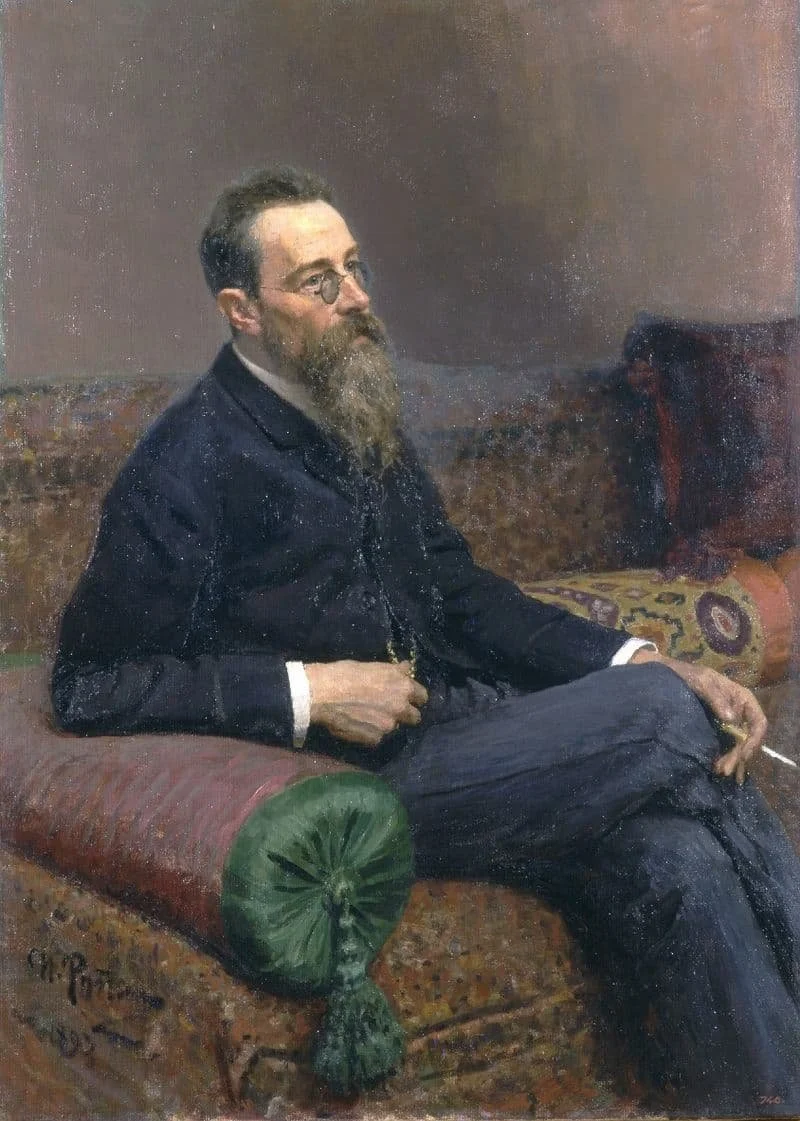
Nicolai Rimsky-Korsakov (1844-1908)
Scheherazade: Symphonic Suite, Op. 35
Composer: Born March 18, 1844, in Tivkin, Russia; died June 21, 1908, in Liubensk, Russia.
Work composed: Rimsky-Korsakov completed Scheherazade in 1888, during his summer break from his duties at the St. Petersburg Conservatory.
World premiere: The composer conducted its premiere in St. Petersburg, on November 9, 1888.
Instrumentation: 3 flutes (2 doubling piccolo), 2 oboes, English horn, 2 clarinets, 2 bassoons, 4 horns, 2 trumpets, 3 trombones, tuba, timpani, cymbals, suspended cymbal, snare drum, triangle, tambourine, tamtam, harp, and strings.
Approximate duration: 40:00.
Background
The Thousand and One Nights is a collection of Arabic and Egyptian stories dating from as early as the 10th century. The framing story is that the Sultan Shahryar, convinced of the infidelity of all women, puts a series of wives to death until the Princess Scheherazade distracts him by telling him one fantastic tale after another, one each night for 1001 nights. He eventually lays aside his murderous plan. There are many versions of The Thousand and One Nights, but most of the stories, including the voyages of Sinbad and the story of Ali Baba and the Forty Thieves, were collected together by the 15th century. Some, including, the story of Aladdin, were added even later. 19th-century readers were fascinated by exotic settings and fairy-tales and the “Arabian Nights” fills this bill nicely—stories of love, humor, bravery, and magic. To be sure, most European, American, and Russian readers knew the collection only through carefully-edited translations that avoided the more sexually explicit bits, and accentuated the fairy-tale aspects. (An exception was the unexpurgated English translation published by Francis Burton in 1885—a highly controversial book in its time.) The tales served as the basis for innumerable works of art, literature, dance and music. The most powerful musical treatment is certainly Rimsky-Korsakov’s symphonic suite Scheherazade, which was composed in 1888.
Rimsky-Korsakov, the great Russian nationalist and leading teacher at the St. Petersburg Conservatory, first conceived of a work on stories from The Thousand and One Nights in the winter of 1887 as he was at work on his completion of Borodin’s Prince Igor. He finished Scheherazade in 1888, during his summer break from his teaching duties—at roughly the same time as he completed his equally famous Russian Easter Overture. In the earliest version, Rimsky-Korsakov gave descriptive titles to Scheherazade’s four sections: I. The Sea and Sinbad’s Ship, II. The Tale of the Kalendar Prince, III. The Young Prince and the Young Princess, and IV. Festival at Bagdad. The Sea. The Ship Goes to Pieces on a Rock Surmounted by the Bronze Statue of a Warrior. Conclusion. He was uncomfortable with a strictly programmatic interpretation, however, and before publishing the work, considered replacing the titles of the four movements with less picturesque designations: Prelude, Adagio, Ballade, and Finale. Rimsky-Korsakov did away with movement-titles altogether in the published version of the suite, but by this time the original descriptive titles were well known. He actually managed to have it both ways, however, as he later wrote in his autobiography:
In composing Scheherazade, I meant these hints to direct but slightly the hearer’s fancy on the path which my own fancy had traveled, and to leave more minute and particular conceptions as to the will and mood of each movement. All that I desired was that, if the listener liked my piece as symphonic music, he should carry away the impression that it is beyond doubt an oriental narrative of some varied fairy-tale wonders, and not merely four pieces played one after the other, and composed on the basis of themes common to all of the four movements. Why then, if this is the case, does my suite bear the specific title of Scheherazade? Because this name and the title The Arabian Nights connote in everybody’s mind the East and fairy-tale marvels—besides, certain details of the musical exposition hint at the fact that all of these are various tales of some one person (which happens to be Scheherazade) entertaining therewith her stern husband.
What You’ll Hear
Rimsky-Korsakov was an acknowledged master of scoring music for orchestra (his Principles of Orchestration is still one of the standard works on the subject)—for him, “orchestration is part of the very soul of the work.” Scheherazade may well be his masterwork in this regard—are few other works that make such effective use of orchestral color. The Sea and Sinbad’s Ship begins with a pair of themes that recur in all four movements, an angry theme from the trombones (the voice of the Sultan?) and a seductive violin solo, which despite all of Rimsky-Korsakov’s circumlocutions, must represent Princess Scheherazade herself. The body of the movement is distinctly aquatic, with a broad 6/4 theme that suggests the rolling of the waves.
There are several princes in the collection who disguise themselves as kalendars—roving holy men. After the violin announces a new story, Rimsky-Korsakov’s The Tale of the Kalendar Prince begins with a series of quiet, oriental-sounding woodwind solos, expanding into a dance for the full string section. A bold pronouncement from the solo trombone suddenly changes the mood, and the movement ends in what sounds like an extended battle scene, alternating Scheherazade’s theme with more warlike music. The next movement is a gentle contrast: The Young Prince and the Young Princess is a nostalgic interlude, with a rich dance melody (derived from Scheherazade’s theme) above a shimmering background, and a hint of oriental percussion. Scheherazade herself appears briefly, before the movement ends with a lush coda.
The finale begins with boisterous and sometimes frantic festival music that alternates with Scheherazade’s sinuous theme. The broad Sinbad music of the first movement returns in the trombones, but now the woodwinds provide the howling of hurricane winds, until a moment of crashing disaster. The movement ends with a quiet epilogue for solo violin, as Scheherazade concludes the tale.
Program notes ©2026 J. Michael Allsen
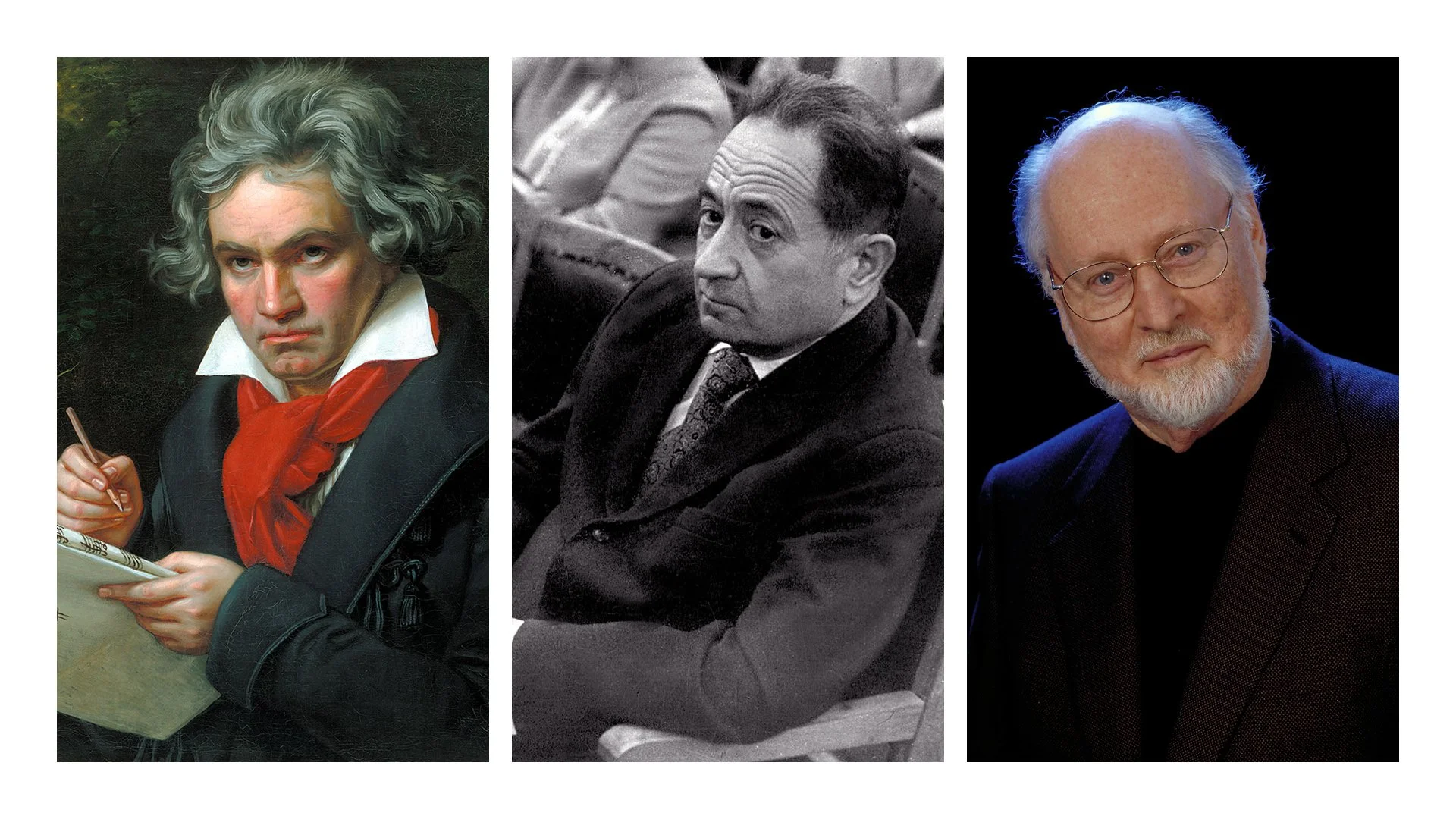
Program Notes: Beethoven & Klebanov
Notes about:
Beethoven: Violin Concerto in D Major
Klebanov: Symphony No. 1
Williams: A Prayer for Peace
Program Notes for November 14 & 15, 2025
Beethoven & Klebanov


Ludwig Van Beethoven (1770-1827)
Concerto in D Major for Violin and Orchestra, Op. 61
Beethoven composed this concerto in 1806, and it was first performed on December 23, 1806, at the Theater-an-der-Wien in Vienna, with Franz Clement as soloist.
Duration: 39 minutes
Background
Beethoven completed his only concerto for violin in 1806, during a burst of creativity that also produced the three “Razumovsky” quartets, the fourth symphony, the “Appassionata” sonata, and the fourth piano concerto. The concerto was written for Franz Clement, a violinist whose association with Beethoven went back to 1794, when Clement was a 14-year-old Wunderkind. The title page dedicates the work to Clement, while noting his “clemency” towards the composer. (Beethoven’s puns were even worse than the normal lot.) The concerto was premiered at a concert that apparently included some pretty flamboyant showmanship. According to a review of the concert in the Wiener Theater-Zeitung, Clement inserted one of his own violin sonatas between the first and second movements of the concerto—a sonata played on one string, with the violin held upside-down! Perhaps because of this blatant showstopper, reviews of the performance were generally disdainful. (The fact that Clement was reportedly sight-reading the concerto may not have helped, either...)
This was not a work that caught on quickly, and it certainly did not follow the fashion of the time. By 1806, audiences were beginning to demand works that displayed astonishing feats of speed and agility: flash over substance. Even as late as 1855, when a young Joseph Joachim played Beethoven’s concerto for the virtuoso Louis Spohr, Spohr’s reaction was: “This is all very nice, but now I’d like you to play a real violin work.” Beethoven’s concerto is more symphonic in scope, focusing on careful development of his broad and profound themes, and brilliant orchestration, instead of empty virtuosity. The concerto finally came into its own in the later 19th century, as players like Joachim confronted the special challenges of Beethoven’s work: thoughtfulness and musical expression.
What You’ll Hear
The first movement (Allegro ma non troppo) begins with five unaccompanied timpani notes that usher in the woodwinds. The orchestral introduction presents the themes that will provide the raw material for the solo violin’s more extensive treatment. At the close of the introduction, the orchestra hushes and allows the opening violin line to burst forth—a flourish that spans the entire range of the instrument. The body of this movement is based on a set of beautiful hymn-like themes. The violin’s expansion of these melodies is never merely flashy decoration, but instead careful development. A lengthy cadenza leads to a final statement of the second main theme.
The Larghetto is certainly one of the most intriguing and expressive of Beethoven’s compositions. Its form has variously been described as “theme and variations,” “semi-variations” and even “strophic.” In a classic essay, Beethoven scholar Owen Jander suggested that the deliberate ambiguities in the overall theme and variations form of the Larghetto reflect a burgeoning Romanticism—that the slow movement is a musical rendering of a poetic dialogue. In fact, the movement proceeds in a gentle but passionate dialogue between the soloist and the orchestra, culminating in a dramatic cadenza that leads directly into the final movement.
The last movement is more typical of Classical style—a spirited 6/8 Rondo. Here, it seems, Beethoven made a slight bow to audience demand and gave the violinist some flashier technical passages. There is a brief minor-key episode at the center, but otherwise the mood of this concerto is exuberant throughout. The concerto closes with an extended coda that gives the violinist one more chance at some soloistic fireworks.
Program Notes ©2025 J. Michael Allsen
Dmitri Klebanov
Symphony No. 1 “In Memoriam Babi Yar”

Dmytro Lvovich Klebanov was born in 1907 to a working-class Jewish family in Kharkiv, Ukraine. A musical prodigy, he enrolled at the Kharkiv Conservatory at age 16, where he would later return as professor of composition (and where he would meet his wife Nina, the conservatory director). His burgeoning reputation as a composer in the Soviet Union in the 1930s speaks to his talent and tenacity at a time when Stalin’s government was targeting and disappearing Ukrainian artists and intellectuals—a period known as the Executed Renaissance.
When the Nazi army invaded Ukraine in 1941, Klebanov and his family, along with thousands of other Soviet Jews, were relocated to Uzbekistan; they returned home in 1944 to find horrific destruction and loss of life, including Klebanov’s brother, a soldier in the Soviet army. With this backdrop, Klebanov immediately began work on his First Symphony, dedicating it to the victims of the September 1941 massacre of nearly 34,000 Jews at the hands of the occupying Nazis at the Babi Yar ravine in Kyiv (some 17 years later, Babi Yar would also be the theme of Dmitri Shostakovich’s Symphony No. 13).
Klebanov’s Symphony No. 1 premiered in 1946 in Kharkiv, and its public success moved it to be submitted for the 1949 Stalin Prize. The score’s arrival in Moscow, however, led not to commendation, but condemnation: Stalin’s cultural authorities connected the symphony’s dedication to its Jewish melodic influences, and claimed that by using such sources, Klebanov had “unpatriotically” and “insolently” dedicated it specifically to Jewish, rather than Soviet, victims of the massacre.
Any additional performances of the symphony were canceled, and Klebanov found himself blacklisted. His wife’s stature as conservatory director likely saved him from deportation or worse, but a ruling by the Union of Soviet Composers stripped him of his titles as Head of the Kharkiv Conservatory’s Composition Department and as Chair of the local Composers’ Union. Klebanov was allowed to remain at his post in Kharkiv, but was he effectively shunned and isolated. He would not hear his symphony again before his death in 1987.
From its first notes, the symphony invokes a curious specter: Beethoven’s famous Ninth Symphony, with its descending fourths and fifths over a rustling bed of tremolando strings. At the same time, this first theme conjures an image of falling, as if into the Babi Yar ravine itself. A gentler, nostalgic second theme is introduced in contrast, based on the opposite motion of a rising fourth.
The Scherzo second movement opens with mysterious celli and basses and soon becomes a rousing, brutal dance in 3/4 time. A romantic arioso theme for the violins opens the middle Trio section, which slowly builds to a raucous climax and settles back to a softer sequence of yearning woodwind solos.
The third movement, a funeral march, recalls the nostalgic second theme of the first movement with its rising fourth, now a dark and somber solo for the bass clarinet. An animated, ferocious middle section summons the first theme of the first movement once again, before a final, grand statement of the Funeral March theme collapses into the most evocative moment of the symphony: the March theme, sung wordlessly by a contralto vocal solo. The ghost of a synagogue cantor, perhaps—a victim of the massacre.
The Finale erupts in a bombastic paraphrase of the Presto Finale of Beethoven’s Ninth, leading to a series of cello-bass recitatives interspersed with recollections of previous movements of the symphony—again, the same architecture as Beethoven’s finale. Klebanov’s recitatives have a singspeak-like intonation that seems to evoke a Hebrew recitation: the Mourner’s Kaddish prayer, perhaps. An English horn solo emulates a shofar, the traditional ram’s horn blown during the Jewish High Holidays.
Klebanov then builds a tightly-constructed fugue, its boisterous subject built around the intervals of the recitative motif, which leads to a reprise of the opening Presto. What follows can only be described as a satire of the Ode to Joy itself, introduced with soft celli and basses in the same way Beethoven presents his famous melody. Klebanov’s mock-Ode theme undergoes a series of dramatic variations before ending up a militaristic trumpet duet punctuated by orchestral cannon fire. The recitative returns, now in an aggressive, off-kilter ostinato, which leads finally to the coda: the return of the first movement “Babi Yar” theme, now rising victoriously as an exuberant brass fanfare, in conversation with the Hebraic recitative in the low voices below.
It does not strain the imagination to interpret these references to Beethoven as an act of defiance against Ukraine’s erstwhile invaders, holding up a mirror to the Germanic music the Nazis once touted as proof of their own superiority while juxtaposing it against Jewish-inspired melodies. “Despite their atrocities against our people,” the subtext might read, “we are still here.”
Program Notes written by Music Director Nicholas Hersh
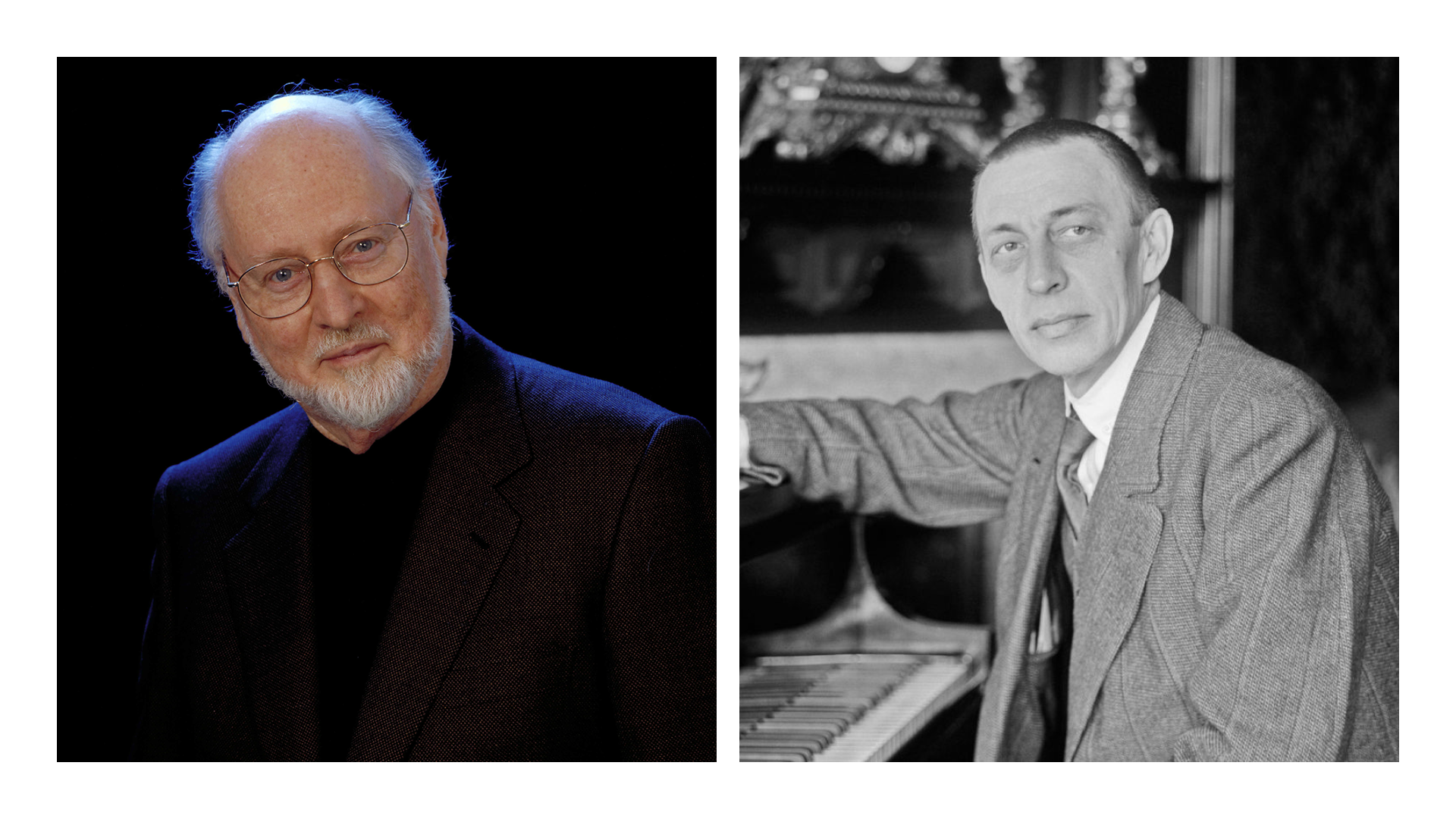
Program Notes: Williams & Rachmaninoff
Notes about:
Williams: Concerto for Cello & Orchestra
Rachmaninoff: Symphony No. 2 in E Minor
Program Notes for October 10 & 11, 2025
Williams & Rachmaninoff

John Williams
Concerto for Cello and Orchestra
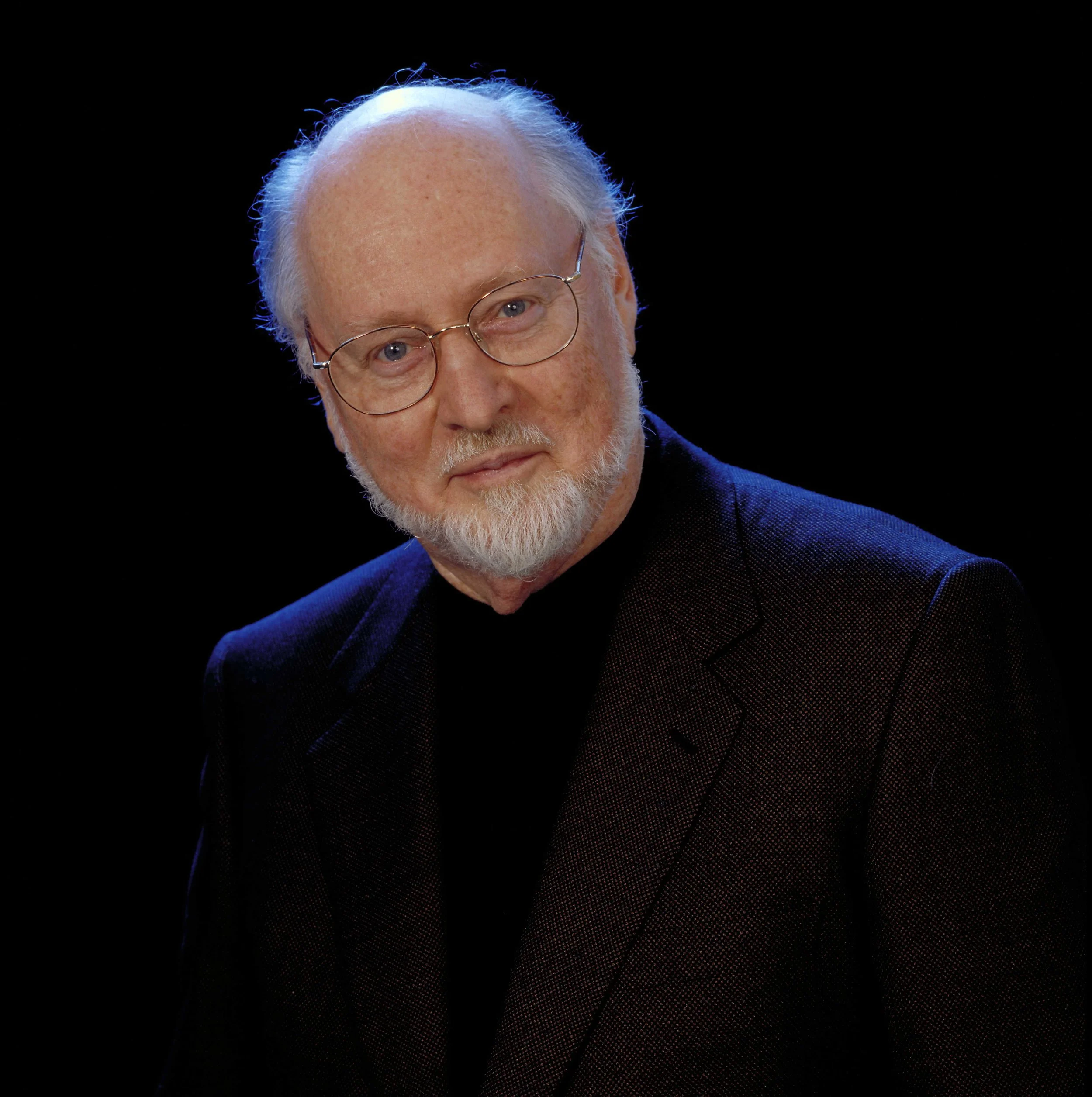
Composer: born February 8, 1932, Flushing, Queens, NY
Work composed: 1993-94. Commissioned by Seiji Ozawa and the Boston Symphony and composed for cellist Yo-Yo Ma.
World premiere: Williams led Yo-Yo Ma and the Boston Symphony on July 7, 1994, at Tanglewood, to mark the opening of Seiji Ozawa Hall.
Instrumentation: solo cello, 3 flutes (1 doubling piccolo), 2 oboes, English horn, 3 clarinets (1 doubling bass clarinet), 2 bassoons, contrabassoon, 4 horns, 3 trumpets, 4 trombones, timpani, bass drum, chimes, glockenspiel, marimba, mark tree, small triangle, suspended cymbal, tam-tam, triangle, tuned drums, vibraphone, harp, piano/celesta, and strings
Estimated duration: 30 minutes
“Music is our oxygen.”
Composer John Williams is synonymous with movie music. He became a household name with the Academy Award-winning score he wrote in 1977 for Star Wars, and he has defined the symphonic Hollywood sound ever since. In addition to the Star Wars films, Williams composed the music for Jaws, the Raiders of the Lost Ark films, Superman, Close Encounters of the Third Kind, E.T., the Jurassic Park films, Schindler’s List, the Harry Potter series, and many other films.
Williams has also composed a considerable body of concert works, including six concertos. Like his scores, Williams’ concert music also features his masterful orchestration and dramatic flourishes, and his concertos are designed to showcase the unique qualities of both the solo instrument and the soloist.
Williams and Ma have been good friends and collaborators for decades. “Given the broad technical and expressive arsenal available in Yo-Yo’s work, planning the concerto was a joy,” Williams writes. “I decided to have four fairly extensive movements that would offer as much variety and contrast as possible but that could be played continuously and without interruption.
“The Theme and Cadenza, after an opening salvo of brass, immediately casts the cello in a kind of hero’s role, making it the unquestioned center of attention. It’s a movement that attempts to put the cello on display in the time-honored sense of ‘concerto,’ and as the hero’s theme is developed, it ‘morphs’ into a cadenza in which I tried to create an opportunity for exploration of the theme that would be both ruminative and virtuosic.
“The second movement I call Blues.… In my mind, and without any conscious prodding on my part, the ghosts of Ellington and Strayhorn seemed to waft through the atmosphere. Invited or not, this was for me very welcome company. I set up clusters in piano and percussion that form a frame within which the cello unveils its misty quasi-improvisations.
“The Scherzo is about speed, deftness, and sleight of hand. The music romps along in triple time over a treacherous landscape where athletic exchanges are periodically and suddenly interrupted by a series of fermatas, as the orchestra and cello try to dominate and outdo each other. There’s a short tutti where it appears that the orchestra might prevail, but the cello outwits and outlasts it.
“In thinking about the finale of the concerto, I was always aware of the fact that Yo-Yo’s ability to ‘connect’ personally and even privately with every individual in his audience is perhaps the greatest of his abundant gifts. I therefore tried in Song, the concerto’s finale, to create long lyrical lines that would give the cello the opportunity to address the audience in the manner of a clear and direct soliloquy.
“Whatever virtues the concerto may have can never surpass, for me, the experience of knowing and working with Yo-Yo Ma. Happily, and with complete justice, the world loves and reveres this man, as do I, and working with him is always a joyous journey to be treasured.”
Sergei Rachmaninoff
Symphony No. 2 in E minor, Op. 27

Composer: born April 1, 1873, Oneg, Russia; died March 28, 1943, Beverly Hills, CA
Work composed: 1906-07. Rachmaninoff dedicated it to his composing teacher, Sergei Taneyev
World premiere: February 7, 1908, in St. Petersburg, with Rachmaninoff conducting
Instrumentation: 3 flutes (1 doubling piccolo), 3 oboes (1 doubling English horn), 2 clarinets, bass clarinet, 2 bassoons, 4 horns, 3 trumpets, 3 trombones, tuba, timpani, bass drum, cymbals, glockenspiel, snare drum, and strings
Estimated duration: 43 minutes
Artists of all types have a love-hate relationship with critics: they need the exposure criticism brings to their work, but often scorn the critiques themselves. Other artists take criticism too much to heart and let it affect them to a debilitating degree, which was the case with Sergei Rachmaninoff. After the premiere of Rachmaninoff’s first symphony, he was so savaged by critics that he did not dare compose a note for three years. Eventually Rachmaninoff consulted a doctor, Nicolai Dahl, who used hypnotism to bolster Rachmaninoff’s flagging confidence. Rachmaninoff’s Second Piano Concerto was dedicated to Dahl, and it vindicated Rachmaninoff as a composer by becoming one of his most popular works.
After the success of the Second Piano Concerto, Rachmaninoff felt ready to tackle another symphony, and in 1906 he began work on his second. The writing was difficult for him, as he reported in a letter to a friend, and the work proceeded slowly. The final version lasted over an hour, although Rachmaninoff later suggested a number of performance cuts that shorten it by as much as 20 minutes; these cuts have become standard when programming this symphony today. Although Rachmaninoff, out of necessity, agreed to the cuts, which amounted to some 300 measures of music, he later confided to conductor Eugene Ormandy, “You don’t know what cuts do to me. It is like cutting a piece out of my heart.” Rachmaninoff might have appreciated the words of one critic, who wrote at the symphony’s premiere, “After listening with unflagging attention to its four movements, one notes with surprise that the hands of the watch have moved sixty-five minutes forward. This may be slightly overlong for the general audience, but how fresh, how beautiful it is!”
The symphony opens with a darkly murmuring theme played by the lower strings, a theme that forms the basis for the remainder of the first movement, as well as much of the rest of the symphony. The violins contrast with a lyrical melody, followed by a plaintive solo for English horn. Throughout this movement, Rachmaninoff uses solo instruments as structural signposts, indicating changes of mood or harmonic foundations.
The horns launch the Scherzo with a bold, energetic theme, and the strings continue with a bouncier, skipping melody. These are contrasted by a series of interludes, one unabashedly romantic, and others feverishly intense. As was his wont in many of his orchestral works, including the Rhapsody on a Theme of Paganini, Rachmaninoff includes the Dies irae melody (Day of Wrath) from the Requiem Mass; it appears here in the coda to the trio.
In the Adagio, Rachmaninoff’s signature romanticism is heard in the violins’ opening melody, which could easily serve as the love song in a cinematic romance. In fact, 1970s pop singer Eric Carmen wrote a hit song based on this theme, “Never Gonna Fall in Love Again.”
For the Finale, Rachmaninoff unleashes a whirlwind of vibrant joy. Buoyant strings recall the Scherzo, but this music is abruptly interrupted by the stark call of muted horns. We then hear snatches of music from previous movements, especially the Scherzo and the Adagio. The strings, playing in the style of the Italian tarantella, are the foundation for this movement, and its energy drives the symphony forward to a triumphant conclusion.
© Elizabeth Schwartz
NOTE: These program notes are published here by the Modesto Symphony Orchestra for its patrons and other interested readers. Any other use is forbidden without specific permission from the author, who may be contacted at www.classicalmusicprogramnotes.com

Program Notes: Verdi's Requiem
Notes about:
Guiseppe Verdi: Requiem Mass (In Memory of Alessandro Manzoni)
Program Notes for May 9 & 10, 2025
Verdi’s Requiem

Giuseppe Verdi
Requiem
Composer: born October 9, 1813, Le Roncole, near Busseto, Italy; died January 27, 1901, Milano
Work composed: Verdi wrote the “Libera me” in 1868, in tribute to Gioachino Rossini. In the summer of 1873, Verdi resumed work on the Requiem, which he completed on April 10, 1874, and dedicated to the memory of Italian poet and patriot Alessandro Manzoni. Verdi’s original title, inscribed in the mss, reads “Requiem Mass for the anniversary of the death of Manzoni, 22 May 1874”
World premiere: Verdi conducted the first performance on May 22, 1874, in the church of St. Marco, Milano, with Teresa Stolz, Maria Waldmann, Giuseppe Capponi, and Ormondo Maini, vocal soloists.
Instrumentation: SATB soloists, four-part chorus, 3 flutes (3rd doubling piccolo), 2 oboes, 2 clarinets, 4 bassoons, 4 horns, 4 trumpets (one offstage), 3 trombones, tuba, timpani, bass drum, and strings.
Estimated duration: 83 minutes
“It was an impulse, or, to put it better, a need from my heart, to honour, as best I could, this great man whom I held in such esteem as a writer, and venerated as a man, and as a model of virtue and patriotism.” – Giuseppe Verdi’s letter to the Mayor of Milan, about the composer’s proposal to write a requiem mass to honor the memory of Italian writer, poet, and patriot Alessandro Manzoni.
“A great name has disappeared from the world! His was the most widespread, the most popular reputation of our time, and it was a glory of Italy! When the other one who still lives [Manzoni] is no more, what will we have left?” These were the words of Giuseppe Verdi upon hearing the news of Gioachino Rossini’s death, in 1868. It was Rossini’s passing that first inspired Verdi to think of composing a Requiem. Just days after Rossini died, Verdi wrote the Italian music publisher Ricordi, proposing a collaborative Requiem written by “the most distinguished Italian composers,” to honor Rossini’s memory. Verdi added many stipulations and conditions to his idea, including the suggestion that everyone involved with the Requiem should help finance it. For a number of reasons – financial, logistical, and political – the proposed Rossini memorial ceremony was shelved, although every composer who was asked to write a movement completed their assigned section on time (The Messa per Rossini did eventually receive a public performance – in 1988).
With the Rossini project scrapped, Verdi turned his creative attention elsewhere. In the years between 1869 and 1873, Verdi busied himself with his opera Aida, a commission from the Egyptian government to commemorate a new Egyptian opera house built to celebrate the 1869 opening of the Suez Canal. As Verdi conducted Aida around Europe, he also composed his E minor String Quartet, his only surviving piece of chamber music.
In the spring of 1873, Ricordi sent Verdi the score to his “Libera me.” A month later, Alessandro Manzoni, one of the most important writers, thinkers, and patriots of 19th-century Italy, died at the age of 88. Verdi, along with most Italians, venerated Manzoni almost to the point of sainthood (Verdi said of Manzoni’s 1827 masterpiece, I promessi sposi (The Betrothed), that it was “not only the greatest book of our epoch, but one of the greatest ever to emerge from a human brain.”) Both men were also deeply committed to the Risorgimento, the decades-long Italian political and social effort to unify all the Italian city-states into one Kingdom of Italy, with Rome as its capital. Verdi was not much given to hero worship generally, but the depth of his feelings for both Manzoni and Manzoni’s impact on Italian culture cannot be exaggerated.
With Manzoni’s death, Verdi returned immediately to the idea of a Requiem Mass to honor a true Italian hero. On June 3, 1873, Verdi wrote to Ricordi, “I too would like to demonstrate what affection and veneration I bore and bear to that Great Man who is no more, and whom Milan has so worthily honored. I would like to set to music a Mass for the Dead to be performed next year on the anniversary of his death. The Mass would have rather vast dimensions, and besides a large orchestra and a large chorus, it would also require … four or five principal singers … I would have the copying of the music done at my expense, and I myself would conduct the performance both at the rehearsals and in church.” Verdi further asked Ricordi to invite the Mayor of Milan to sanction this undertaking. Permission was soon granted, and Verdi quickly set to work.
Verdi’s Requiem, like Johannes Brahms’ Ein Deutsches Requiem, is a personal statement of grief that employs structure and text borrowed from church liturgy. However, neither Verdi nor Brahms was personally devout. For both men, the texts they chose for their respective Requiems served as an expressive outlet for the universal need to convey the emotions that surface when a beloved person dies: grief, loss, sadness, anger, fear of judgment, and the hope of a lasting peace for both the departed and the bereaved. The dramatic, operatic quality of Verdi’s requiem ill-suited it for use as part of a regular church service, and Verdi never intended it to function as liturgy. From the beginning, Verdi conceived his Requiem for performance, not worship.
Conductor Hans von Bülow’s famous remark that the Requiem was “an opera in ecclesiastical costume” was meant as condemnation. However, one can take von Bülow’s words at face value, without the harsh judgment he intended. Certainly no other Requiem comes close to approaching the drama and tension of Verdi’s, and the ebb and flow of emotion it generates parallels the narrative arc of a grand opera. The obvious passion of Verdi’s music, and the operatic vocabulary he employs throughout, need not diminish the Requiem’s impact as a profound articulation of grief. For Verdi, as for his countrymen, the only way to properly mourn Manzoni and pay homage to his unique stature in Italy was through an equally significant, expansive musical statement.
The liturgy of the requiem mass is not standardized; each composer must make specific choices regarding which texts to include. Verdi begins with the standard opening lines, “Requiem aeternam dona eis, Domine” (Grant them eternal rest, O Lord), which the chorus and orchestra intone in hushed, muted phases. The four soloists join the chorus and orchestra for an exuberant “Kyrie eleison” (Lord have mercy), which makes the “Dies irae” that follows all the more terrifying. This music is the most recognizable to audiences, but familiarity cannot dent its powerful impact. The sopranos and tenors sustain a high G while the lower voices, punctuated by a shrill piccolo and a pounding bass drum, warn of the Day of Wrath, when fire shall destroy the earth, according to dire prophecy. A chorus of brasses precedes the bass soloist, who describes the sound of the trumpet that will summon all to judgment. The mezzo-soprano and chorus tell of the Book of Judgment, in which all deeds are recorded, and from which the world cannot escape. The focus shifts from prophecy to first person entreaty, as the soprano, mezzo, and tenor plead in vain for clemency (Who will intercede for me when even the just are unsafe?) The Sequence, which begins with “Dies irae” and ends with “Lacrimosa” (Weeping), covers the full emotional spectrum from abject terror to gentle entreaties for mercy, as the supplicant, on bended knee, acknowledges his/her own unworthiness.
The tender opening of the Offertorio, which features the four soloists, emphasizes the mercy of Christ. Its rocking meter suggests a lullaby, and as the singers describe the “holy light” God promised to Abraham and his descendants, both the vocal and orchestral writing grow more luminous. Verdi expertly delivers us from the pits of hell (low timbres and registers) into the glowing warmth of salvation, and readies us for the untrammeled joy of the Sanctus, with its trumpet fanfare proclaiming “Holy, holy, holy, Lord of Hosts! Heaven and earth are filled with your glory!” In the Agnus Dei, Verdi shifts from extroversion to unadorned unisonal contemplation with minimal orchestral accompaniment, as first the chorus, then the soprano and mezzo sing, “Lamb of God, who takes away the sins of the world, grant them eternal rest.” Verdi ends his Requiem with an agitated soprano intoning the opening lines of “Libera me” (Deliver me, O Lord, from eternal death on that awful day). All the drama of the earlier sections returns, as if Verdi intended to leave us with a sense of uncertainty: will we, in the final analysis, be redeemed? Verdi reprises the music of the “Dies irae,” but eventually, the chorus and soprano end with an almost inaudible whisper, “Libera me. Libera me.”
© Elizabeth Schwartz
NOTE: These program notes are published here by the Modesto Symphony Orchestra for its patrons and other interested readers. Any other use is forbidden without specific permission from the author, who may be contacted at www.classicalmusicprogramnotes.com
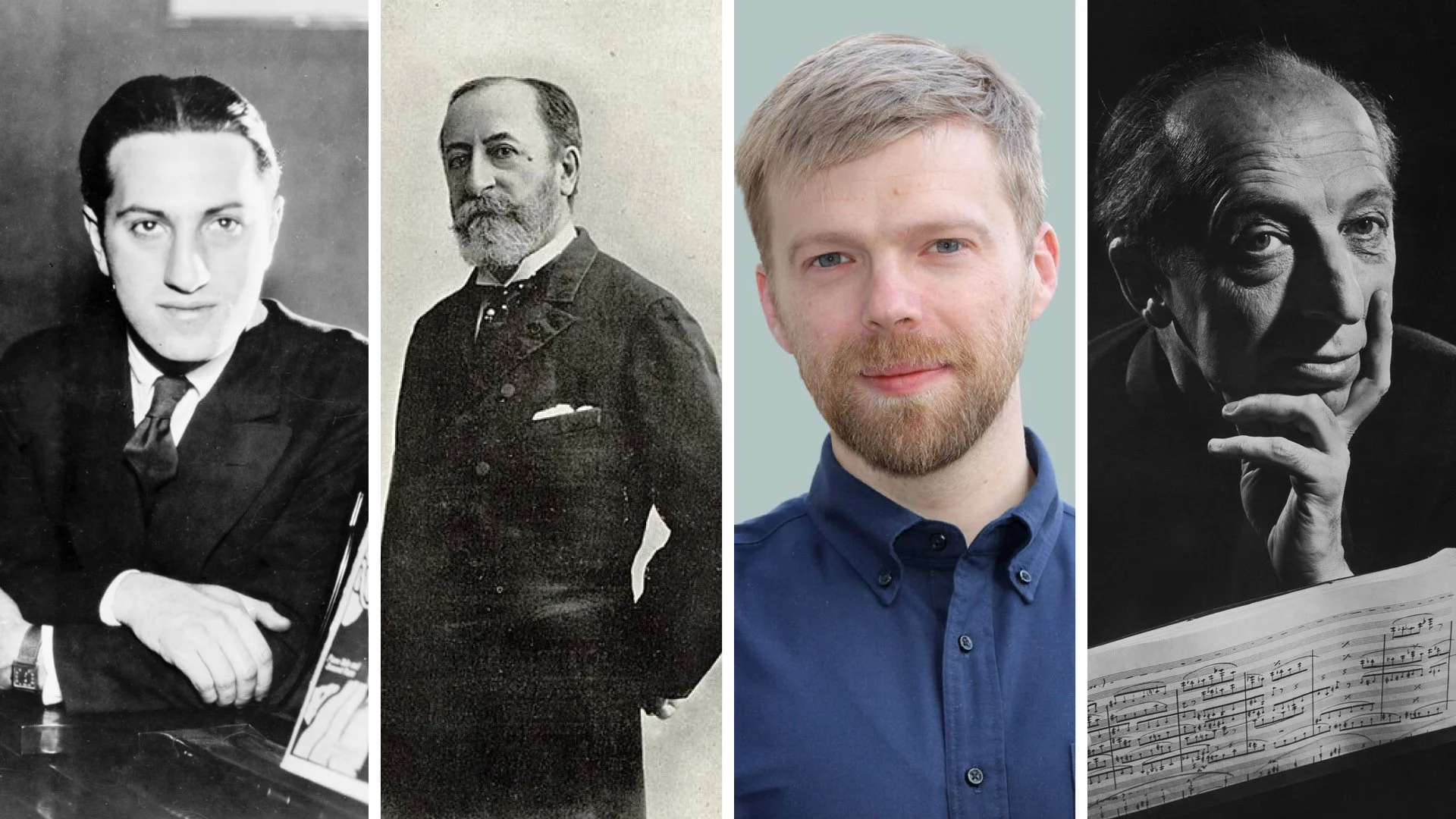
Program Notes: Carnival of the Animals
Notes about:
Gershwin (arr. Hersh): Three Preludes
Saint-Saëns: Carnival of the Animals
Norman: Drip Blip Sparkle Spin Glint Glide Glow Float Flop Chop Pop Shatter Splash
Copland: Four Dance Episodes from Rodeo
Program Notes for April 11 & 12, 2025
Carnival of the Animals

George gershwin
Three Preludes (arr. Hersh)

Composer: born September 26, 1898, Brooklyn, NY; died July 11, 1937, Hollywood, CA
Work composed: 1926, originally for solo piano. Dedicated to Gershwin’s friend and colleague Bill Daly
World premiere: Gershwin performed the three preludes at the Roosevelt Hotel in New York City on December 4, 1926.
Instrumentation: flute, oboe, clarinet, bassoon, 4 horns, trumpet, trombone, timpano, bass drum chime, glockenspiel, snare drum, suspended cymbal, tam-tam, triangle, vibraphone, woodblock, xylophone, and strings
Estimated duration: 6 minutes
After the success of Rhapsody in Blue made George Gershwin a household name, the young composer set himself the daunting task of writing 24 preludes for solo piano. He began early in 1925, but quickly abandoned the project, probably for lack of time. Between January 1925 and the premiere of Gershwin’s three preludes in December 1926, the composer wrote no less than four Broadway shows, made two trips to Europe, and composed and performed his Concerto in F with the New York Philharmonic.
These three concise, highly atmospheric pieces have become favorites with both musicians and audiences since their premiere. Arrangements for small orchestra, solo instruments and piano, particularly for violin, clarinet, and other winds, have proved as popular as Gershwin’s original versions. The first prelude centers on a distinctive blue note theme set to a syncopated jazz rhythm. Gershwin described the second prelude as “a sort of blues lullaby;” its languid melody suggests both fatigue and melancholy. The third piece, which Gershwin referred to as “the Spanish prelude,” combines a striking offbeat rhythmic motif with jazz-flavored melodies.
Camille Saint-saËns
Canival of the Animals

Composer: born October 9, 1835, Paris; died December 16, 1921, Algiers
Work composed: February 1886
World premiere: March 3, 1886, in a private concert hosted by cellist Charles Lebouc in Paris.
Instrumentation: 2 solo pianos, flute (doubling piccolo), clarinet, glass harmonica (or glockenspiel), xylophone, and strings
Estimated duration: 22 minutes
Camille Saint-Saëns occupies a pivotal place in the history of French music. His numerous compositions include works in every genre, and, stylistically, his music bridges the gap between Berlioz and Debussy. (Before Saint-Saëns, 19th-century French music was virtually synonymous with opera; Berlioz’ Symphonie fantastique is a notable, but isolated, exception.)
Through his many instrumental works, Saint-Saëns expanded the boundaries of French music to include a broad array of orchestral and chamber works, thus raising the profile of French music internationally.
Saint-Saëns wanted his music to outlive him, and to be remembered as a significant composer. Ironically, he is best known today for his Carnival of the Animals, a satirical “witty fantasy burlesque,” in the words of a colleague, and one he refused to have published during his lifetime, fearing it would tarnish his reputation as a writer of “serious” music. (Interestingly, Saint-Saëns also stipulated in his will that Carnival be published after his death; Durand brought out the first edition in 1922). Originally written for two pianos and chamber ensemble, Carnival of the Animals has delighted children and adults for more than a century. Excerpts from Carnival have also entered popular culture through classic cartoons, films, and television commercials.
In 1885, Saint-Saëns embarked on an extensive concert tour of Germany, but his well-publicized negative opinions on the music of Richard Wagner enraged German audiences, and many of Saint-Saëns scheduled concerts were abruptly cancelled. In January 1886, Saint-Saëns took himself off to an out-of-the-way Austrian village to rest and recover. While there, Saint-Saëns amused himself by writing a humorous, satirical suite, each movement depicting a different animal.
Musical jokes and well-known quotations from other works appear throughout Carnival, which opens with a glittering tremolo of an Introduction that gives way to the magisterial Royal March of the Lion, music befitting the all-powerful King of the Jungle. Saint-Saëns effectively captures the hither-and-thither bustle of Hens and Roosters darting about, pecking at seeds on the ground while the clarinet squawks the rooster’s crow. Both pianists execute a headlong gallop up and down the keyboard as Wild Donkeys race past. Saint-Saëns pokes fun at the Tortoises’ sluggish pace with a slowed-down-to-a-crawl version of the famous high-stepping theme of the French Can-Can. The Elephant waltzes to a gently lumbering tune in the double basses, accompanied by delicate flourishes from the pianos. The pianos jumping chords depict Kangaroos hopping here and there, pausing now and then to look around. In The Aquarium, lissome fishes swim through sun-dappled water, while the strings’ flowing melody hints at mysterious underwater realms, accented by sharp pings of the glockenspiel and the pianos’ sinuous accompaniment.
The bray of Donkeys is featured in the brief Characters With Long Ears. Next, the pianos establish a quiet forest scene for The Cuckoo, whose characteristic call is sounded by the clarinet. Flocks of colorful tuneful birds surround us in The Aviary, as the flute’s nimble fluttering evokes their breathless flights. In the original score, Saint-Saëns tells the Pianists to “imitate the hesitant style and awkwardness of a beginner,” as they play a series of tedious scales and other practice exercises. In Fossils, the only non-living animals in the Carnival, Saint-Saëns borrows from his own Danse macabre to portray Fossils dancing to the metallic staccato sound of the xylophone. Quotes from other well-known tunes including “Twinkle, Twinkle, Little Star,” the French children’s song “Au clair de la lune,” and a quick nod to an aria from Rossini’s Barber of Seville are also featured.
The Swan is the only movement from Carnival that Saint-Saëns allowed to be published during his lifetime, in an arrangement for piano and cello. The piano’s graceful, understated arpeggios support the cello’s fluid unbroken melody as the swan glides with seeming effortlessness over the waters of a still pond.
In the joyful Finale, Saint-Saëns reprises snippets from previous movements, as the animals celebrate. True to form, the Donkeys have the last word, hee-hawing the Carnival to a close.
When Carnival was published and publicly performed after Saint-Saëns death, it was hailed by all as an unqualified delight. The newspaper Le Figaro’s review was typical: “We cannot describe the cries of admiring joy let loose by an enthusiastic public. In the immense oeuvre of Camille Saint-Saëns, The Carnival of the Animals is certainly one of his magnificent masterpieces. From the first note to the last it is an uninterrupted outpouring of a spirit of the highest and noblest comedy. In every bar, at every point, there are unexpected and irresistible finds. Themes, whimsical ideas, instrumentation compete with buffoonery, grace and science …”
Andrew Norman
Drip, Blip, Sparkle, Spin, Glint, Glide, Glow, Float, Flop, Chop, Pop, Shatter, Splash

Composer: born October 31, 1979, Grand Rapids, MI
Work composed: Commissioned by the Minnesota Orchestra for their Young People’s Concert Series in 2005.
World premiere: Bill Schrickel led the Minnesota Orchestra in the premiere on November 2, 2005, in Orchestra Hall, Minneapolis, MN.
Instrumentation: piccolo, 2 flutes, 2 oboes, 3 clarinets, 2 bassoons, 4 horns, 3 trumpets, 3 trombones, tuba, timpani, brake drum, crotales, ratchet, snare drum, slapstick, tambourine, tam-tam, triangle, vibraphone, woodblock, xylophone, piano and strings
Estimated duration: 4 minutes
Andrew Norman is a composer, educator, and advocate for the music of others. Praised as “the leading American composer of his generation” by the Los Angeles Times, and “one of the most gifted and respected composers of his generation” by the New York Times, Norman has established himself as a significant voice in American classical music.
Norman’s music often takes inspiration from architectural structures and visual cues. His music draws on an eclectic mix of instrumental sounds and notational practices, and it has been cited in the New York Times for its “daring juxtapositions and dazzling colors,” and in the Los Angeles Times for its “Chaplinesque” wit.
Drip, Blip, Sparkle, Spin, Glint, Glide, Glow, Float, Flop, Chop, Pop, Shatter, Splash was conceived as a “get-to-know-you” piece to introduce young listeners to the multifaceted sounds of the orchestra. “The process of writing it was a bit like making a tossed salad,” says Norman. “I chopped up sounds from the orchestra – one sound for each of the thirteen verbs in the title – and then I tossed them all together and called it a piece.”
The four-minute work whizzes by with the hyperkinetic energy of a Tom & Jerry cartoon. Each word of the title is delightfully and recognizably embodied by myriad, disparate sounds, from a battery of percussion instruments to muted brasses to bows playing col legno (on the wood) and a single woodblock ticking with anticipatory hold-your-breath excitement. Audience members should note that the verbs of the title are not necessarily depicted in order, but are encouraged to identify each one nonetheless.
aaron copland
Four Dance Episodes from Rodeo

Composer: born November 14, 1900, Brooklyn, NY; died December 2, 1990, North Tarrytown, NY
Work composed: The ballet Rodeo, from which this suite of dances is adapted, was commissioned in 1942, by the Ballet Russe de Monte Carlo, with choreography by Agnes de Mille. Shortly after its premiere in October 1942, Copland arranged the Four Dance Episodes for orchestra.
World premiere: Alexander Smallens led the New York Philharmonic at the Stadium Concerts in July 1943
Instrumentation: 3 flutes (2 doubling piccolo), 2 oboes, English horn, 2 clarinets, bass clarinet, 2 bassoons, 4 horns, 3 trumpets, 3 trombones, tuba, timpani, bass drum, cymbals, orchestra bells, slapstick, snare drum, triangle, wood block, xylophone, harp, piano, celesta, and strings.
Estimated duration: 18 minutes
When choreographer Agnes de Mille approached Aaron Copland about collaborating on a new “cowboy ballet,” Copland was less than enthusiastic. Copland’s 1938 ballet about the outlaw Billy the Kid had already given the composer the opportunity to explore Western musical themes in his work, and he saw de Mille’s project as more of the same. But de Mille, then a young and largely unknown choreographer, convinced the skeptical Copland her ballet was sufficiently different from Billy the Kid – a basic, universally appealing story set against the epic sweep of the American West – and Copland eventually agreed.
De Mille’s scenario featured a tomboyish Cowgirl from Burnt Ranch who shows up the ranch hands by out-lassoing them while roping bucking broncos. She is drawn to the Head Wrangler, who takes little notice of her, despite her obvious skills as a cowboy, until she puts on a pretty dress and makes eyes at him at the Saturday night barn dance.
As he did in Billy the Kid, Copland makes use of several authentic cowboy songs. After a high-energy brass introduction, Buckaroo Holiday features the song “If He Be a Buckaroo by His Trade,” (trombone solo approximately halfway through the movement). In the gentle Corral Nocturne, Copland quotes the song “Sis Joe” (about a train named Sis Joe heading for California’s Gold Rush country). By slowing down the song’s usual tempo, Copland creates an intimate, wistful interlude that captures the Cowgirl’s loneliness. The relaxed, low-key Saturday Night Waltz features a famous cowboy song, “I Ride An Old Paint. Hoe Down is the most recognized movement from Rodeo, thanks to its use in a popular commercial advertising American beef. In the final scene of the ballet, at a boisterous hoe-down, the cowgirl appears in a party dress, and the cowboys finally notice her. After a rhythmic introduction, “Bonaparte’s Retreat,” “McLeod’s Reel,” and other square dances fill the air with foot-stomping, thigh-slapping tunes.
© Elizabeth Schwartz
NOTE: These program notes are published here by the Modesto Symphony Orchestra for its patrons and other interested readers. Any other use is forbidden without specific permission from the author, who may be contacted at www.classicalmusicprogramnotes.com
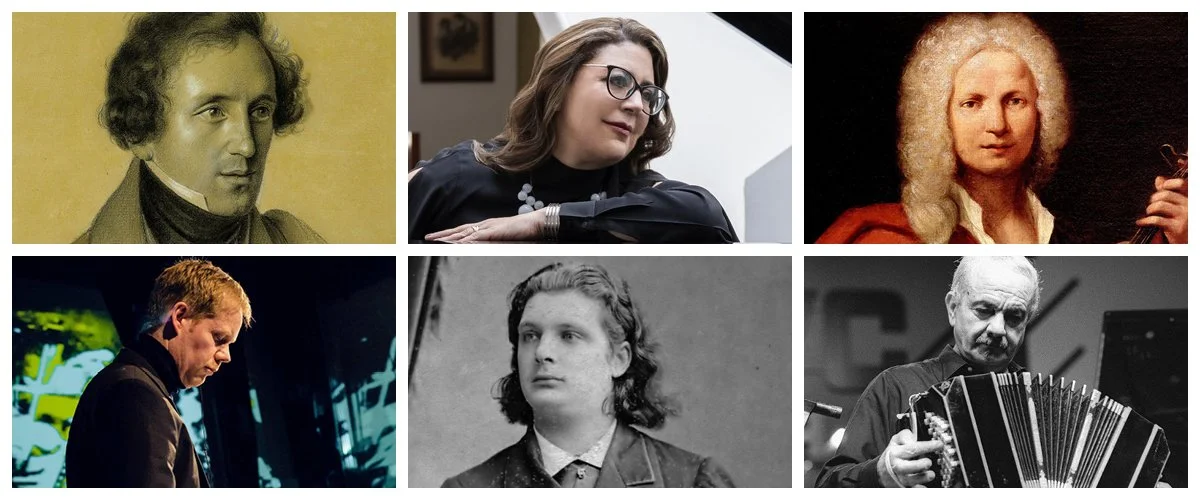
Program Notes: The Four Seasons Mixtape
Notes about:
Mendelssohn’s Overture from A Midsummer Night’s Dream
Ortiz’s La Calaca for String Orchestra
The Four Seasons Mixtape:
Vivaldi’s L’estate (Summer)
Richter’s Autumn from The Four Seasons Recomposed
Ysaÿe’s Chant d’hiver (Wintersong)
Piazzolla’s Primavera portena (Beunos Aires Spring)
Program Notes for November 1 & 2, 2024
The Four Seasons Mixtape

Felix Mendelssohn
Overture to A Midsummer Night’s Dream, Op. 21

Composer: born February 3, 1809, Hamburg; died November 4, 1847, Leipzig
Work composed: 1826
World premiere: Mendelssohn’s first version of the Overture was a two-piano arrangement for himself and his sister Fanny, which they premiered at their home in Berlin on November 19, 1826, for their piano teacher, Ignaz Moscheles. After that performance, Mendelssohn scored the work for orchestra and conducted the first performance of the orchestral version himself the following February in the city of Stettin.
Instrumentation: 2 flutes, 2 oboes, 2 clarinets, 2 bassoons, 2 horns, 2 trumpets, tuba, timpani, and strings.
Estimated duration: 11 minutes
In July 1826, Felix Mendelssohn began composing what would become one of his most enduring works. Immediately upon its completion, the Overture to A Midsummer Night’s Dream established the 17-year-old Mendelssohn as a composer of depth and astonishing maturity.
Young Felix and his family were ardent fans of Shakespeare, whose works had been translated into German in 1790. Mendelssohn’s grandfather Moses had read the plays in English and had attempted some translations of his own, including bits from A Midsummer Night’s Dream. Felix and his older sister, the equally talented Fanny, immediately took to the fanciful play and staged a series of at-home performances, each child playing multiple roles. In a letter to their sister Rebecka some years after the Overture was composed, Fanny wrote, “Yesterday we were thinking about how the Midsummer Night’s Dream has always been such an inseparable part of our household, how we read all the different roles at various ages, from Peaseblossom to Hermia and Helena … We have really grown up together with the Midsummer Night’s Dream, and Felix, in particular, has made it his own.”
Much more than a simple introduction, Mendelssohn’s Overture to A Midsummer Night’s Dream serves as the perfect musical description of Shakespeare’s play, which was Mendelssohn’s intention. He thought of the work as a kind of mini-tone poem, rather than a musical prologue to the play itself. In just twelve minutes, Mendelssohn captures the airy magic that imbues the story: the opening chords representing the enchanted forest; the lissome, iridescent violin passages evoking fairies fluttering here and there; the alternately affectionate and turbulent encounters among the four lovers; the dismaying bray of Bottom after he is transformed into a donkey. It is a stunning achievement for a composer of any age.
While he was at work on the Overture, Mendelssohn played violin in an orchestra that performed the overture to Carl Maria von Weber’s opera Oberon. In a letter to his father and sister, Mendelssohn sketched out several of its themes, all musical representations of ideas from the opera’s libretto. This experience suggested to Mendelssohn that he intertwine recurring motifs into his own Overture that would, in his words, “weave like delicate threads throughout the whole.”
Gabriela Ortiz
La Calaca for String Orchestra (The Skull)

Composer: born December 20, 1964, Mexico City
Work composed: originally the final movement of Altar de Muertos, a string quartet written for and commissioned by the Kronos Quartet in 1996-97. Arranged for string orchestra in 2021
World premiere: John Adams led the Los Angeles Chamber Orchestra at Libbey Bowl in Ojai, CA, on September 19, 2021.
Instrumentation: string orchestra
Estimated duration: 10 minutes
Born into a musical family, Gabriela Ortiz has always felt she didn’t choose music – music chose her. Her parents were founding members of the group Los Folkloristas, a renowned music ensemble dedicated to performing Latin American folk music. Growing up in cosmopolitan Mexico City, Ortiz’s music education was multifaceted; she played charango and guitar with Los Folkloristas while also studying classical piano. Later, Ortiz was mentored in composition by renowned Mexican composers Mario Lavista, Julio Estrada, Federico Ibarra, and Daniel Catán. Ortiz continued her studies in Europe, earning a doctorate in composition and electronic music from London’s City University under the guidance of Simon Emmerson.
Ortiz’s music incorporates seemingly disparate musical worlds, from traditional and popular idioms to avant-garde techniques and multimedia works. This is, perhaps, the most salient characteristic of her oeuvre: an ingenious merging of distinct sonic worlds. While Ortiz continues to draw inspiration from Mexican subjects, she is interested in composing music that speaks to international audiences.
Conductor Gustavo Dudamel, a longtime champion of Ortiz’s music, stated: “Gabriela is one of the most talented composers in the world – not only in Mexico, not only in our continent – in the world. Her ability to bring colors, to bring rhythm and harmonies that connect with you is something beautiful, something unique.” Under Dudamel’s direction, the Los Angeles Philharmonic has commissioned and premiered seven works by Ortiz in recent years, including her ballet Revolución diamantina (2023), her violin concerto Altar de Cuerda (2021), and Kauyumari (2021) for orchestra. These three works are featured on the album Revolución diamantina, which was released in June 2024.
La Calaca began as the final movement of Altar de Muertos (Altar of the Dead), a string quartet commissioned by the Kronos Quartet. Altar de Muertos reflects the traditions and festivities of the Day of the Dead. Ortiz writes, “The tradition of the Day of the Dead festivities in Mexico is the source of inspiration for the creation of a work for string quartet whose ideas could reflect the internal search between the real and the magic, a duality always present in Mexican culture, from the past to this present.”
Each movement of Altar embodies the “diverse moods, traditions and the spiritual worlds which shape the global concept of death in Mexico, plus my own personal concept of death,” Ortiz explains. In La Calaca, the music expresses “Syncretism [in religion, the practice of merging beliefs and rituals from disparate traditions] and the concept of death in modern Mexico, chaos and the richness of multiple symbols, where the duality of life is always present: sacred and profane; good and evil; night and day; joy and sorrow. This movement reflects a musical world full of joy, vitality, and a great expressive force. At the end of La Calaca I decided to quote a melody of Huichol origin, which attracted me when I first heard it. That melody was sung by Familia de la Cruz. The Huichol culture lives in the State of Nayarit, Mexico. Their musical art is always found in ceremonial and ritual life.”
The Four Seasons Mixtape
“A mixtape, harkening back to the days of holding a cassette recorder up to the radio, has come into the modern lexicon as a compilation of different musical selections, often from different artists or composers, and usually evoking some similar mood or subject matter,” writes Modesto Symphony Orchestra’s Music Director Nicholas Hersh. “In fact, Vivaldi’s Four Seasons is perhaps an early representation of this concept: a set of four violin concerti, each of which can be performed separately, but when taken together they form a greater narrative. Our MSO ‘Four Seasons Mixtape’ takes this a step further by assigning each season to a different composer. Vivaldi’s original Summer sets the tone, and Max Richter’s Autumn [Recomposed] follows it up with a ‘remix’ of the Baroque sound with modern harmony and syncopation. Belgian violin virtuoso Eugene Ysaÿe’s Wintersong imparts a Romantic sumptuousness to an otherwise bleak season, and finally Astor Piazzolla takes us home with his uproarious Buenos Aires Spring, infused with the rhythms of the Tango.
“It is no easy feat to perform such wildly different musical styles as part of the same whole, and I am so grateful to Audrey Wright for realizing this Mixtape with us!”
Antonio Vivaldi
“L’estate” (Summer) from The Four Seasons for Violin and Orchestra, Op. 8 No 2

Composer: born March 4, 1678, Venice; died July 27/28, 1741, Vienna
Work composed: published 1725. Dedicated to Count Wenceslas Morzin.
World premiere: undocumented
Instrumentation: solo violin, continuo, and strings
Estimated duration: 11.5 minutes
Antonio Vivaldi’s The Four Seasons are some of the most recognizable and most performed Baroque works ever written. They have also been used by numerous companies to sell products, from diamonds to high-end cars to computers. With that level of exposure, it is easy to assume we “know” The Four Seasons, but there is more to these concertos than meets the eye, or the ear.
The Four Seasons are part of a larger collection of concertos Vivaldi titled Il cimento dell’armonia e dell’inventione (The contest between harmony and invention). Each concerto is accompanied by a sonnet, possibly written by Vivaldi himself, which gives specific descriptions of the music as it unfolds.
Summer’s slow introduction evokes a hot, humid summer day: “Under the merciless summer sun languishes man and flock; the pine tree burns … ” Lethargic birdcalls are abruptly interrupted by violent thunderstorms. In the slow movement, the soloist (shepherd) cries out in fear for his flock in the blistering heat. While he laments, the ensemble becomes buzzing flies. The final movement morphs into a tremendous hailstorm that destroys the crops.
Max Richter
“Autumn” from The Four Seasons Recomposed

Composer: born March 22, 1966, Hamelin, Lower Saxony, West Germany
Work composed: 2011-12
World premiere: André de Ridder led the Britten Sinfonietta with violinist Daniel Hope at the Barbican Centre on October 31, 2012, in London.
Instrumentation: solo violin and strings
Estimated duration: 8 minutes
Max Richter’s fusion of classical music and electronic technology, as heard in his genre-defining solo albums and numerous scores for film, TV, dance, art, and fashion, has blazed a trail for a generation of musicians.
In 2011, the recording label Deutsche Grammophon invited Richter to join its acclaimed Recomposed series, in which contemporary artists are invited to re-work a traditional piece of music. Richter chose Antonio Vivaldi’s The Four Seasons. In a 2014 interview with the website Classic FM, Richter explained, “When I was a young child I fell in love with Vivaldi’s original, but over the years, hearing it principally in shopping centres, advertising jingles, on telephone hold systems and similar places, I stopped being able to hear it as music; it had become an irritant – much to my dismay! So I set out to try to find a new way to engage with this wonderful material, by writing through it anew – similarly to how scribes once illuminated manuscripts – and thus rediscovering it for myself. I deliberately didn’t want to give it a modernist imprint but to remain in sympathy and in keeping with Vivaldi’s own musical language.”
“ … The key thing for me to figure out when navigating through this material was just how much Vivaldi and how much me was happening at any point,” Richter continued. “Three quarters of the notes in the new score are mine, but that is not the whole story. Vivaldi’s DNA is omnipresent in the work, and trying to take that into account at all times was the key challenge for me.”
Richter’s version of “Autumn” inserts syncopations (rhythmic off-beats) and subtle electronics into Vivaldi’s original music; the overall effect blurs the boundaries between which phrases are Vivaldi’s and which are Richter’s to a remarkable degree. “I’ve used electronics in several movements, subtle, almost inaudible things to do with the bass,” says Richter, “but I wanted certain moments to connect to the whole electronic universe that is so much part of our musical language today.”
During the recording sessions for Richter’s Recomposed Four Seasons, the composer adds, “In the second movement of ‘Autumn,’ I asked the harpsichordist Raphael Alpermann to play in what is a rather old-fashioned way, very regularly, rather like a ticking clock. That was partly because I didn’t want the harpsichord part to be attention-seeking, but also because that style connects to various pop records from the 1970s where the harpsichord or Clavinet was featured, including various Beach Boys albums and the Beatles’ Abbey Road.”
Eugène Ysaÿe
Chant d’hiver (Winter Song)

Composer: born July 16, 1858, Liège, Belgium; died May 12, 1931, Liège
Work composed: 1902
World premiere: undocumented
Instrumentation: solo violin, 2 flutes, 2 oboes, 2 clarinets, 2 bassoons, 2 horns, timpani, and strings
Estimated duration: 12.5 minutes
Known during his lifetime as “The King of the Violin,” Eugène Ysaÿe was also a noted composer and conductor. Born 18 years after the death of the legendary Italian violinist Niccolò Paganini, the Belgian virtuoso was – and is – widely considered the greatest violinist of his time. This opinion was shared by the foremost composers of the latter 19th – and early 20th-century, including Claude Debussy, Ernest Chausson, Gabriel Faurè, and fellow Belgian César Franck, all of whom dedicated works to Ysaÿe.
Ysaÿe’s Chant d’hiver was inspired by a famous poem from medieval French poet François Villon (c.1431-after 1463). The poem, known in English as “Ballad of the Ladies of Bygone Times,” features a wistful refrain, “But where are the snows of yesteryear?” The exquisite melancholy of the soloist’s long phrases and the orchestra’s deft accompaniment evoke an air of longing – and also captures the quintessentially Romantic situation in which one is sad while simultaneously finding an odd pleasure in it.
Astor Piazzolla
“Primavera porteña” from Cuatro estaciones porteñas de Buenos Aires (“Spring” from The Four Seasons of Buenos Aires)

Composer: born March 11, 1921, Mar del Plata, Argentina; died July 5, 1992, Buenos Aires
Work composed: Piazzolla originally composed the Cuatro estaciones porteñas de Buenos Aires for Melenita de oro, a play by his countryman, Alberto Rodríguez Muñoz. The movements were written individually, between the years 1965 -1970, and Piazzolla did not originally intend them to be performed as a single work. The original version of Cuatro estaciones is scored for Piazzolla’s quintet, which consisted of violin, electric guitar, piano, bass, and bandóneon (a large button accordion). Tonight’s arrangement, for solo violin and string orchestra, was created in 1999 by Leonid Desyatnikov for violinist Gidon Kremer.
World premiere: Piazzolla and his quintet played the Cuatro estaciones for the first time at the Teatro Regina in Buenos Aires, on May 19, 1970.
Instrumentation: solo violin and strings
Estimated duration: 5 minutes
“For me, tango was always for the ear rather than the feet.” – Astor Piazzolla
Astor Piazzolla and tango are inseparably linked. He took a dance from the back rooms of Argentinean brothels and blurred the lines between popular and “art” music to such an extent that such categories no longer apply.
In the mid-1950s, Piazzolla went to Paris to study with Nadia Boulanger, one of the 20th century’s most renowned composition teachers. She was unimpressed with the scores he showed her but, after insisting he play her some of his own tangos, she declared, “Astor, this is beautiful. I like it a lot. Here is the true Piazzolla – do not ever leave him.” Piazzolla later called this “the great revelation of my musical life,” and followed Boulanger’s advice. He took tango’s raw passion and fire, with its powerful rhythms and edgy melodies, and made it an essential part of classical repertoire.
The version of the Cuatro estaciones porteñas de Buenos Aires heard on tonight’s program was created in 1999 by Russian composer/arranger Leonid Desyatnikov, at the request of violinist Gidon Kremer. Desyatnikov not only arranged Cuatro estaciones, but also inserted quotes from Antonio Vivaldi’s Four Seasons into Piazzolla’s music.
Tango’s musical style requires several string techniques not often heard in classical music: wailing glissandos, sharp pizzicatos that threaten to break strings, bouncing harmonics and, in particular, a harsh, scratchy, distinctly “un-pretty” manner of bowing, sometimes using the wood, rather than the hair, of the bow.
© Elizabeth Schwartz
NOTE: These program notes are published here by the Modesto Symphony Orchestra for its patrons and other interested readers. Any other use is forbidden without specific permission from the author, who may be contacted at www.classicalmusicprogramnotes.com
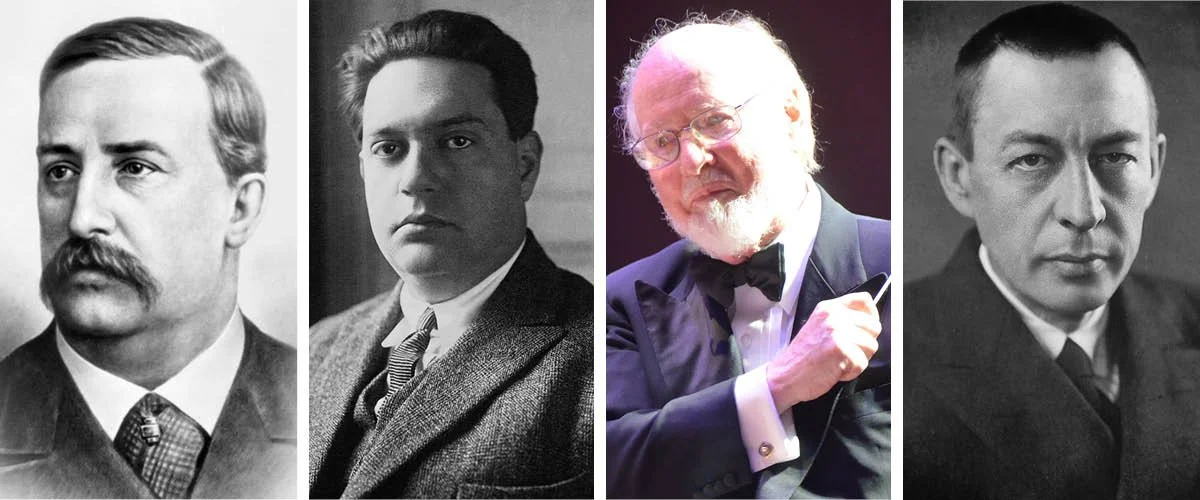
Program Notes: Branford Marsalis with the Modesto Symphony Orchestra
Notes about:
Borodin's “Polovtsian Dances” from Prince Igor
Milhaud’s Scaramouche, Op. 165
Williams' “Escapades” from Catch Me If You Can
Rachmaninoff’s Symphonic Dances for Large Orchestra, Op. 45
Program Notes for october 5th, 2024
Branford Marsalis with the
Modesto Symphony Orchestra

Alexander Borodin
“Polovtsian Dances” from Prince Igor

Composer: born November 12, 1833, St. Petersburg; died February 27, 1887, St. Petersburg
Work composed: Borodin worked on Prince Igor from 1869-1874 and intermittently thereafter, but it remained uncompleted at the time of his death. Borodin’s friend and colleague, Nikolai Rimsky-Korsakov, orchestrated the Polovtsian Dances.
World premiere: Eduard Nápravnik led the first performance of Prince Igor on November 16, 1890, at the Mariinsky Theatre in St. Petersburg
Instrumentation: piccolo, 2 flutes, 2 oboes (1 doubling English horn), 2 clarinets, 2 bassoons, 4 horns, 2 trumpets, 3 trombones, tuba, timpani, bass drum, cymbals, glockenspiel, snare drum, suspended cymbal, tambourine, triangle, harp, and strings
Estimated duration: 14 minutes
Alexander Borodin, like the other members of the Kucha, or Mighty Five, wrote music in his spare time. (A music critic coined the nickname “The Kucha” in reference to a group of influential 19th century Russian composers based in St. Petersburg. In addition to Borodin, the group included Mily Balakirev, César Cui, Modest Mussorgsky, and Nikolai Rimsky-Korsakov). A chemist by profession, Borodin made significant contributions to both his profession and his avocation.
The Kucha aspired to create authentically Russian music, free from the domination of German aesthetics. To this end, the Kucha featured indigenous folk songs and dances from different regions of the Russian empire.
Borodin employed folk dance tunes most effectively in his unfinished opera Prince Igor, the tale of 12th-century prince Igor Sviatoslavich’s failed attempt to stop the invasion of the Polovtsian Tatars in 1185. In the opera’s second act, Igor and his son are captured and held in the Polovtsian military camp. To pass the time, the Polovtsians sing and dance for the captive Russians.
The opera Prince Igor has had a fitful performance history, but the ballet sequence known as the “Polovtsian Dances” quickly became a stand-alone orchestral piece, and Borodin’s most popular and most performed music.
In 1953, the Tony award-winning musical Kismet debuted on Broadway; two years later, MGM adapted it for film. Much of the music from Kismet was derived from Borodin’s music, including the “Polovtsian Dances,” and both musical and film versions introduced Borodin to new audiences. One of Borodin’s most unforgettable melodies became Kismet’s signature hit song, “Stranger in Paradise.”
Darius Milhaud
Scaramouche, Op. 165

Composer: born September 4, 1892, Marseilles; died June 22, 1974, Geneva
Work composed: 1935-37. Originally written for two pianos. Milhaud subsequently arranged Scaramouche for alto saxophone and orchestra. At Benny Goodman’s request, Milhaud also produced a version for clarinet and orchestra.
World premiere: 1937, at the Paris International Exposition.
Instrumentation: solo alto saxophone, 2 flutes (1 doubling piccolo), 2 oboes, 2 clarinets, 2 bassoons, 2 horns, 2 trumpets, 2 trombones, bass drum, castanets, cymbals, snare drum, and strings
Estimated duration: 11 minutes
In 1937, French pianist Marguerite Long asked her friend and colleague Darius Milhaud to compose a two-piano duet for her students to perform at the Paris International Exposition. Milhaud complied, repurposing some music he had written for a production of Moliere’s play Le médecin volant (The Flying Doctor) for the first and third movements. The central slow section of Scaramouche is another recycled work, an overture Milhaud wrote in 1936 for a French play based on the life of Simón Bolívar. (Milhaud, fascinated by the life of the man South Americans nicknamed “El Libertador,” also made Bolívar the subject of his third opera. However, none of the music Milhaud wrote for the play, including the excerpt that became the second movement of Scaramouche, ended up in the opera).
Scaramouche, one of the central characters from Renaissance Italy’s Commedia dell’arte, is most often portrayed as clown who specializes in pranks. Although the music for Milhaud’s Scaramouche derives from previously composed works, the ebullience and merriment of Scaramouche’s character permeates the music, particularly the final movement, in which infectious Brazilian samba rhythms support a delightfully cheeky melody.
Composers are not always the best judges of their own work. Camille Saint-Saëns refused to allow Carnival of the Animals to be published during his lifetime, because he didn’t want his reputation as a serious composer tarnished by what he considered a musical trifle. Today, of course, Carnival of the Animals is Saint-Saëns’ most performed and best-known works, and it has been delighting audiences for more than 100 years. Similarly, Milhaud thought little of Scaramouche, and urged his publisher to ignore it. Fortunately, the publisher did not listen to his client, and Scaramouche became immensely popular. Today it is one of the most-performed piano duets in the repertoire, and its many arrangements for soloist and orchestra attest to its enduring charm.
John Williams
“Escapades” from Catch Me If You Can

Composer: born February 8, 1932, Flushing, Queens
Work composed: 2002
World premiere: The film Catch Me If You Can with Williams’ score premiered on December 25, 2002
Instrumentation: 3 flutes, 2 oboes, 3 clarinets, bass clarinet, alto saxophone, tenor saxophone, 2 bassoons, 4 horns, 3 trumpets, 2 trombones, bass trombone, tuba, timpani, percussion, piano/celeste, harp, and strings
Estimated duration: 13 minutes
John Williams is synonymous with movie music. He became a household name with the Academy Award-winning score he wrote in 1977 for Star Wars, and he has defined the symphonic Hollywood sound ever since.
Over his career, Williams has garnered a record 54 Oscar nominations for Best Original Score, including the one he wrote for longtime collaborator Steven Spielberg’s 2002 film, Catch Me If You Can. The movie is based on Frank Abagnale’s eponymous autobiography, which details his criminal activities during the 1960s, as well as the FBI’s years-long campaign to apprehend him. Over seven years, Abagnale impersonated an airline pilot, a doctor, and a public prosecutor in the course of his successful efforts as a master conman and forger.
“The film is set in the now nostalgically tinged 1960s,” Williams writes about his music, “and so it seemed to me that I might evoke the atmosphere of that time by writing a sort of impressionistic memoir of the progressive jazz movement that was then so popular. The alto saxophone seemed the ideal vehicle for this expression ... “In ‘Closing In,’ we have music that relates to the often-humorous sleuthing which took place in the story, followed by ‘Reflections,’ which refers to the fragile relationships in Abnagale’s family. Finally, in ‘Joy Ride,’ we have the music that accompanies Frank’s wild flights of fantasy that took him all over the world before the law finally reined him in.”
Sergei Rachmaninoff
Symphonic Dances for Large Orchestra, Op. 45
Composer: born April 1, 1873, Oneg, Russia; died March 28, 1943, Beverly Hills, CA
Work composed: the summer and autumn of 1940. The published score bears the inscription: “Dedicated to Eugene Ormandy and The Philadelphia Orchestra.”
World premiere: Eugene Ormandy led the Philadelphia Orchestra on January 3, 1941
Instrumentation: piccolo, 2 flutes, 2 oboes, English horn, 2 clarinets, bass clarinet, alto saxophone, 2 bassoons, contrabassoon, 4 horns, 3 trumpets, 3 trombones, tuba, timpani, bass drum, chimes, cymbals, drum, orchestra bells, tam-tam, tambourine, triangle, xylophone, piano, harp, and strings
Estimated duration: 35 minutes
Sergei Rachmaninoff had great regard for the Philadelphia Orchestra and its music director, Eugene Ormandy. As a pianist, he had performed with them on several occasions, and as a composer, he appreciated the full rich sound Ormandy and his musicians produced. Sometime during the 1930s, Rachmaninoff remarked that he always had the unique sound of this ensemble in his head while he was composing orchestral music: “[I would] rather perform with the Philadelphia Orchestra than any other of the world.” When Rachmaninoff began working on the Symphonic Dances, he wrote with Ormandy and the orchestra in mind. Several of Rachmaninoff’s other orchestral works, including the Rhapsody on a Theme of Paganini and the Piano Concerto No. 4, were also either written for or first performed by Ormandy and the Philadelphia Orchestra.
The Symphonic Dances turned out to be Rachmaninoff’s final composition. Although not as well-known as the piano concertos or the Rhapsody on a Theme of Paganini, Rachmaninoff himself and many others regard the Symphonic Dances as his greatest orchestral work. “I don’t know how it happened,” the composer remarked. “It must have been my last spark.”
Nervous pulsing violins open the Allegro, over which the winds mutter a descending minor triad (three-note chord). The strings set a quickstep tempo, while the opening triad becomes both the melodic and harmonic foundation of the movement as it is repeated, reversed and otherwise developed. The introspective middle section features the first substantial melody, sounded by a distinctively melancholy alto saxophone. The Allegro concludes with a return of the agitated quickstep and fluttering triad.
Muted trumpets and pizzicato strings open the Andante con moto with a lopsided stuttering waltz, followed by a subdued violin solo. This main theme has none of the Viennese lightness of a Strauss waltz; its haunting, ghostly quality borders on the macabre suggestive of Sibelius’ Valse triste or Ravel’s eerie La valse. Rachmaninoff’s waltz is periodically interrupted by sinister blasts from the brasses.
In the Lento assai: Allegro vivace, Rachmaninoff borrows the melody of the Dies irae (Day of Wrath) from the requiem mass. Rachmaninoff had used this iconic melody many times before, most notably in Isle of the Dead and the Rhapsody on a Theme of Paganini. In the Symphonic Dances, the distinctive descending line has even more suggestive power; we can hear it as Rachmaninoff’s final statement about the end of his compositional career. This movement is the most sweeping and symphonic of the three and employs all the orchestra’s sounds, moods, and colors. In addition to the Dies irae, Rachmaninoff also incorporates other melodies from the Russian Orthodox liturgy, including the song “Blagosloven Yesi, Gospodi,” describing Christ’s resurrection, from Rachmaninoff's choral masterpiece, All-Night Vigil.
On the final page of the Symphonic Dances manuscript, Rachmaninoff wrote, “I thank Thee, Lord!”
© Elizabeth Schwartz
NOTE: These program notes are published here by the Modesto Symphony Orchestra for its patrons and other interested readers. Any other use is forbidden without specific permission from the author, who may be contacted at www.classicalmusicprogramnotes.com
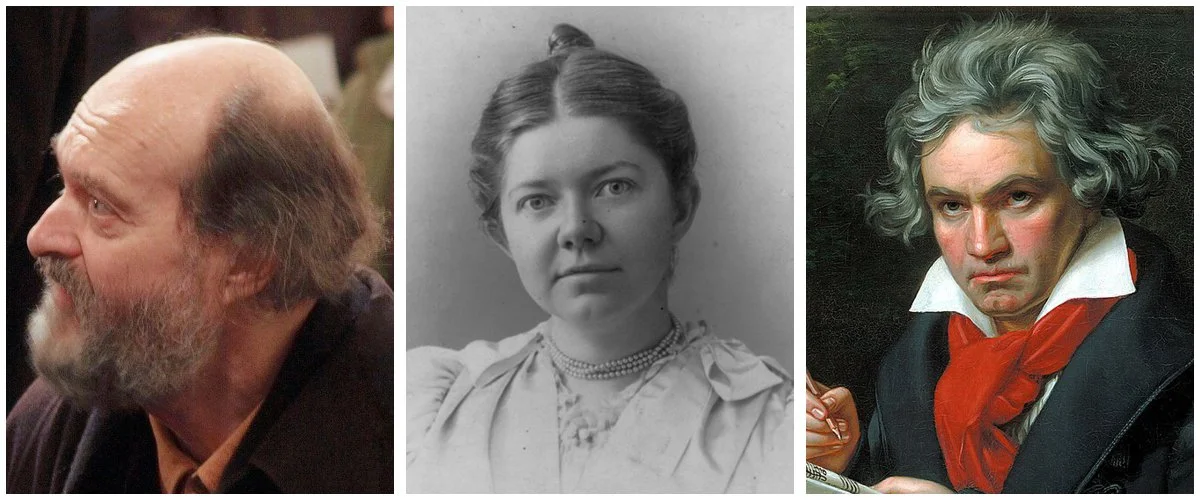
Program Notes: Beethoven's Symphony No. 9
Notes about:
Pärt’s Fratres
Beach’s Peace I Leave With You
Beethoven’s Symphony No. 9 in D minor, Op. 125 “Choral”
Program Notes for MAy 10 & 11, 2024
Beethoven’s Symphony No. 9
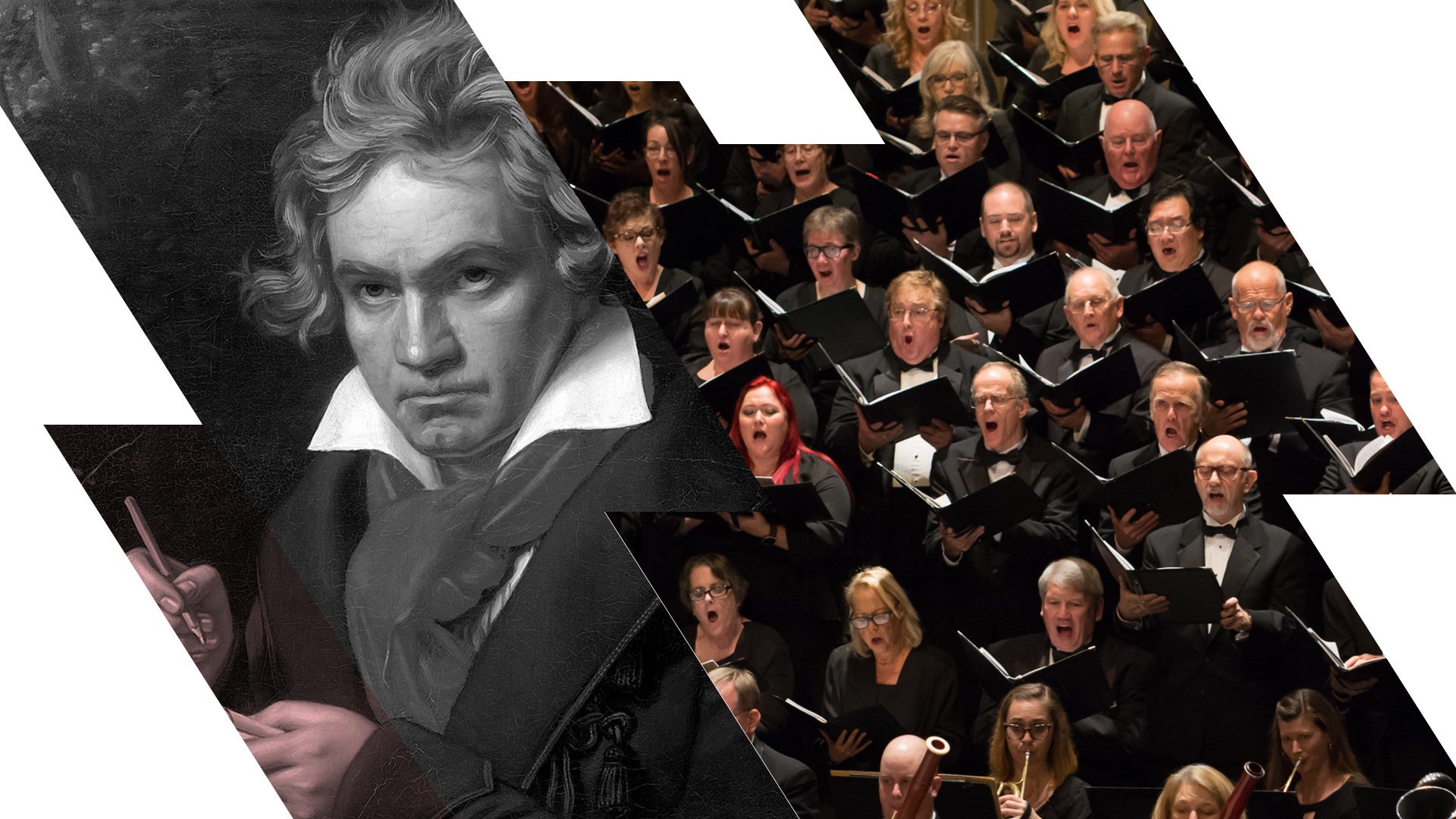

Arvo pärt
Fratres
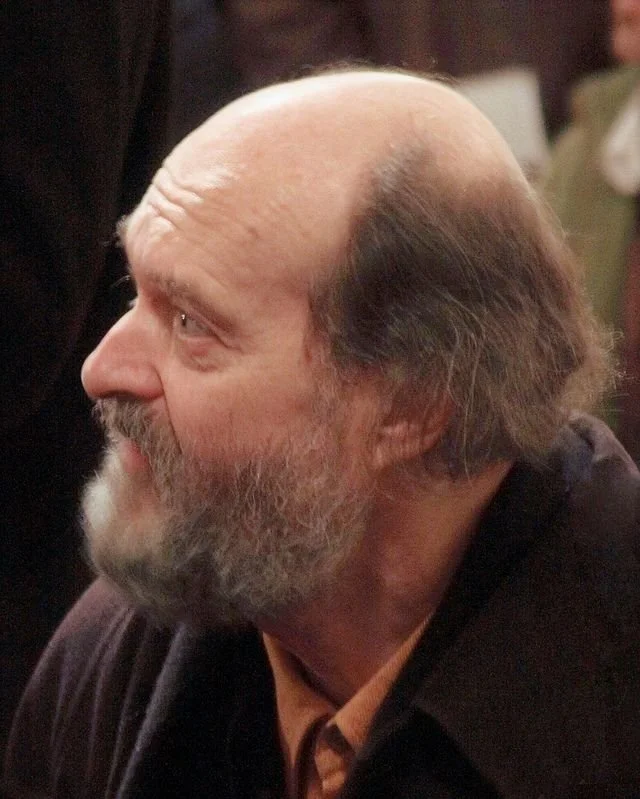
Composer: born September 11, 1935, Paide, Estonia
Work composed: 1977
World premiere: undocumented
Instrumentation: string orchestra
Estimated duration: 6 minutes
The crystalline quality of Arvo Pärt’s music evokes the wintry climate of his native Estonia. Pärt achieves this shimmering transparency through single notes, a compositional style he named “tintinnabulation,” Latin for “little bells.” Pärt explains, “I have discovered that it is enough when a single note is beautifully played. This one note, or a silent beat, or a moment of silence, comforts me. I work with very few elements – with one voice, two voices. I build with primitive materials – with the triad, with one specific tonality. The three notes of a triad are like bells, and that is why I call it tintinnabulation.”
At the time Pärt composed Fratres, he was also immersing himself in the sound world of medieval and Renaissance music. Music from these periods did not often indicate which instruments or voice parts should be used, a practice Pärt employed with Fratres. This choice showcases notes and melodic phrases, rather than particular timbres, or sound colors.
Fratres features a series of variations on a simple stepwise theme, which reappears in several different octaves. Underneath the gently shimmering variations, the low strings maintain a steady drone. The overall effect is meditative, enveloping the listener in a mood of reflection.
AMy BEach
Peace I Leave With You
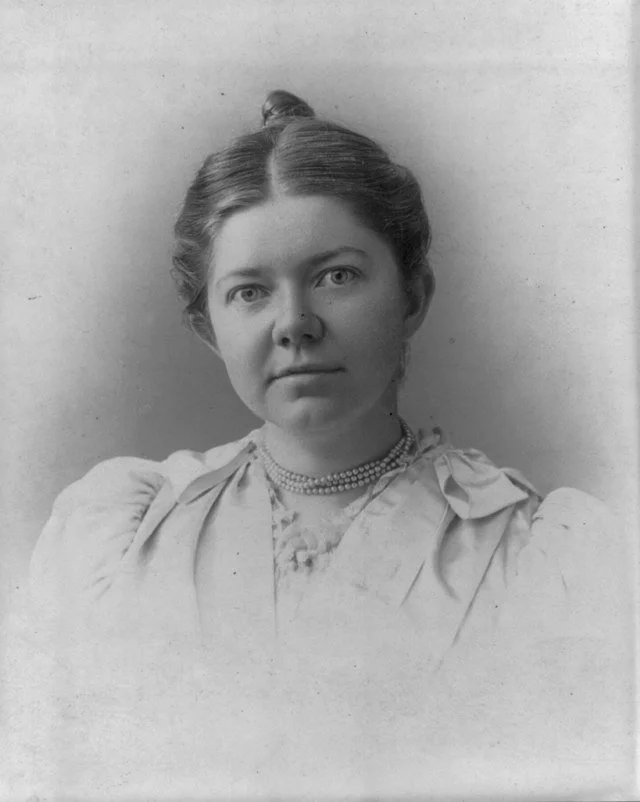
Composer: born September 5, 1867, Henniker, NH; died December 27, 1944, New York City
Work composed: 1891
World premiere: undocumented
Instrumentation: a cappella SATB chorus
Estimated duration: 1.5 minutes
Amy Beach’s musical accomplishments include several firsts: the first American woman to compose and publish a symphony – and the first American woman to have a symphony performed. She is also one of the first American composers – of any gender – whose musical training occurred wholly within the United States, rather than Europe. As such, Beach’s approach to composition and her aesthetics are uniquely American, and she did not measure the quality of her work by comparing it to music by European composers, unlike some of her contemporaries.
Beach’s prodigal musicality emerged as early as age two, as documented by her mother Clara: “Her gift for composition showed itself in babyhood before two years of age. She could, when being rocked to sleep in my arms, improvise a perfectly correct alto to any soprano air I might sing … She played the piano at four years, memorizing everything that she heard correctly ...” Clara was Beach’s first piano teacher; the young girl later studied piano in Boston. By the time she reached age 12, Beach’s parents were being lobbied by musical impresarios eager to launch their wunderkind daughter onto the concert stage. Beach’s parents declined, allowing Beach to refine her piano skills and pursue other musical studies through her teenage years. She made her concert debut at age 16, to great acclaim, and continued concertizing for the next two years, until her marriage to Dr. Henry Harris Aubrey Beach, 25 years her senior.
In 1930, Beach moved to New York, where she formed a close relationship with St. Bartholomew’s Episcopal Church, and wrote many liturgical choral works for their choir. It is likely her 1891 anthem, “Peace I Leave with You,” with text from the Gospel of John, was first sung there. The simple elegance of Beach’s homophonic setting emphasizes the clarity and meaning of the words to create a gentle benediction.
ludwig van beethoven
Symphony No. 9 in D minor, Op. 125 “Choral”
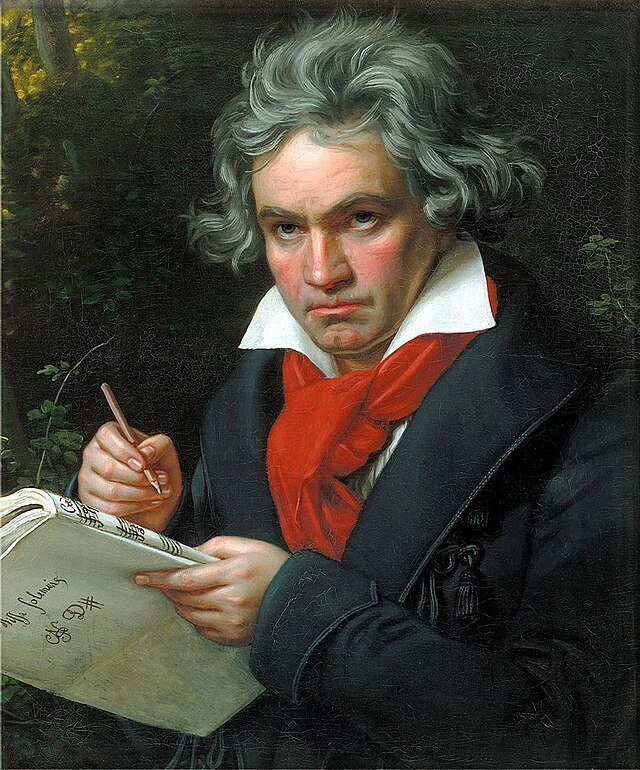
Composer: born December 16, 1770, Bonn, Germany; died March 26, 1827, Vienna
Work composed: Beethoven made preliminary sketches in 1817-18, but most of the music was composed between 1822–24. Beethoven finished his Ninth Symphony in February 1824, and dedicated it to King Frederick William III of Prussia.
World premiere: Beethoven conducted the first performance on May 7, 1824, at the Kärntnerthor Theater in Vienna.
Instrumentation: soprano, alto, tenor, and bass soloists, four-part mixed chorus, piccolo, 2 flutes, 2 oboes, 2 clarinets, 2 bassoons, contrabassoon, 4 horns, 2 trumpets, 3 trombones, timpani, bass drum, cymbals triangle and strings.
Estimated duration: 70 minutes
The Ninth Symphony extends beyond the realm of the concert hall and has permeated Western culture on many levels, including socio-political and commercial arenas. The music of the Ninth, particularly the “Ode to Joy” melody of the final movement, is so familiar to us that it has lost its unique character and taken on the quality of folk music; that is, it has shed its “composed” identity as a melody written by Ludwig van Beethoven and simply exists within the communal ear of our collective consciousness.
While some classical works are inextricably linked to the time in which they were written, Beethoven’s profound musical statements about freedom, equality, and humanity resonate just as powerfully today as they did at the Ninth’s premiere. This was evident to the entire world 35 years ago, when Leonard Bernstein conducted an international assembly of instrumentalists and singers in a historic performance of Beethoven’s Ninth at East Berlin’s Schauspielhaus (now Konzerthaus) on December 22, 1989, three days after the fall of the Berlin Wall. To emphasize the historic event, Bernstein substituted the word “freedom” for “joy” in the famous lyrics by the poet Friedrich Schiller in the final movement. The performance was broadcast on television worldwide, attracting more than 200 million viewers.
By 1822, Beethoven was completely deaf and emotionally isolated. Five years earlier, at the age of 47, he had written in his journal, “Before my departure for the Elysian fields I must leave behind me what the Eternal Spirit has infused into my soul and bids me complete.” Alone and embittered, Beethoven focused almost exclusively on his musical legacy.
The lofty salute to the human spirit expressed in Schiller’s poem An die Freude (To Joy) had resonated with Beethoven for many years; in 1790 he set a few lines in a cantata written to commemorate the death of Emperor Leopold II; he also included portions of Schiller’s poem in his opera Fidelio. “The search for a way to express joy,” as Beethoven described it, was the subject of his final symphony. To that end, Beethoven edited and arranged Schiller’s lines to suit his musical and dramatic needs, using a melody from the Choral Fantasy he had written 20 years earlier.
The symphony opens with the strings sounding a series of hollow open chords, neither major nor minor, which are harmonically ambiguous – what key is this? The fifths build into a massive statement featuring a weighty dotted rhythmic theme. The intensity of this movement foreshadows the finale.
As was his wont, Beethoven broke with symphonic convention by writing a second-movement scherzo. The music bursts forth with dramatic string octaves and pounding timpani. The main theme, a contrapuntal fugue, gives way to a demure wind melody. Underneath its playful simplicity, the barely contained agitation of the scherzo pulses in the strings, like a racehorse pawing at the starting gate.
In a symphony synonymous with innovation, Beethoven’s most significant departure from convention is the inclusion, for the first time, of a chorus and vocal soloists in a formerly exclusively instrumental genre. The cellos and basses play an instrumental recitative, later sung by the baritone, which is followed by the unaccompanied “Joy” melody. Beethoven then presents several instrumental variations, including a triumphal brass fanfare. The baritone soloist introduces Schiller’s poem with words of Beethoven’s: “O friends, not these tones; instead, let us strike up more pleasing and joyful ones.” The chorus repeats the last four lines of each stanza as a refrain, followed by the vocal quartet. A famous interlude, the Turkish March, follows (this music was considered “Turkish” because of the inclusion of the triangle, cymbals and bass drum, exotic additions to the orchestra of Beethoven’s time). After a number of variations, the chorus returns with a monumental concluding double fugue.
© Elizabeth Schwartz
NOTE: These program notes are published here by the Modesto Symphony Orchestra for its patrons and other interested readers. Any other use is forbidden without specific permission from the author, who may be contacted at www.classicalmusicprogramnotes.com
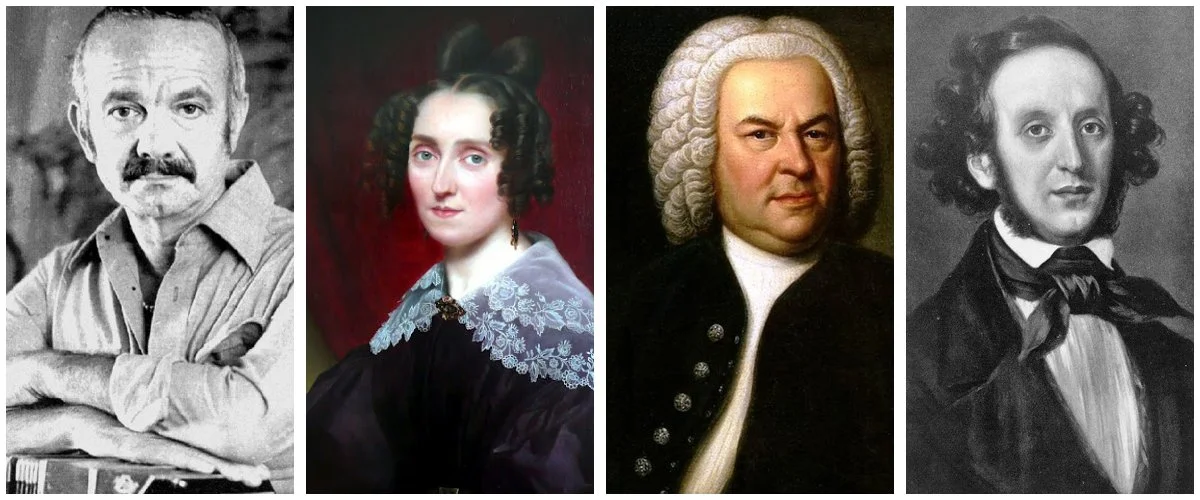
Program Notes: Mendelssohn's Violin Concerto
Notes about:
Piazzolla’s Tangazo (Variations on Buenos Aires)
Farrenc’s Symphony No. 3 in G minor
Bach’s Fugue in G minor BWV 578 “Little Fugue”
Mendelssohn’s Violin Concerto in E minor, Op. 64
Program Notes for April 12 & 13, 2024
Mendelssohn’s Violin Concerto


Astor piazzolla
Tangazo (Variations on Buenos Aires)

Composer: born March 11, 1921, Mar del Plata, Argentina; died July 5, 1992, Buenos Aires
Work composed: 1969
World premiere: 1970 in Washington, D.C., by the Ensemble Musical de Buenos Aires
Instrumentation: 2 flutes, 2 oboes, 2 clarinets, 2 bassoons, 2 horns, cymbals, glockenspiel, guiro, tom-toms, triangle, xylophone, piano, and strings
Estimated duration: 15 minutes
“For me, tango was always for the ear rather than the feet.” – Astor Piazzolla
Astor Piazzolla is inextricably linked with tango. He took a dance from the back rooms of Argentinean brothels and blurred the lines between popular and “art” music to such an extent that, in the case of his music, such categories no longer apply.
Tangazo is a later composition, originally scored for solo bandoneon, piano, and strings. Piazzolla was a master of the bandoneón, a small button accordion of German origin, which originally served as a portable church organ. The distinctive sound of the bandoneón became a fundamental element of Piazzolla’s tangos; its insouciance and melancholy permeate Piazzolla’s music, even in works scored for other instruments.
Tangazo begins in the low strings, which murmur a slow introduction with more than a hint of menace. Harmonically, Tangazo often ranges beyond conventional tango tonalities to explore a modernist palette replete with unexpected detours. After the deliberate legato pace of the introduction, a solo oboe takes off with a skittish tango full of bounce and swagger. Legato interludes featuring pensive horn solos alternate with the agitated tango. Overall, Tangazo conveys restlessness, even as its last notes fade away.
Louise farrenc
Symphony No. 3 in G minor

Composer: born May 31, 1804, Paris; died September 15, 1875, Paris
Work composed: 1847
World premiere: 1849, by the Orchestre de la Société des concerts du Conservatoire in Paris
Instrumentation: 2 flutes, 2 oboes, 2 clarinets, 2 bassoons, 2 horns, timpani, and strings
Estimated duration: 33 minutes
During her lifetime, Louise Farrenc was well known as both a composer and outstanding pianist. Throughout the 19th century, she was also the first and only female professor of music on the faculty of the Paris Conservatory.
Farrenc grew up in a family of artists who encouraged their daughter’s musical interests. Young Louise displayed extraordinary talent at the piano in early childhood, and soon began composing her own music. When she was 15, her parents enrolled her at the Paris Conservatory to continue her composition studies, although she was tutored privately by its faculty because women were not admitted to the Conservatory’s composition program at the time..
At 18, Louise married a flutist, Aristede Farrenc, who later founded a music publishing house. By the 1830s, Farrenc was balancing a busy, multifaceted career as a teacher, composer, and pianist who concertized all over France. As a composer, Farrenc also began expanding her portfolio from solo piano music to larger forms such as symphonies, concert overtures, and a number chamber works, including piano quintets and trios. Farrenc, unlike many female composers whose music was discovered only long after their deaths, was able to hear the public performance of all three of her symphonies – which were well-reviewed – during her lifetime.
The symphonic format evolved from earlier German and Italian genres; by the mid-19th century, symphonies epitomized German style. In fervently nationalist France, particularly in Paris, symphonies and their composers faced aesthetic discrimination from those who deemed the symphony an exclusively German art form. Moreover, the idea of a woman writing symphonic music – in the eyes of some putting herself on par with symphonic greats such as Beethoven, Mendelssohn, Mozart, Schubert, and others – seemed an outrageous provocation.
After a brief Adagio for winds, a graceful Allegro ensues, featuring themes in the strings. This opening movement is full of vigor, artful melodies, and a sense of orchestral mastery. Farrenc follows this confident beginning with a serene Adagio cantabile, featuring a solo clarinet soaring over low winds and brasses, suggesting the intimacy of a woodwind quintet. An agitated Scherzo follows, full of quicksilver flashes of light and shadow that showcases the upper winds. The Finale bristles with dramatic energy and features several powerful statements that unleash the strings’ fiery virtuosity with a series of scalar passages. Minor-key symphonies of this period usually conclude in their corresponding major key, but Farrenc maintains the G-minor intensity right up to the closing notes.
Johann Sebastian Bach
Fugue in G minor BWV 578 “Little Fugue” arr. Hersh
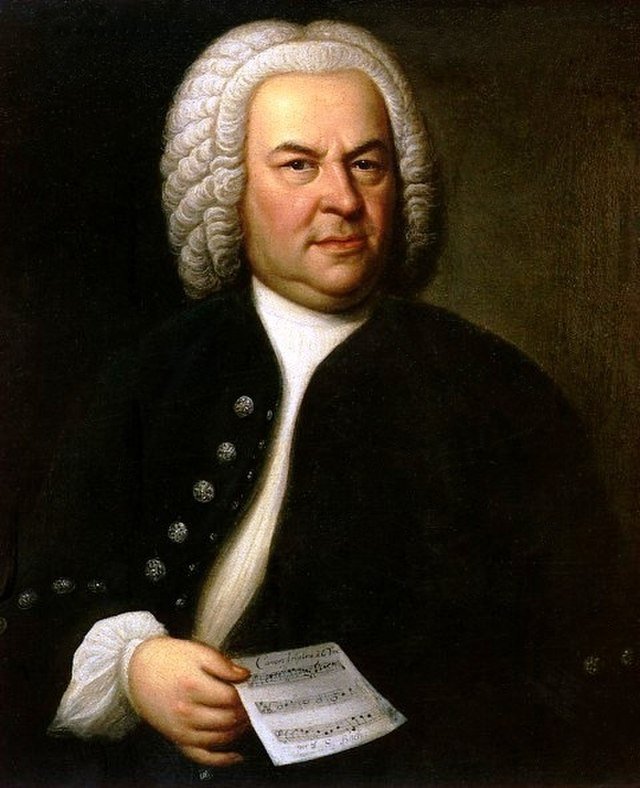
Composer: born March 21, 1685, Eisenach; died July 28, 1750, Leipzig
Work composed: c. 1703-07, written while Bach served as an organist in Arnstadt.
World premiere: undocumented
Instrumentation: flute, oboe, clarinet, bassoon, 2 horns, trumpet, chimes, vibraphone, and strings
Estimated duration: 3.5 minutes
Nicknames can be misleading. The only thing “little” about Johann Sebastian Bach’s Fugue in G minor, BWV 578, is its length. Just under four minutes long, this fugue features one of Bach’s best known and most recognizable fugue subjects, and it has been arranged for diverse ensembles, including Leopold Stowkowsi’s brass-heavy arrangement for full orchestra, and the Swingle Singers’ popular vocal jazz version.
Bach was renowned during his lifetime for his extraordinary ability to improvise at the keyboard. It is possible the distinctive fugue subject emerged first as an improvisation; at over four measures long, it is an unusually lengthy statement. Bach allows each voice to shine, including the basses (played by foot pedals on the organ). The opening three notes cut through the dense counterpoint, announcing the subject’s entrance clearly each time, as the music swirls and eddies towards a bold conclusion.
Felix Mendelssohn
Violin Concerto in E minor, Op. 64

Composer: born February 3, 1809, Hamburg; died November 4, 1847, Leipzig
Work composed: July 1838 – September 1844
World premiere: Niels Gade led the Gewandhaus Orchestra and violinist Ferdinand David in Leipzig on March 13, 1845
Instrumentation: solo violin, 2 flutes, 2 oboes, 2 clarinets, 2 bassoons, 2 horns, 2 trumpets, timpani, and strings
Estimated duration: 27 minutes
“I would like to write a violin concerto for you next winter,” wrote Felix Mendelssohn to his longtime friend and colleague Ferdinand David in the summer of 1838. “There’s one in E minor in my head, and its opening won’t leave me in peace.” Mendelssohn, then conductor of the Leipzig Gewandhaus Orchestra, had known David for years. The two prodigies met as teenagers; 15-year-old David was a budding violin virtuoso and 16-year-old Mendelssohn had just completed his Octet for Strings. Years later, when Mendelssohn was appointed director of the Gewandhaus concerts in 1835, he hired David as concertmaster. In 1843, Mendelssohn founded the Leipzig Conservatory and quickly appointed David to the violin faculty.
Mendelssohn had played the violin since childhood, and by all accounts was quite accomplished. However, the E minor Violin Concerto required a level of technical knowledge and skill beyond Mendelssohn’s abilities, so he turned to David for hands-on advice. During the composition of the E minor Concerto, Mendelssohn wrote the melodies and designed the overall structure, while David served as technical consultant.
In this concerto, the violin is always and indisputably the star, while the orchestra’s role provides what the late music critic Michael Steinberg called “accompaniment, punctuation, scaffolding and a bit of cheerleading.” Music this familiar can be difficult to hear as a “composed” work at all; instead, it seems to emerge sui generis, like Athena bursting fully formed from the head of Zeus.
In a break with convention, the solo violin rather than the full orchestra opens the Allegro molto appassionato with the main theme. Mendelssohn also defied expectations by placing the first movement cadenza, which David composed, between the development and return of the main theme, rather than at the end of the movement.
A solo bassoon holds the last note of the Allegro and pivots without interruption to the Andante. Here the soloist leads with a lyrical, singing melody full of tender poignancy. The gentle Andante flows almost without pause into the Allegro molto vivace. The exuberant quicksilver theme of the finale contrasts sharply with the intimate Andante, and demands all the soloist’s technical and artistic skill.
Op. 64 turned out to be Mendelssohn’s last completed orchestral work; he died two years after its premiere. Scholar Thomas Grey observed, “It seems fitting, if fortuitous, that [the Violin Concerto] should combine one of his most serious and personal orchestral movements (the opening Allegro) with a nostalgic return to the world of A Midsummer Night’s Dream in the finale – the world of Mendelssohn’s ‘enchanted youth’ and the music that, more than any other, epitomizes his contribution to the history of music.”
© Elizabeth Schwartz
NOTE: These program notes are published here by the Modesto Symphony Orchestra for its patrons and other interested readers. Any other use is forbidden without specific permission from the author, who may be contacted at www.classicalmusicprogramnotes.com

Program Notes: Symphonic Soundtrack
Notes about:
Rossini’s Overture to La Gazza Ladra
Gabrieli’s Sonata pian’e forte
Montgomery’s Starburst
Copland’s Clarinet Concerto
Faure’s Sicilienne from Pelleas and Melisande Suite
Stravinsky’s Suite from The Firebird
William’s Princess Leia’s Theme from Star Wars
Program Notes for March 15 & 16, 2024
Symphonic Soundtrack


Gioachino rossini (1792-1868)
Overture to La Gazza Ladra (1817)
This piece was chosen by violinist Josephine Gray
"Who Is the wittiest composer? Mozart, Rossini or perhaps Berlioz? My first memory of the Thieving Magpie overture during my early childhood in the UK was it being a musical joke as the opening drum roll caused the entire audience to spring to their feet, mistaking it for God Save the Queen! Rossini was undoubtedly a master entertainer and a musical tease, showing off the virtuoso winds and strings, and the pompous brass and percussion. He sure knew how to build momentum and excitement and has scored the magpie protagonist perfectly with lilting, graceful, cheeky and mischievous themes and masterful orchestration."
Giovanni gabrieli (1554-1612)
Sonata pian’e forte (1597)
This piece was chosen by principal viola, Patricia Whaley
In addition to the many philosophical and scientific advancements brought on by the Italian Renaissance, music also saw significant innovation, including a standardization of notation to something very close to what we would recognize in modern sheet music. The prolific Venetian composer Giovanni Gabrieli gave remarkably clear instructions to performers in his written music while he served as maestro of St. Mark’s Basilica, including, in the case of his 1597 Sonata pian’ e forte, which passages should be played forte (loud) and which piano (soft)—indications we still use today. In St. Mark’s, the musicians were traditionally split into two groups in choir lofts facing one another, and Gabrieli wrote much of his music with this layout in mind, making extensive use of echoes and call-and-response; today, we can recreate this almost 500-year-old style to great effect with brass instruments laid out in a similar “antiphonal choir” setup.*
*Program Notes written by Nicholas Hersh, music director
jessie montgomery (b. 1981)
Starburst (2012)
This piece was chosen by principal viola, Patricia Whaley
"I love Starburst! I hope you will too. It’s full of wonderfully bright, propulsive energy, and it shows off the wealth of different sounds and colors that strings alone can produce, using all the different techniques we have at our disposal. Jessie Montgomery, a violinist herself, writes in a style that’s both distinctly modern and still welcoming for all listeners, as well as being challenging but eminently playable for us."
aARON COPLAND (1900-1990)
Clarinet Concerto (1948)
This piece was chosen by violinist Josephine Gray
"I suggested this piece because my late father played jazz clarinet and saxophone.For me the first movement has a heart rending plaintiff quality that reaches my soul in a poignant and nostalgic way. It's not particularly sad, but just very human. Pain and hope, serenity coupled with disquiet as it goes in harmonic directions that are unexpected. After a cadenza bridge which introduces the jaunty theme of the second movement, Copland uses slap bass and Latin American jazz themes to set up a kind of musical race that's bright, intricate and overwhelmingly fun ending with a Gershwin "smear" flourish."
Gabriel faure (1845-1924)
Sicilienne from Pelleas and Melisande Suite (1948)
This piece was chosen by Don Grishaw, violin
"I first heard it when I was in fourth or fifth grade, on the radio... It's a magical piece with a beautiful melody."
The slow, symbolism-laden words of Belgian playwright Maurice Maeterlinck’s 1893 Pelléas and Mélisande never saw much success until the play was set to music—multiple times, by musical luminaries like Claude Debussy, Arnold Schoenberg, and Gabriel Fauré. Fauré used a light touch: the play was staged in an English translation and Fauré only added incidental music (music usually played only during scene changes or in the background). Matching the moody story of forbidden love, the most well-known segment of music is the “Sicilienne,” which accompanies Mélisande playing the flute for her lover Pelléas by a well, the gentle lilt to its rhythm in a dreamy 6/8 time adding an air of antiquity.*
*Program Notes written by Nicholas Hersh, music director
Igor stravinsky (1882-1971)
Suite from The Firebird (1919)
This piece was chosen by principal viola, Patricia Whaley
Igor Stravinsky was a 20th-century chameleon—he explored several different musical styles over the course of his nearly one-hundred-year life, from experiments in modernist atonal music to a conservative “neo-Classical” style. Russian by birth, he soared to fame (and scandal) in Paris with his late-Romantic, folk-infused Ballets Russes, which included the infamous Rite of Spring, so avant-garde that it allegedly started a riot at its premiere. Among his earlier successes in Paris was the 1910 ballet The Firebird, a retelling of an ancient folk tale of a young warrior-prince defeating a monstrous sorcerer with the help of a magic bird. The music is immensely evocative and a tour-de-force of orchestration, from the low strings depicting a shadowy forest, to the frenetic xylophone and trombone glissandos of the sorcerer’s wild minions, and finally to the majestic horn call that marks the hero’s victory over evil.*
*Program Notes written by Nicholas Hersh, music director
John williams (b. 1932)
Princess Leia’s Theme from Star Wars (1977)
This piece was chosen by music director, Nicholas Hersh
"This is really one of the first pieces of music that I would have heard as a kid that used the orchestra in a huge and engaging way, and watching Star Wars as a kid is a fundamental part of my upbringing. This music is written so beautifully by John Williams with this soaring, beautiful melody, which really left a mark on me and may have even set me down a path to become the conductor I am today. Performing Williams's musicis always such a privilege because he just knows how to write for the orchestra to make it sound its absolute best. Every instrument is involved. Every instrument gets an interesting line to play. In addition to hearing these lush harmonies and soaring melodies that we instantly associate with our favorite characters from Star Wars."
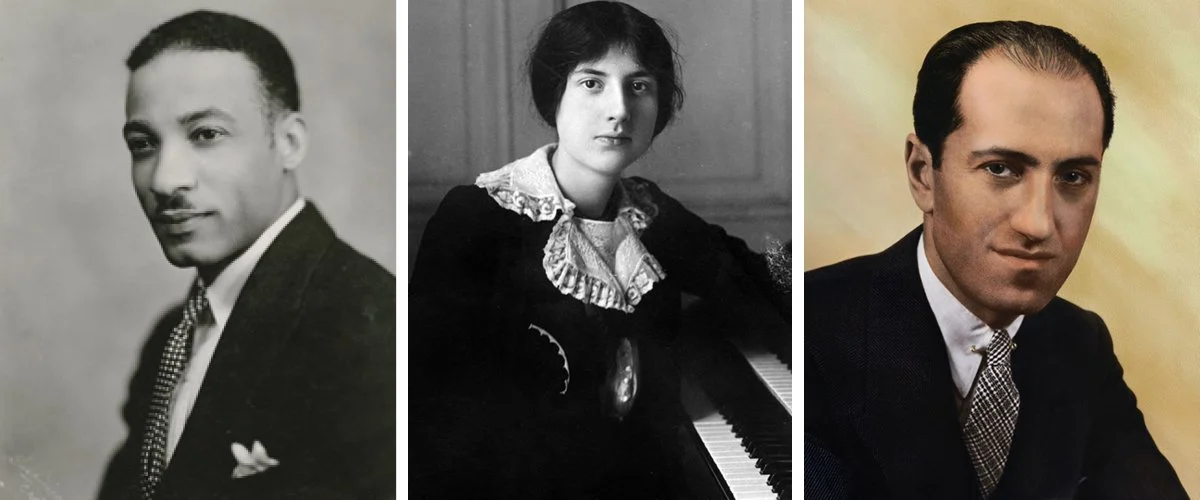
Program Notes: Gershwin's An American in Paris
Notes about:
Dawson’s Negro Folk Symphony
Boulanger’s D’un Matin de Printemps
Gershwin’s An American in Paris
Program Notes for February 9 & 10, 2024
Gershwin’s An American in Paris


William dawson
Negro Folk Symphony

Composer: born September 26, 1899, Anniston, AL; died May 2, 1990, Montgomery, AL
Work composed: 1934, rev. 1952
World premiere: Leopold Stokowski led the Philadelphia Orchestra on November 20, 1934, at Carnegie Hall in New York City
Instrumentation: piccolo, 2 flutes, 2 oboes, English horn, 3 clarinets, bass clarinet, 2 bassoons, contrabassoon, 4 horns, 3 trumpets, 3 trombones, tuba, timpani, adawura (Ghanaian bell), African clave, bass drum, chimes, cymbals, gong, snare drum, tenor drum, xylophone, harp, and strings
Estimated duration: 30 minutes
“I’ve not tried to imitate Beethoven or Brahms, Franck or Ravel – but to be just myself, a Negro,” William Dawson remarked in a 1932 interview. “To me, the finest compliment that could be paid my symphony when it has its premiere is that it unmistakably is not the work of a white man. I want the audience to say: ‘Only a Negro could have written that.’”
Two years later, Leopold Stokowski led the New York Philharmonic in the premiere of Dawson’s Negro Folk Symphony. Critics and audiences alike hailed it as a masterpiece. One reviewer declared it “the most distinctive and promising American symphonic proclamation which has so far been achieved,” and another enthused, “the immediate success of the symphony [did not] give rise to doubts as to its enduring qualities. One is eager to hear it again and yet again.” Given this overwhelmingly positive reception, Dawson’s Negro Folk Symphony, which at the time he thought of as the first of several future symphonies, should have been heard “again and yet again.” But it was not. Despite Stokowski’s advocacy for Dawson and the Negro Folk Symphony, and despite the stellar reviews it received at its premiere, within a few years both the music and its composer had faded into relative obscurity. Dawson never composed another symphony, although he did continue writing and arranging music – primarily spirituals, which he preferred to call “Negro folk songs” – for the rest of his long career.
In the current climate of racial reckoning, Dawson’s Negro Folk Symphony is enjoying a long-overdue revival, as is the music of other Black classical composers such as Florence Price, William Grant Still, Nathaniel Dett, and many others.
Dawson wrote that his symphony was “symbolic of the link uniting Africa and her rich heritage with her descendants in America,” and gave each of its three movements a descriptive title. Dawson explained in his own program note: “The themes are taken from what are popularly known as Negro Spirituals. In this composition, the composer has employed three themes taken from typical melodies over which he has brooded since childhood, having learned them at his mother’s knee.” Musicologist Gwynne Kuhner Brown observes, “The themes are handled with such virtuosic flexibility of rhythm and timbre that each movement seems to evolve organically,” creating a “persuasive musical bridge between the ‘Negro Folk’ and the ‘Symphony.’”
In “The Bond of Africa,” Dawson opens with a horn solo. The dialogue between the horn and the orchestra echoes the call-and-response format of most spirituals. The horn solo repeats, usually in abbreviated form, several times throughout this movement, and serves as a musical “bond” holding the work together. The central slow movement, “Hope in the Night,” also features a unifying solo. Here an English horn sounds Dawson’s own spiritual-inspired melody, which he described as an “atmosphere of the humdrum life of a people whose bodies were baked by the sun and lashed with the whip for two hundred and fifty years; whose lives were proscribed before they were born.” Underneath the plaintive tune, the orchestra provides a dirge-like accompaniment that builds to an ominous repetition of the solo for tutti orchestra. This episode is offset by an abrupt change of mood, and we hear a lighthearted, up-tempo reworking of the original tune (the “hope” of the movement’s title). These two contrasting interludes alternate throughout the rest of the movement. Towards the end, Dawson reworks the harmony, which has been grounded in minor keys up to this point, and tiptoes towards major tonalities without fully embracing them. Musically, this device works as a powerful metaphor for the importance and elusive nature of hope to sustain people through traumatic circumstances.
The closing section, “Oh, Le’ Me Shine, Shine Like A Morning Star!” imagines a world in which the hopes of the previous movement are fully realized. Dawson creates this musical utopia through rhythm. The central melody showcases accented off-beat exclamations from various solo instruments and sections throughout, as the rhythms layer increasingly complex parts over one another. Dawson revised this movement in the early 1950s after he encountered the intricate polyrhythms of West African music during a trip to Africa. The interlocking parts and the sounds of African percussion instruments captured Dawson’s ear; when he returned to America, he added these elements. Eventually all these rhythmic strands come together in a final buoyant exclamation.
Lili Boulanger
D’un matin de printemps (From A Spring Morning)
Composer: born August 21, 1893, Paris; died March 15, 1918, Mézy-sur-Seine
Work composed: 1917-18. Boulanger made arrangements in multiple versions: for violin and piano, string trio, and full orchestra
World premiere: undocumented
Instrumentation: piccolo, 2 flutes, 2 oboes, English horn, 2 clarinets, bass clarinet, 2 bassoons, contrabassoon, 4 horns, 2 trumpets, 3 trombones, tuba, bass drum, castanets, cymbals, tambourine, tam-tam, timbales, triangle, celeste, harp, and strings
Estimated duration: 5 minutes
Women composers, like other female creative artists, have to fight battles their male counterparts do not. Even today, a female visual artist, writer, or composer is sometimes evaluated on criteria that have little or nothing to do with her work, and everything to do with her gender, her appearance, or her life circumstances. Lili Boulanger was no exception.
The younger sister of composer and pedagogue Nadia Boulanger, who taught composition to many of the 20th century’s most distinguished composers, Lili Boulanger revealed her enormous talent at a very young age. She was a musical prodigy born into a musical family; in 1913, at age 20, she became the first woman to win the coveted Prix de Rome, France’s most prestigious composition prize. Boulanger’s compositional style, while grounded in the prevailing impressionistic aesthetics associated with Claude Debussy, is nonetheless wholly her own. Her music features rich harmonic colors, hollow chords (open fifths and octaves), ostinato figures, running arpeggios, and static rhythms.
Along with her tremendous musical ability, Boulanger was born with a chronic, debilitating intestinal illness, probably Crohn’s disease. Today there are drugs and other therapies to manage this condition, but in Boulanger’s time the illness itself had neither name nor cure, and its treatment was likewise little understood. Throughout her short life, Boulanger suffered from acute abdominal pain, bouts of uncontrollable diarrhea, and constant fatigue; all these symptoms naturally impacted her stamina and her ability to write. Contemporary reviews of Boulanger’s work always emphasized her physical fragility, often in lieu of a thoughtful assessment of her music.
Despite illness, Boulanger continued composing, even on her deathbed. D’un matin printemps, the second half of a diptych that includes its shorter counterpart D’un soir triste (From a Sad Evening) are two of the last works she wrote. Both pieces treat the same opening melodic and rhythmic theme in different ways: in D’un soir triste, the tempo is slow and the mood elegiac, while the same melodic/rhythmic fragment receives a cheerful, puckish treatment in D’un matin printemps that sparkles with effervescence and youthful joy.
George gershwin
An American in Paris

Composer: born September 26, 1898, Brooklyn, NY; died July 11, 1937, Hollywood, CA
Work composed: March - June 1928, while Gershwin and his siblings were vacationing in Paris
World premiere: Walter Damrosch led the New York Philharmonic on December 13, 1928 in New York
Instrumentation: 3 flutes (1 doubling piccolo), 2 oboes, English horn, 2 clarinets, bass clarinet, 3 saxophones (alto, tenor, baritone), 2 bassoons, 4 horns, 3 trumpets, 3 trombones, tuba, timpani, bass drum, bells, cymbals, snare drum, taxi horns, tom-toms, triangle, xylophone, celesta, and strings
Estimated duration: 17 minutes
“My purpose here is to portray the impression of an American visitor in Paris, as he strolls about the city and listens to various street noises and absorbs the French atmosphere,” wrote George Gershwin about his tone poem, An American in Paris. “As in my other orchestral compositions, I’ve not endeavored to represent any definite scenes in this music. The rhapsody is programmatic only in a general impressionistic way, so that the individual listener can read into the music such as his imagination pictures for him,” This highly evocative, colorful symphonic music expertly captures the sights and sounds of Paris as its American protagonist wanders through the city streets. To illustrate the American’s journey, Gershwin included several of what he termed “walking themes,” which recur throughout the work. The trumpet sounds the most recognizable of these, the “homesick music,” in a bluesy solo. The “American” section concludes with an up-tempo Charleston played by a pair of trumpets, and the walking themes return. Finally, the orchestra winds up with a glittering exuberant finale as night falls on the City of Light.
An American in Paris marked a breakthrough for Gershwin as a composer, as the first symphonic piece for which he created his own orchestrations. When Rhapsody in Blue premiered in 1924, Gershwin was criticized because the Rhapsody’s orchestral version was created by Ferde Grofé. Four years after Rhapsody’s premiere, with An American In Paris, Gershwin demonstrated his growing command of orchestral colors, effectively silencing his detractors.
© Elizabeth Schwartz
NOTE: These program notes are published here by the Modesto Symphony Orchestra for its patrons and other interested readers. Any other use is forbidden without specific permission from the author, who may be contacted at www.classicalmusicprogramnotes.com
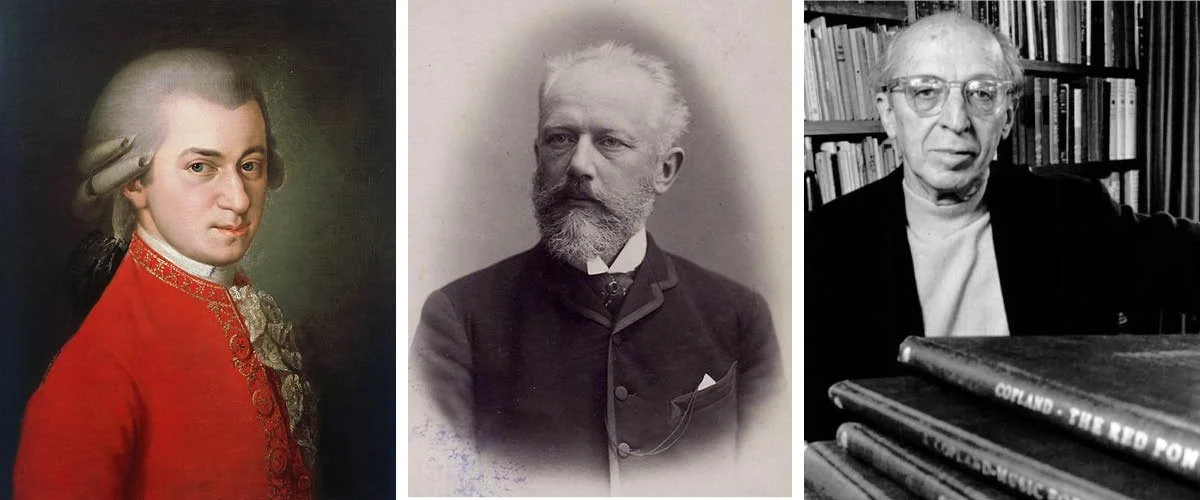
Program Notes: Tchaikovsky & Copland
Notes about:
Mozart’s Overture to The Marriage of Figaro KV492
Tchaikovsky’s Piano Concerto No.1 in B-flat minor, Op. 23
Copland’s Symphony No. 3
Program Notes for october 13 & 14, 2023
Tchaikovsky & Copland


Wolfgang Amadeus Mozart
Overture from Le nozze di Figaro, K. 492

Composer: born January 27, 1756, Salzburg, Austria; died December 5, 1791, Vienna
Work composed: May 28, 1786.
World premiere: Mozart conducted the first performance of Figaro at Vienna’s Burgtheater on May 1, 1786
Instrumentation: 2 flutes, 2 oboes, 2 clarinets, 2 bassoons, 2 horns, 2 trumpets, timpani, and strings
Estimated duration: 4 minutes
The best way to generate interest in something is to ban it. This holds as true today as it did in 1782, when King Louis XIV, after attending a private reading of a French comedy of manners written by Pierre Beaumarchais, declared it “detestable.” Beaumarchais’ play contained revolutionary ideas too dangerous for commoners to hear, as far as the rulers of Europe was concerned. Austria’s Emperor Joseph II agreed, and banned Beaumarchais’ play within Austria’s borders.
When Wolfgang Amadeus Mozart encountered Beaumarchais’ subversive play, he saw in it the perfect basis for an opera. With librettist Lorenzo da Ponte, Mozart relocated the story of Figaro, Susanna, Count Almaviva and Countess Rosina, and all their circle to Italy, and toned down the more obvious revolutionary elements.
The dizzyingly intricate plot of Le nozze di Figaro, Mozart’s most popular and frequently staged opera, is rife with twists, turns, reversals, misunderstandings, rumors, gossip, and deceptions. Such narrative complexity is mirrored in the Overture’s series of running notes, which generate the nonstop high energy needed to keep the story going over four acts. As was common at the time, none of the actual music in the opera appears in the Overture, but the anticipatory excitement of the music readies the audience for all the shenanigans to come.
Piotr ilyich tchaikovsky
Piano Concerto No.1 in B-flat minor, Op. 23

Composer: born May 7, 1840, Kamsko-Votinsk, Vitaka province, Russia; died November 6, 1893, St. Petersburg
Work composed: Tchaikovsky began composing his first piano concerto in November 1874 and finished it in February, 1875. He revised it in the summer of 1879 and again in December 1888; this final revision is the one usually performed. Tchaikovsky originally dedicated the concerto to his mentor Nicolai Rubinstein, but after Rubinstein declared it unplayable, Tchaikovsky removed his mentor’s name from the manuscript and dedicated it to pianist and conductor Hans von Bülow.
World premiere: Valter Poole led the Michigan WPA Symphony Orchestra (aka the Detroit Civic Symphony) on November 6, 1940
Instrumentation: solo piano, 2 flutes, 2 oboes, 2 clarinets, 2 bassoons, 4 horns, 2 trumpets, 3 trombones, timpani, and strings.
Estimated duration: 33 minutes
The first measures of Piotr Ilyich Tchaikovsky’s Piano Concerto No. 1 have assumed an identity all their own. Many people recognize the four-note descending horn theme and the iconic crashing chords of the pianist’s first entrance without knowing the work as a whole. Interestingly, this signature introduction to the Piano Concerto No. 1 is just that, an introduction; after approximately 100 measures it disappears and never returns. These opening bars have also become part of popular culture, as the theme to Orson Welles’ Mercury Theatre radio programs; in the 1971 cult film Harold and Maude; and in a Monty Python sketch.
Although the rest of the concerto is equally compelling, that was not the initial opinion of Tchaikovsky’s friend and mentor, Nikolai Rubinstein. Rubinstein, director of the Moscow Conservatory, had premiered many of Tchaikovsky’s works, including Romeo and Juliet. Tchaikovsky considered Rubinstein “the greatest pianist in Moscow,” and wanted Rubinstein’s help regarding the technical aspects of the solo piano part. In a letter to his patron Nadezhda von Meck, Tchaikovsky described his now-infamous meeting with Rubinstein on Christmas Eve, 1874: “I played the first movement. Not a single word, not a single comment!” After Tchaikovsky finished, as he explained to Mme. von Meck, “A torrent poured from Nikolai Gregorievich’s mouth … My concerto, it turned out, was worthless and unplayable – passages so fragmented, so clumsy, so badly written as to be beyond rescue – the music itself was bad, vulgar – only two or three pages were worth preserving – the rest must be thrown out or completely rewritten.”
It is true that this concerto is awkwardly constructed in places, with some abrupt musical transitions. The writing for the soloist is often exceedingly difficult, because Tchaikovsky was not a pianist and did not possess a player’s kinetic, idiomatic knowledge. However, Rubinstein’s excessively negative reaction seems disproportionate.
After the majestic introduction, which anticipates the harmonic language of the following movements, the Andante non troppo continues with a theme Tchaikovsky borrowed from a Ukrainian folk song. Woodwinds introduce a second theme, gentler and quieter, later echoed by the piano. The movement ends with a huge cadenza featuring a display of virtuoso solo fireworks.
In the Andantino semplice, Tchaikovsky also features a borrowed melody, “Il faut s'amuser, danser et rire” (You must enjoy yourself by dancing and laughing) from the French cabaret. Tchaikovsky likely meant this tune as a wistful tribute to the soprano Désirée Artôt, with whom he had been in love a few years previously. (In another musical compliment, Tchaikovsky used the letters of her name as the opening notes of a melody from the first movement).
The galloping melody of the Allegro con fuoco, another Ukrainian folk song, suggests a troika of horses racing over the steppes. A rhapsodic theme in the strings recalls the lush texture of the introduction. The two melodies alternate and overlap, dancing toward a monumental coda.
Aaron Copland
Symphony No. 3

Composer: born November 14, 1900, Brooklyn, NY; died December 2, 1990, North Tarrytown, NY
Work composed: 1944-46. Copland’s Third Symphony was commissioned by the Koussevitzky Foundation and Copland dedicated it “to the memory of my good friend, Natalie Koussevitzky.”
World premiere: Serge Koussevitzky led the Boston Symphony Orchestra on October 18, 1946.
Instrumentation: piccolo, 3 flutes (one doubling 2nd piccolo), 3 oboes (one doubling English horn), 2 clarinets, E-flat clarinet, bass clarinet, 2 bassoons, contrabassoon, 4 horns, 4 trumpets, 3 trombones, tuba, timpani, anvil, bass drum, chimes, claves, cymbals, glockenspiel, ratchet, slapstick, snare drum, suspended cymbal, tam tam, tenor drum, triangle, wood block, xylophone, celeste, piano, 2 harps, and strings.
Estimated duration: 38 minutes
In 1922, Nadia Boulanger, who taught composition to many of the 20th century’s greatest composers, introduced conductor Serge Koussevitzky to one of her young American students. From that moment, Koussevitzky and Aaron Copland forged a reciprocal collaboration that lasted until Koussevitzky’s death, in 1951. Koussevitzky championed Copland’s music and taught him the nuances of conducting; in turn, Copland encouraged Koussevitzky to focus on American composers, particularly at the Berkshire Music Center (now the Tanglewood Music center), which Koussevitzky established in 1940 in Lenox, MA.
In 1944, Copland received his last commission from Koussevitzky’s Foundation; this evolved into his most substantial orchestral work, the Third Symphony. Copland explained, “I knew exactly the kind of music he [Koussevitzky] enjoyed conducting and the sentiments he brought to it, and I knew the sound of his orchestra, so I had every reason to do my darndest to write a symphony in the grand manner.”
In his autobiography, Copland wrote, “If I forced myself, I could invent an ideological basis for the Third Symphony. But if I did, I’d be bluffing – or at any rate, adding something ex post facto, something that might or might not be true but that played no role at the moment of creation.” Nonetheless, one cannot help hearing Copland’s Third Symphony as the expression of a country emerging victorious from a devastating war. Copland acknowledged as much, noting that the Third Symphony “intended to reflect the euphoric spirit of the country at the time.”
Copland described the Molto moderato as “open and expansive.” Of particular note is the second theme, a singing melody for violas and oboes, which sounds like an inspirational moment from a film score.
The Andantino quasi allegretto contains the most abstract and introspective music in the symphony. High strings wander through an empty landscape, like soldiers stumbling upon a field after a bloody battle. A solo flute intones a melody that binds the rest of the movement together with, as Copland explains, “quiet singing nostalgia, then faster and heavier – almost dance-like; then more childlike and naïve, and finally more vigorous and forthright.” As the third movement’s various themes weave and coalesce, sounding much like sections of Copland’s ballet music, they produce a half-conscious sense of déjà vu – have we heard this before? Not quite, but almost, and as the third movement dissolves without pause into the final movement, we hear the woodwinds repeating a theme present in all three of the preceding sections. Now the theme shifts, the last jigsaw puzzle piece locks into place, and the Fanfare for the Common Man emerges.
Although the Fanfare is instantly recognizable today, at the time Copland was writing the Third Symphony it was little known. In 1942, Eugene Goossens, music director of the Cincinnati Symphony, commissioned Copland and eighteen other composers to write short, patriotic fanfares, for the orchestra to premiere during their 1942-43 season. Copland explained his choice of title: “It was the common man, after all, who was doing all the dirty work in the war and the army. He deserved a fanfare.”
Copland wanted a heroic finale to represent the Allied victory in WWII, and the Fanfare epitomized it. The flutes and clarinets introduce the basic theme, before the brasses and percussion burst forth with the version most familiar to audiences.
Reviews were enthusiastic, ranging from Koussevitzky’s categorical statement that it was the finest American symphony ever written to Leonard Bernstein’s declaration, “The Symphony has become an American monument, like the Washington Monument or the Lincoln Memorial.”
© Elizabeth Schwartz
NOTE: These program notes are published here by the Modesto Symphony Orchestra for its patrons and other interested readers. Any other use is forbidden without specific permission from the author, who may be contacted at www.classicalmusicprogramnotes.com
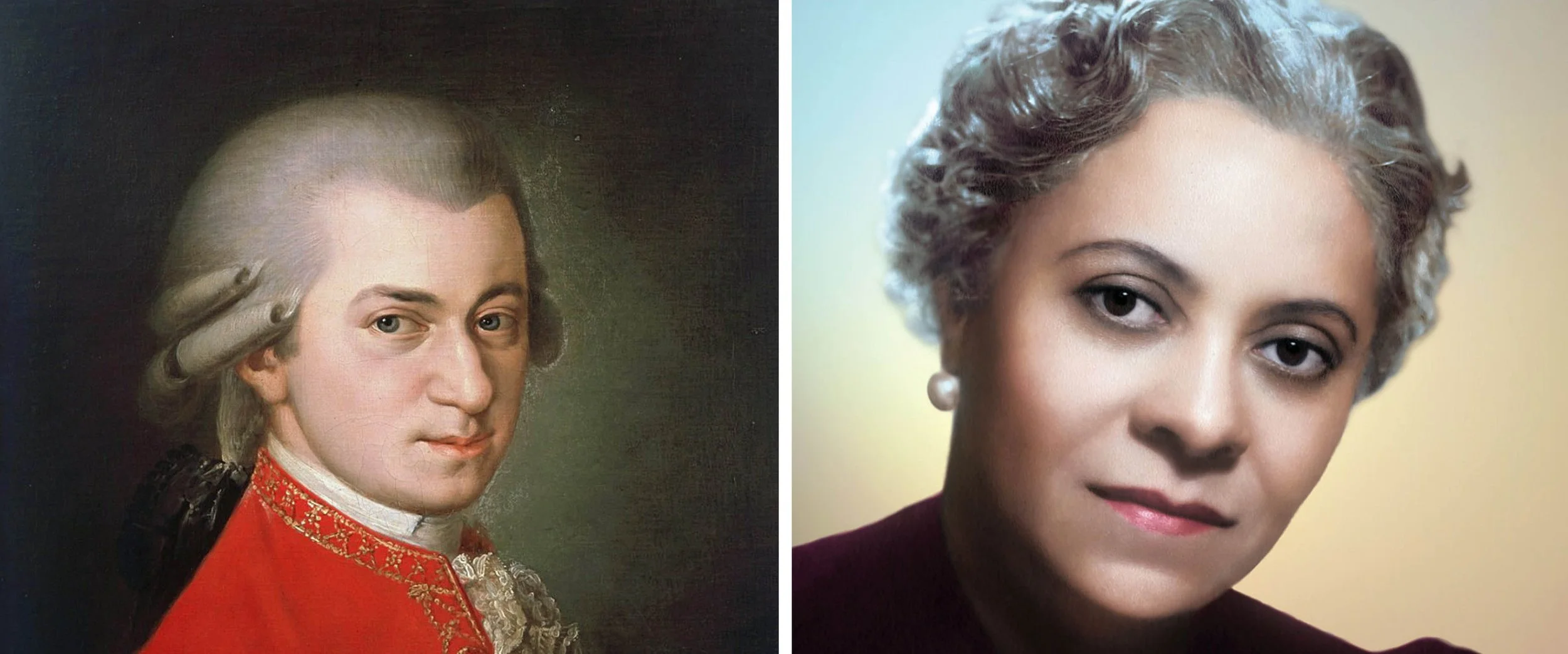
Program Notes: Mozart Requiem
Notes about:
Mozart’s Requiem, K. 626
Price’s Symphony No. 3 in C minor
Program Notes for MAy 12 & 13, 2023
Mozart Requiem
Wolfgang Amadeus Mozart
Requiem, K. 626 (completed by Robert Levin)
Composer: born January 27, 1756, Salzburg, Austria; died December 5, 1791, Vienna
Work composed: 1791. Mozart died before completing the Requiem, an anonymous commission from Count Franz Walsegg von Stuppach. The Requiem was originally finished by one of Mozart’s students, Franz Xaver Süssmayr. The version heard in these concerts was realized and completed by musicologist Robert Levin in 1991.
World premiere: Helmuth Rilling conducted the first performance of Levin’s realization in August 1991 at the European Music Festival in Stuttgart.
Instrumentation: soprano, alto, tenor and bass soloists, SATB chorus, 2 bassoons, 2 basset horns (or clarinets), 2 trumpets, 3 trombones, timpani, organ, and strings
Estimated duration: 53 minutes
The mysterious circumstances surrounding Wolfgang Amadeus Mozart’s Requiem have lent the work an aura of romance and intrigue almost as compelling as the music itself. In the summer of 1791, Count Franz Walsegg von Stuppach sent a messenger to Mozart with an anonymous commission for a Requiem intended to honor Walsegg’s late wife. Walsegg, an amateur musician, had a habit of commissioning works from well-known composers and then claiming them as his own, hence his need for anonymity and subterfuge. Chronically hard up, Mozart accepted the commission. He completed several sketches before putting the Requiem aside to finish Die Zauberflöte and La Clemenza di Tito and to oversee a production of Don Giovanni.
In October 1791, in failing health, Mozart returned to the Requiem. When Mozart died two months later, the Requiem remained unfinished. Mozart’s wife, Constanze, facing a mountain of debt, asked one of Mozart’s associates, Franz Xaver Süssmayr, to complete it. Süssmayr agreed, but his claims of authorship of the later movements of the Requiem have provoked sharp debates over which man wrote what, debates that continue today.
In 1991, musicologist Robert Levin presented his ‘completed’ version of the Requiem in which he corrected what he called Süssmayr’s “errors in musical grammar.” This version has become preferred by conductors and ensembles; since its premiere, there have been over 125 recordings of Levin’s edition.
The fine attention to detail in the meaning of the words of the requiem mass dictates the musical structure throughout. The chorus’ heartfelt pleading in the opening lines, “Requiem aeternam dona eis, Domine” (Grant them eternal rest, O God), are presented in a dark minor key. This is transformed into a promise of glowing eternity in the next sentence, “Et lux perpetua luceat eis” (and may perpetual light shine upon them) as the music moves into the light of a major key. The strong Kyrie (Lord, have mercy/Christ, have mercy) that follows is set in a stark fugue, Mozart’s homage to J. S. Bach.
The Sequence, which is composed of a number of short movements, begins with the Dies Irae (Day of Wrath), whose fiery, agitated setting and orchestral accompaniment bring the terror and fury of the text frighteningly alive. In the Tuba mirum, the bass soloist and a solo trombone proclaim the Day of Judgment, followed by each of the soloists in turn. The chorus returns to beg for salvation from hell in the powerful Rex tremendae, which is followed by the more intimate pleading of the Recordare, in which each of the soloists makes a personal petition to God. The gentleness of this movement is followed by the thunder of the Confutatis, which juxtaposes the images of the damned consigned to the flames of hell with that of the supplicant kneeling in prayer. Then comes the exquisite Lacrymosa, in which the chorus grieves and sobs; The sighing appoggiaturas of the violins echo the lamenting of the text. In the Offertory, the chorus ends its plea for mercy with a reminder of God’s promise to Abraham; these words are set into a tremendous fugue, which recurs at the end of the graceful Hostias.
With the Sanctus comes the first wholly joyful expression of emotion, as the chorus and orchestra together sing God’s praises with shining exclamations in the brasses and a fugue on the words “Hosanna in the highest.” The operatic grace of the melody of the Benedictus, sung by the four soloists, conveys the sense of blessedness of those “who come in the name of the Lord;” this is followed by a recurrence of the choral fugue from the Sanctus. With the Agnus Dei, the chorus and orchestra return to the darkly shifting mood of the opening movement; this culminates in the Communio, which uses the music of the opening Requiem aeternam and concludes with the same fugue used in the Kyrie, but this time on the words “cum sanctis tuis in aeternam” (with Thy saints forever).

Florence price
Symphony No. 3 in C minor

Composer: born April 9, 1887, Little Rock, AR; died June 3, 1953, Chicago
Work composed: 1938-39
World premiere: Valter Poole led the Michigan WPA Symphony Orchestra (aka the Detroit Civic Symphony) on November 6, 1940
Instrumentation: 4 flutes (1 doubling piccolo), 3 oboes (1 doubling English horn), 2 clarinets, bass clarinet, 2 bassoons, 4 horns, 3 trumpets, 3 trombones, tuba, timpani, bass drum, castanets, crash cymbals, gong, orchestral bells, sand paper, slapstick, snare drum, suspended cymbal, tambourine, triangle, wood block, xylophone, celesta, harp, and strings
Estimated duration: 28 minutes
Florence Price, the first Black female American composer to have a symphony performed by a major orchestra, enjoyed considerable renown during her lifetime. Her compositional skill and fame notwithstanding, however, the entrenched institutional racism and sexism of the white male classical music establishment effectively erased Price and her music from general awareness for decades after her death in 1953. More than 50 years later, in 2009, a large collection of scores and unpublished works by Price were discovered in a house in rural Illinois. Since then, many ensembles and individual musicians have begun including Price’s music in concerts, and audiences are discovering her distinctive, polished body of work for the first time.
The daughter of a musical mother, Price was a piano prodigy, giving her first recital at age four and publishing her first composition at 11. During her childhood and teens in Little Rock, Arkansas, Price’s mother was the guiding force behind her piano and composition studies. In 1903, at age 16, Price won admittance to New England Conservatory (she had to “pass” as Mexican and listed her hometown as Pueblo, Mexico, to circumvent prevailing racial bias against Blacks), where she double majored in organ performance and piano pedagogy. While at NEC, Price also studied composition with George Whitefield Chadwick. Chadwick was an early advocate for women composers, and he believed, as did Antonín Dvořák before him, that American composers should incorporate the rich traditions of American vernacular music into their own work, rather than trying to imitate European styles.
Price, already inclined in this direction, was encouraged by Chadwick; many of her works reflect the expressive, distinctive idioms of what were then referred to as “Negro” traditions: spirituals, ragtime, jazz, and folkdance rhythms whose origins trace back to Africa. In 1938, Price wrote, “We are even beginning to believe in the possibility of establishing a national musical idiom. We are waking up to the fact pregnant with possibilities that we already have a folk music in the Negro spirituals – music which is potent, poignant, compelling. It is simple heart music and therefore powerful. It runs the gamut of emotions.”
Price’s later works, including the Symphony No. 3, fuse these uniquely Black American musical idioms with the modernist European language employed by many classical composers of the day. Price explained, “[The Symphony No. 3 is] a cross section of present-day Negro life and thought with its heritage of that which is past, paralleled or influenced by concepts of the present day,” specifically, her use of the expressively dissonant harmonic language of the 20th century.
Each of the Third Symphony’s four movements juxtaposes elements of both musical traditions, often in opposition to one another. The Andante; Allegro opens with a slow, pensive introduction in which brasses and winds feature prominently. This gives way to the Allegro’s restless, harmonically unsettled first theme. A solo trombone introduces a contrasting second section, featuring original melodies grounded in the Black vernacular tradition. The pastoral quality of the Andante ma non troppo evokes the warm serenity of a summer afternoon, while the Juba, an African dance brought to America by enslaved people, transmits its infectious ebullience through syncopated rhythms and specific percussion accents, particularly the castanets and xylophone. The closing Scherzo combines Black-inflected rhythms and 20th-century harmonies in an orchestral showcase full of virtuosic passages.


© Elizabeth Schwartz
NOTE: These program notes are published here by the Modesto Symphony Orchestra for its patrons and other interested readers. Any other use is forbidden without specific permission from the author, who may be contacted at www.classicalmusicprogramnotes.com

Program Notes: Barber & Brahms
Notes about:
Brouwer’s Remembrances
Barber’s Violin Concerto
Brahms’ Symphony No. 2 in D major
Program Notes for February 10 & 11, 2023
Barber & Brahms

Margaret Brouwer
Remembrances

Composer: born February 8, 1940, in Ann Arbor, Michigan
Composed: 1996
written for the Roanoke Symphony, dedicated to Robert Stewart
Premiere: Roanoke Symphony, Yong-Yan Hu, guest conductor, Roanoke, VA, March 18, 1996
Duration: 14 minutes
Instrumentation: 2 (2nd picc.) 2 EH 2 2(2nd cbsn.); 4331; timp., 2 perc., hp., strings
This tone poem is an elegy and a tribute to Robert Stewart who was a musician, composer, sailor and loved one. Beginning with an expression of grief and sorrow, the music evolves into a musical portrait, full of warm memories, love and admiration, and images of sailing. Typical of elegies and tone poems, such as "Death and Transfiguration" by Strauss, it ends in a spirit of consolation and hope.
REVIEWS
"...Next was RSO Composer- in-Residence Margaret Brouwer's lovely tone poem "Remembrances." This was Brouwer at her best: lyrical, accessible, powerful and deeply moving. I have heard a number of Brouwer's works in several venues, and "Remembrances" made the best impression by a long shot. If more contemporary composers would write like Brouwer in this vein, the uneasy armed truce between audiences and modern music would quickly come to an end....In the long second section there were numerous gorgeous solos for winds, including a ravishing line from solo oboe over timpani roll and pedal tones from the double basses. There was also a lovely soliloquy for clarinet. The mood alternated between gentle sorrow and striving affirmation. "Remembrances" ended on a rising three-note figure and the piece was quickly awarded enthusiastic applause, bravos and a standing ovation." - Seth Williamson, Roanoke Times, March 19, 1996
"The moving "Remembrances" is 'an elegy and a tribute' to a deceased loved one. Its 15-minute span allows it to move with unhurried sincerity from mourning to hard-won reassurance. With its consonant tonality, it is the most stereotypical "American" piece on this disc." - Raymond S Tuttle, International Record Review, June 2006
Samuel Barber
Violin Concerto, op. 14
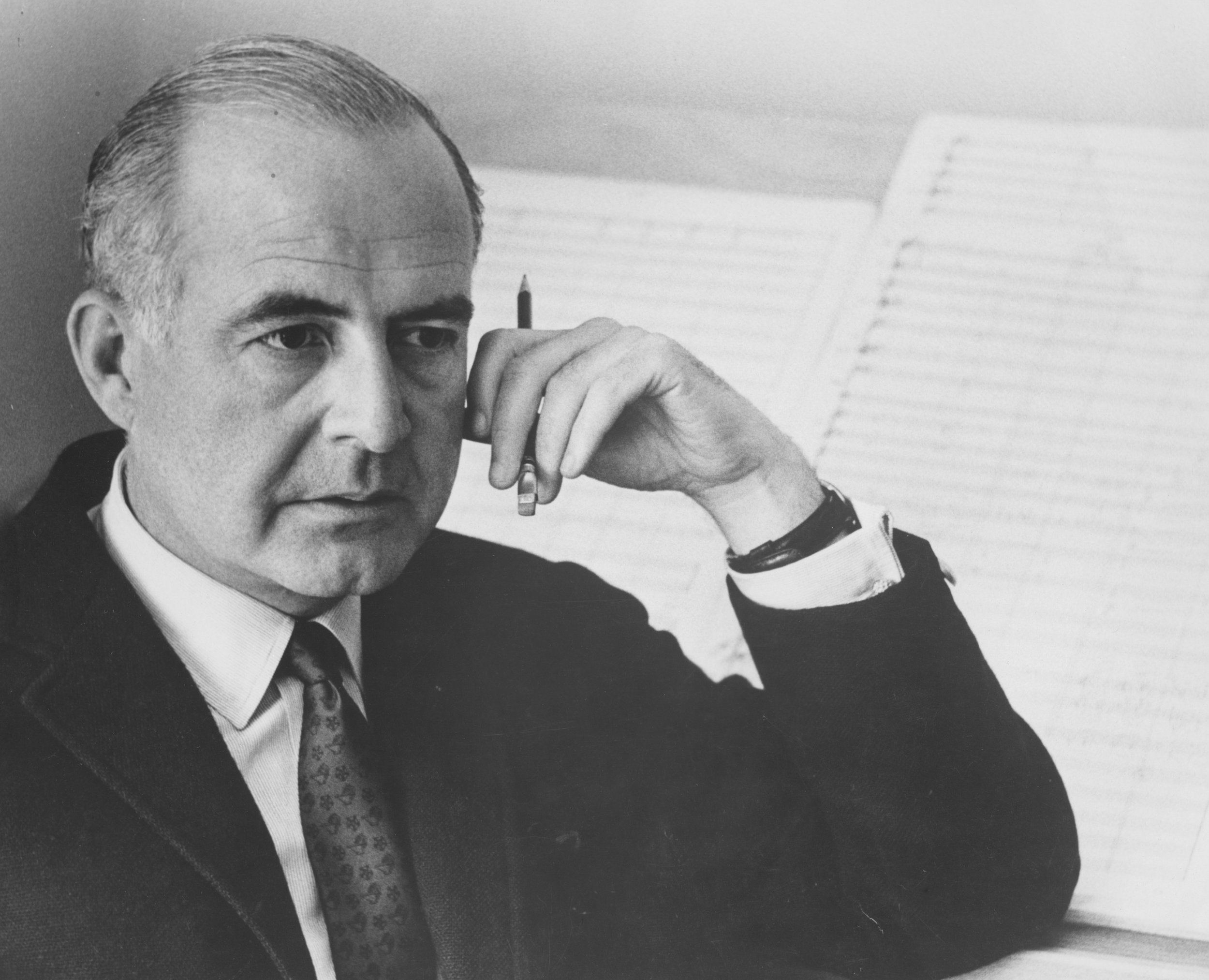
Composer: born March 9, 1910, West Chester, PA; died January 23, 1981, New York City
Work composed: 1939, rev. 1948
World premiere: Eugene Ormandy led the Philadelphia Orchestra, with violinist Albert Spalding, on February 7, 1941. The revised version was first performed by violinist Ruth Posselt, with Serge Koussevitzky leading the Boston Symphony Orchestra, on January 6, 1949.
Instrumentation: solo violin, 2 flutes (one doubling piccolo), 2 oboes, 2 clarinets, 2 bassoons, 2 horns, 2 trumpets, timpani, snare drum, piano, and strings
Estimated duration: 25 minutes
Samuel Barber wrote the Violin Concerto, his first major commission, for Samuel Fels, the inventor of Fels Naptha soap, on behalf Fels’ adopted son, violinist Iso Briselli. Barber began work on the concerto in Switzerland in the summer of 1939, but, due to what he described in a letter as “increasing war anxiety,” Barber left Europe in August and returned home with the final movement still unfinished.
At the end of summer 1939, Barber sent the first two movements to Briselli for comment. Briselli was unimpressed, describing them as “too simple and not brilliant enough for a concerto.” Taking these comments to heart, Barber resolved to write a final movement that would afford “ample opportunity to display the artist’s technical powers.” Briselli found fault with this movement as well, calling it “too lightweight” in comparison with the other movements. In a letter to Fels, Barber wrote, “[I am] sorry not to have given Iso what he had hoped for, but I could not destroy a movement in which I have complete confidence, out of artistic sincerity to myself. So we decided to abandon the project, with no hard feelings on either side.” Barber later approached violinist Albert Spalding, who immediately agreed to premiere the work. Because of all the controversy generated by the third movement, Barber gave the concerto a humorous nickname, the “concerto del sapone,” or a “soap concerto,” a reference both to Fels Naptha and the melodrama of soap operas.
Reviews praised the concerto as “an exceptional popular success” and Barber for writing a concerto “refreshingly free from arbitrary tricks and musical mannerisms … straightforwardness and sincerity are among its most engaging qualities.” The late annotator Michael Steinberg called the opening of the first movement “magical,” and goes on to ask, “Does any other violin concerto begin with such immediacy and with so sweet and elegant a melody?” Few works, certainly few concertos, draw the listener in so quickly, and keep our attention focused so completely. The Andante semplice features a heartbreakingly beautiful oboe solo – classic Barber in its yearning – and the violinist answers it with an impassioned yet surprisingly intimate melody that suggests the violin musing aloud to itself.
The finale, a rondo theme and variations, is particularly impressive. In his program notes for the 1941 premiere, Barber wrote, with characteristic understatement, “The last movement, a perpetual motion, exploits the more brilliant and virtuoso characteristics of the violin.” But as biographer Barbara Heyman points out, “This is one of the few virtually nonstop concerto movements in the violin literature (the solo instrument plays for 110 measures without interruption).”
Watch to learn more about Barber’s Violin Concert from violinist Simone Porter!
JOhannes Brahms
Symphony No. 2 in D major, op. 73
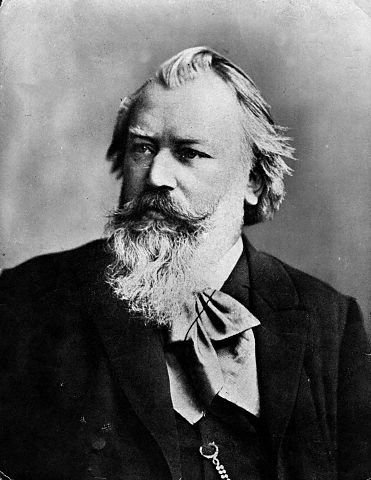
Composer: born May 7, 1833, Hamburg; died April 3, 1897, Vienna
Work composed: During the summer and fall of 1877
World premiere: Hans Richter led the Vienna Philharmonic on December 30, 1877
Instrumentation: 2 flutes, 2 oboes, 2 clarinets, 2 bassoons, 4 horns, 2 trumpets, 3 trombones, tuba, timpani, and strings.
Estimated duration:39 minutes
Less than a year after the successful premiere of Johannes Brahms’ first symphony, on November 4, 1876, the composer left Vienna to spend the summer at the lakeside town of Pörtschach on Lake Wörth, in southern Austria. There, in the beauty and quiet of the countryside, Brahms completed his second symphony. Pörtschach was to be a productive place for Brahms; over the course of three summers there he wrote several important works, including his Violin Concerto. In a letter to critic Eduard Hanslick, a lifelong Brahms supporter, Brahms wrote, “The melodies fly so thick here that you have to be careful not to step on one.”
Unlike Brahms’ first symphony, which took more than 20 years to complete, work on the second went smoothly, and Brahms finished it in just four months. Brahms felt so good about his progress that he joked with his publisher, “The new symphony is so melancholy that you won’t stand it. I have never written anything so sad … the score must appear with a black border.” In a different letter, Brahms self-mockingly observed, “Whether I have a pretty symphony I don’t know; I must ask clever people sometime.”
As Brahms composed, he shared his work-in-progress with lifelong friend Clara Schumann. “Johannes came this evening and played me the first movement of his Second Symphony in D major, which greatly delighted me,” Schumann noted in her diary in October 1877. “I find it in invention more significant than the first movement of the First Symphony … I also heard a part of the last movement and am quite overjoyed with it. With this symphony he will have a more telling success with the public as well than he did with the First, much as musicians are captivated by the latter through its inspiration and wonderful working-out.”
The Symphony No. 2 is often described as the cheerful alter ego to the solemn melancholy of the Symphony No. 1. Brahms uses the lilting notes of the Allegro non troppo as a common link throughout all four movements, where they are repeated, reversed and otherwise, in Schumann’s words, “wonderfully worked-out.” In the extended coda, Brahms introduces the trombones and tuba, casting a tiny shadow over the sunny mood. The Adagio’s lyrical cello melody hints at the wistful melancholy that characterizes so much of Brahms’ music. The Allegretto grazioso is remarkably gentle, and the infectious joy of the closing Allegro con spirito expands on the first movement’s amiable mood, so much so that at the Vienna premiere, the audience demanded an encore.
© Elizabeth Schwartz
NOTE: These program notes are published here by the Modesto Symphony Orchestra for its patrons and other interested readers. Any other use is forbidden without specific permission from the author, who may be contacted at www.classicalmusicprogramnotes.com
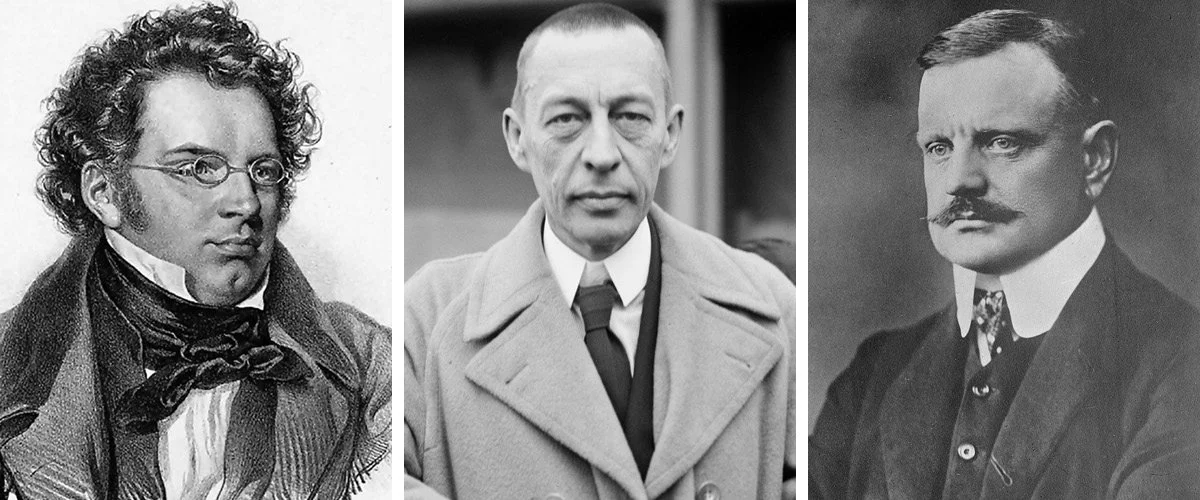
Program Notes: Rachmaninoff & Sibelius
Notes about:
Schubert’s String Quartet No. 14
Rachmaninoff’s Rhapsody on a Theme of Paganini
Sibelius’ Symphony No. 5 in E-flat major
Program Notes for November 11 & 12, 2022
Rachmaninoff & Sibelius
Program Book
Franz Schubert (arr. Hersh)
String Quartet No. 14, II. Andante con moto
Variations on a Theme "Death and the Maiden"

Composer: born January 31, 1797, Vienna; died November 19, 1828, Vienna
Work composed: March 1824; dedicated to violinist Ignaz Schuppanzigh.
World premiere: First performed in a private gathering at the home of Josef Barth on February 1, 1826
Instrumentation: string orchestra
Estimated duration: 10 minutes
In 1824, 27-year-old Franz Schubert was physically and mentally worn out from his years-long battle with syphilis, a battle he lost four years later. The disease caused him extreme pain and weakness, and amplified his tendency to depression. On March 31, 1824, Schubert wrote to a friend, “I feel myself to be the most unfortunate, the most miserable being in the world. Think of a man whose health will never be right again, and who from despair over the fact makes it worse instead of better … My peace is gone, my heart is heavy … each night when I go to sleep I hope never again to wake, and each morning merely reminds me of the misery of yesterday.”
The String Quartet in D minor reflects Schubert’s understandable preoccupation with mortality, from its powerful opening notes through the meditative, soothing Andante; from the angry denunciations of the Scherzo to the breathless defiance of the Presto. The nickname “Death and the Maiden” comes from Schubert’s 1817 setting of Matthias Claudius’ eponymous poem, written in the form of a dialogue between Death and a young woman. The maiden pleads for her life, while Death woos her with promises of an eternal, all-embracing sleep. Schubert repurposed Death’s melody from the song as the basis for the second movement’s theme and variations.
Notes from the Arranger, Nicholas Hersh
This set of variations on the lied "Der Tod und das Mädchen" is an orchestration of the complete second movement of the String Quartet No. 14 "Death and the Maiden," functioning in this arrangement as a standalone concert piece for chamber orchestra. The string section presents the unaltered theme, while the five subsequent variations and coda explore various orchestral colors. I have attempted to preserve Schubert's original markings wherever possible, but I also took an occasional liberty to better serve this symphonic milieu.
Sergei Rachmaninoff
Rhapsody on A Theme of Paganini, Op. 43

Composer: born April 1, 1873, Semyonovo, Starorusky District, Russia; died March 28, 1943, Beverly Hills, CA
Work composed: Rachmaninoff wrote his Rhapsody in six weeks, from July 3 – August 18, 1934, while staying at his villa in Switzerland.
World premiere: Leopold Stokowski led the Philadelphia Orchestra with Rachmaninoff as soloist at the Lyric Opera house in Baltimore, Maryland, on November 7, 1934
Instrumentation: solo piano, piccolo, 2 flutes, 2 oboes, English horn, 2 clarinets, 2 bassoons, 4 horns, 2 trumpets, 3 trombones, tuba, timpani, bass drum, cymbals, glockenspiel, snare drum, triangle, harp, and strings.
Estimated duration: 23 minutes
After he left Russia, Sergei Rachmaninoff found little time for composition. He had a family to support, and his skills as a conductor and concert pianist were more in demand, and paid far better, than composition. Consequently, Rachmaninoff wrote relatively little in the years after the Russian Revolution; instead, he toured with earlier works, like the Second and Third Piano Concertos.
The Rhapsody on a Theme of Paganini is an exception; Rachmaninoff wrote it in 1934, just seven years before his death. Based on the last of Niccolò Paganini’s 24 Caprices for Solo Violin, this melody has inspired variations from a number of other composers, including Franz Liszt, Johannes Brahms, and Witold Lutosławski.
Audiences immediately responded to the Rhapsody’s technical virtuosity and unabashed romanticism. As the late musicologist Michael Steinberg noted, “[the Rhapsody] embodies [Rachmaninoff’s] late style at its brilliant and witty best, it has one of the world’s irresistible melodies and it gives the audiences the satisfaction of watching a pianist work very hard and with obviously rewarding results.”
Critics were far less enthusiastic: one described it as “trite to the verge of cheapness,” while another opined, “[it is] just a concert piece for the composer’s playing, and the day for that sort of thing is past.” The New Yorker critic was especially harsh, denigrating both music and audience: “The Rhapsody isn’t philosophical, significant, or even artistic. It is something for audiences.” Despite the condescending reviews, the Rhapsody became an instant hit on the concert circuit, and remains one of the most popular works for piano and orchestra.
The Rhapsody can be organized into the conventional outline of a piano concerto, with the first ten variations (some under 20 seconds) corresponding to a first movement. These ten variations stay very close to Paganini’s theme and remain in the key of A minor, each one building on the excitement and tension of its predecessor. Variation 11 transitions to the slow “second movement” (variations 12-18). In keeping with the middle movement of a concerto, the harmony shifts from A minor and wanders through several other keys until it arrives at the famous 18th variation in D-flat major, which was featured in the 1993 hit movie Groundhog Day. “This one,” Rachmaninoff shrewdly commented, “is for my agent.” While this variation seems unrelated to the fundamental melody, Rachmaninoff constructed it by simply inverting Paganini’s original theme. The final six variations make up the third movement and feature Paganini’s opening theme as the Rhapsody builds to its fiery climax.
Jean Sibelius
Symphony No. 5 in E-flat major, Op. 82

Composer: born December 8, 1865, Hämeenlinna, Finland; died September 20, 1957, Järvenpää, Finland
Work composed: 1914-15, rev. 1916, 1919
World premiere: Sibelius completed the first version of the Fifth Symphony just in time to conduct it for his fiftieth birthday on December 8, 1915, with the Helsinki Municipal Orchestra. A year later, Sibelius revised Op. 82 and conducted it with the same ensemble. The final version was completed in 1919; Sibelius conducted it on October 21, 1921.
Instrumentation: 2 flutes, 2 oboes, 2 clarinets, 2 bassoons, 4 horns, 3 trumpets, 3 trombones, timpani, and strings
Estimated duration: 31 minutes
“These symphonies of mine are more confessions of faith than are my other works,” wrote Jean Sibelius in 1918, while revising his Symphony No. 5 for the third time. Always his own harshest critic, Sibelius struggled to realize his original musical conception of the Symphony over a period of six difficult years.
Sibelius’ multiple attempts to write a version of the Fifth Symphony that withstood his implacable self-criticism were hampered by personal problems and global upheaval. In the years 1910-14, Sibelius struggled with the desire to be perceived by the world as a “modern” composer, but at the same time he rejected the prevailing styles established by Debussy, Mahler, and Richard Strauss. Composing, frequently difficult for Sibelius even under the best of circumstances, was made even harder by the composer’s poor health and chronic alcoholism.
From 1914-18, the chaos and brutality of WWI engulfed Europe. In 1917 Finland declared independence from Russia, which sparked additional conflict between the two countries. In 1918, an invasion of Russian soldiers into his town forced Sibelius and his family to flee to Helsinki. Later that year, Sibelius returned home and resumed his life and work, including the third revision of the Fifth Symphony, which he described as “practically composed anew.”
The reworked symphony condenses the original four movements into three – Sibelius combined the first and second movements – and features a new finale. The Tempo molto moderato is textbook Sibelius, featuring brief, fragmentary ideas that surface somewhat enigmatically from the depths of the orchestra. A short melody in the horns later coalesces into a fully developed theme. At times the instruments seem to murmur to themselves; as the music progresses, the strings and brasses declaim bold proclamations.
In the Andante mosso, pizzicato strings and staccato flutes state the primary melody, while a group of woodwinds and horns sound a counter-theme of long sustained notes. These shimmering notes become a backdrop for several variations on the staccato main theme.
On April 21, 1915, Sibelius wrote in his diary, “Today at ten to eleven I saw 16 swans. One of my greatest experiences. Lord God, that beauty!” The opening of the finale captures this rustle of wings with tremolo strings accompanying an expansive melody, also in the strings. Sibelius juxtaposed this breathless music with a majestic “swan theme” sounded first by the horns. As the symphony concludes, the swan theme becomes an exultant shout of triumph.
© Elizabeth Schwartz
NOTE: These program notes are published here by the Modesto Symphony Orchestra for its patrons and other interested readers. Any other use is forbidden without specific permission from the author, who may be contacted at www.classicalmusicprogramnotes.com
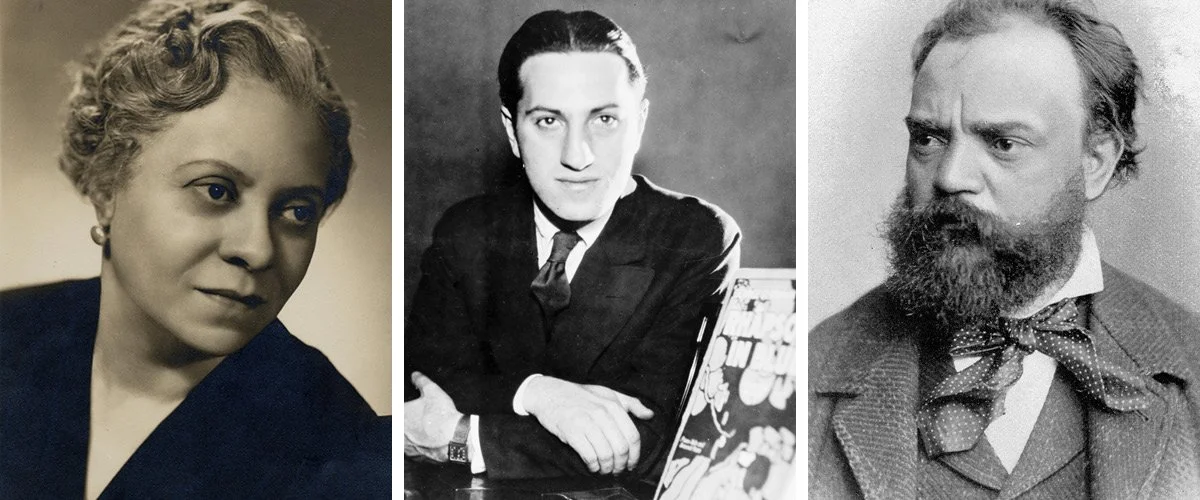
Program Notes: Rhapsody in Blue
Notes about:
Price’s Concert Overture No. 2
Gershwin’s Rhapsody in Blue
Dvořák’s Symphony No. 9 in E minor, “From the New World,” Op. 95
Program Notes for October 21 & 22, 2022
Rhapsody in Blue
Florence Price
Concert Overture No. 2
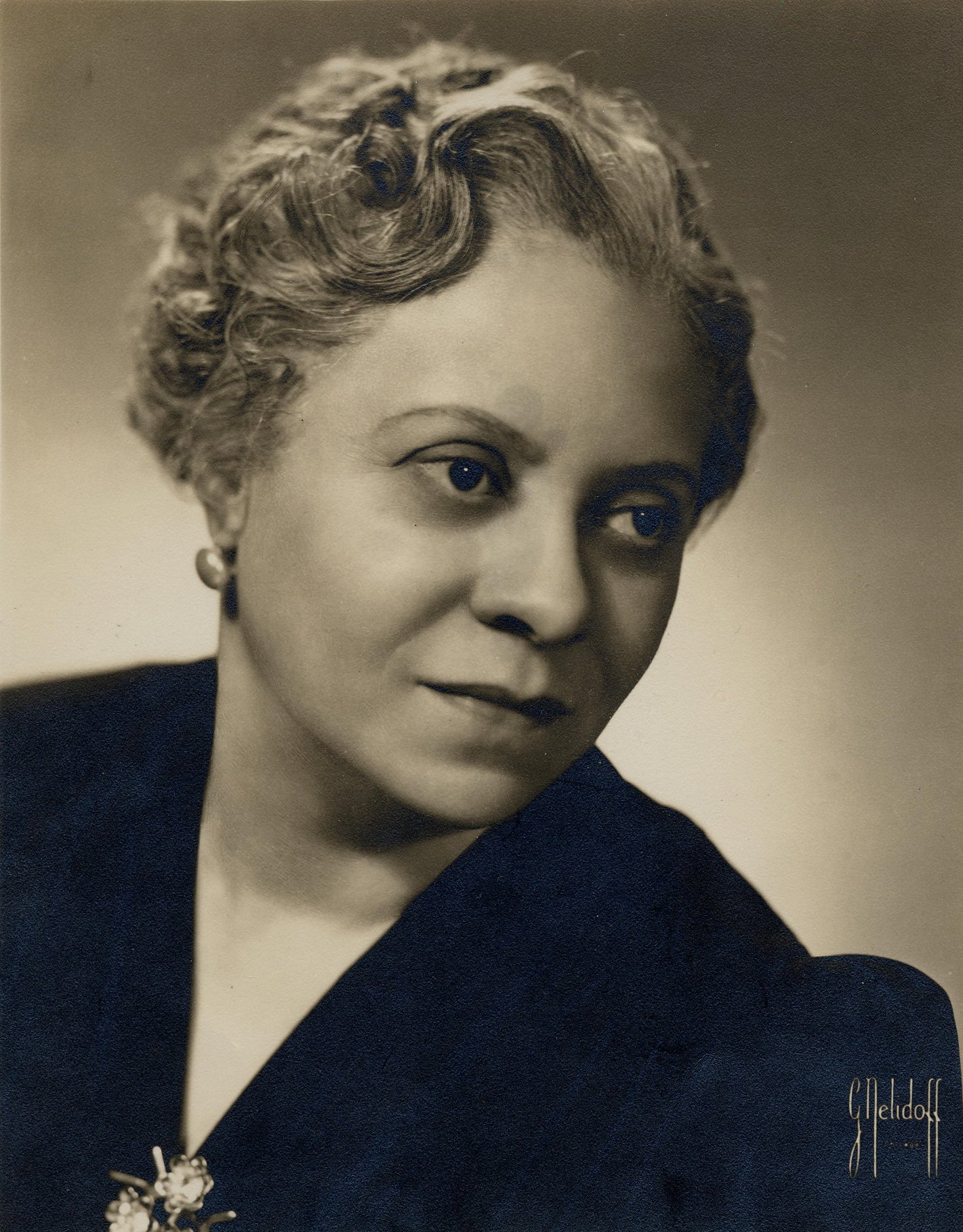
Composer: born April 9, 1887, Little Rock, AR; died June 3, 1953, Chicago
Work composed: 1943
World premiere: undocumented
Instrumentation: piccolo, 3 flutes, 2 oboes, English horn, 2 clarinets, bass clarinet, 2 bassoons, 4 horns, 3 trumpets, 3 trombones, tuba, timpani, bass drum, cymbals, snare drum, harp, and strings
Estimated duration:15 minutes
As the first Black female American composer to have a symphony performed by a major orchestra, Florence Price enjoyed considerable renown during her lifetime. Her compositional skill and fame notwithstanding, the entrenched institutional racism and sexism of the white male classical music establishment effectively erased Price and her music from general awareness for decades after her death. In 2009, a large collection of scores and unpublished works by Price were discovered in a house in rural Illinois. Since then, scholars, musicians, and audiences have been discovering Price’s work and her rich legacy.
The daughter of a musical mother, Price was a prodigy, giving her first recital at age four and publishing her first composition at 11. During her childhood and teens, Price’s mother was the guiding force behind her piano and composition studies. Young Florence entered New England Conservatory in 1903, at 16, where she double majored in organ performance and piano pedagogy. While at NEC, Price also studied composition with George Whitefield Chadwick. Chadwick was an early champion of women as composers, which was highly unusual at the time, and he believed that American composers should incorporate the rich traditions of native American and “Negro” styles in their own works. Price, already inclined in this direction, was encouraged by Chadwick, and many of her works, including tonight’s Concert Overture No. 2, reflect the expressive and distinctive sounds of Negro traditions, particularly the spirituals, ragtime, and folkdance rhythms whose origins trace back to Africa. This overture features the spirituals “Go Down, Moses,” “Nobody Knows the Trouble I’ve Seen,” and “Every Time I Feel the Spirit.”
George Gershwin
Concerto for Tabla & Orchestra
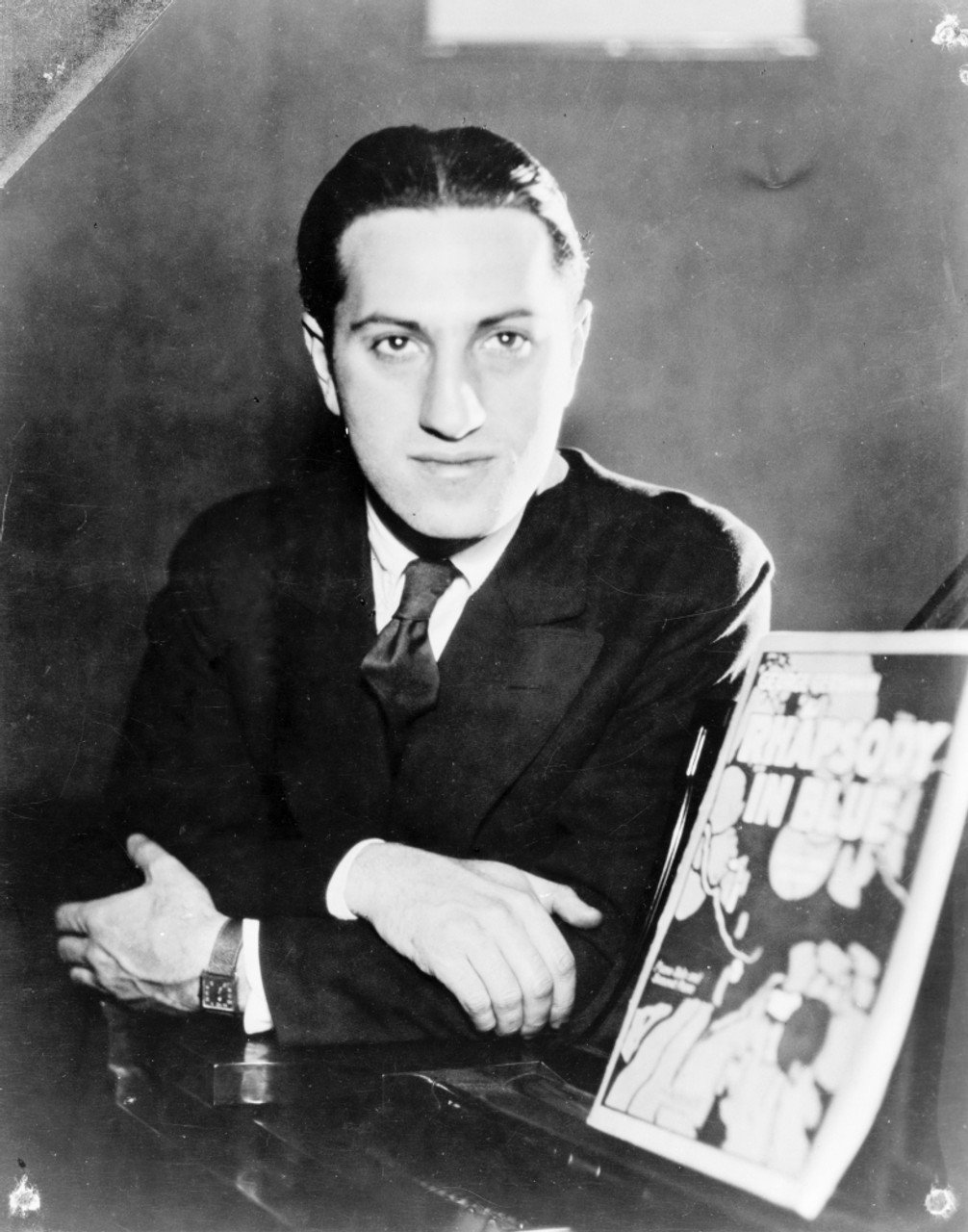
Composer: born September 26, 1898, Brooklyn, NY; died July 11, 1937, Hollywood, CA
Work composed: Gershwin wrote Rhapsody in Blue in the first three weeks of 1924
World premiere: Gershwin was at the piano when Paul Whiteman’s Orchestra premiered Rhapsody in Blue at Aeolian Hall in New York City, on February 12, 1924
Instrumentation: solo piano, 2 flutes, 2 oboes, 2 clarinets, bass clarinet, alto saxophone, tenor saxophone, 3 horns, 3 trumpets, 3 trombones, tuba, timpani, bass drum, cymbals, gong, glockenspiel, snare drum, celesta, triangle, banjo, and strings
Estimated duration: 15 minutes
Rhapsody in Blue introduced jazz to classical audiences, and simultaneously made an instant star of its composer. From its iconic clarinet glissando to its brilliant finale, Rhapsody in Blue epitomizes the Gershwin sound, and transformed the 25-year-old Tin Pan Alley songwriter into a composer of “serious” music.
On January 4, 1924, Ira Gershwin showed George a news report in the New York Tribune about a concert put together by jazz bandleader Paul Whiteman, grandiosely titled “An Experiment in Modern Music,” that would endeavor to trace the history of jazz. The article concluded, “George Gershwin is at work on a jazz concerto.” This was certainly news to Gershwin, who was then in rehearsals for a Broadway show, Sweet Little Devil. Gershwin contacted Whiteman to refute the Tribune article, but Whiteman eventually talked Gershwin into writing the concerto.
In 1931, Gershwin described to biographer Isaac Goldberg how the musical ideas for Rhapsody in Blue first emerged: “It was on the train, with its steely rhythms, its rattle-ty bang, that is so often so stimulating to a composer … And there I suddenly heard, and even saw on paper – the complete construction of the Rhapsody, from beginning to end … I heard it as a sort of musical kaleidoscope of America, of our vast melting pot, of our unduplicated national pep, of our metropolitan madness. By the time I reached Boston I had a definite plot of the piece, as distinguished from its actual substance.”
At the premiere, Gershwin’s unique realization of this “musical kaleidoscope of America,” coupled with his phenomenal abilities at the keyboard, wowed the audience as much as the novelty of hearing jazz idioms in a classical work.
The opening clarinet solo got its signature jazzy glissando from Whiteman’s clarinetist Ross Gorman. This opening unleashes a floodgate of colorful ideas that blend seamlessly. The pulsing syncopated rhythms and showy music eventually morph into a warm, expansive melody à la Sergei Rachmaninoff.
Antonín Dvořák
Symphony No. 9 in E minor, Op. 95, “From the New World”
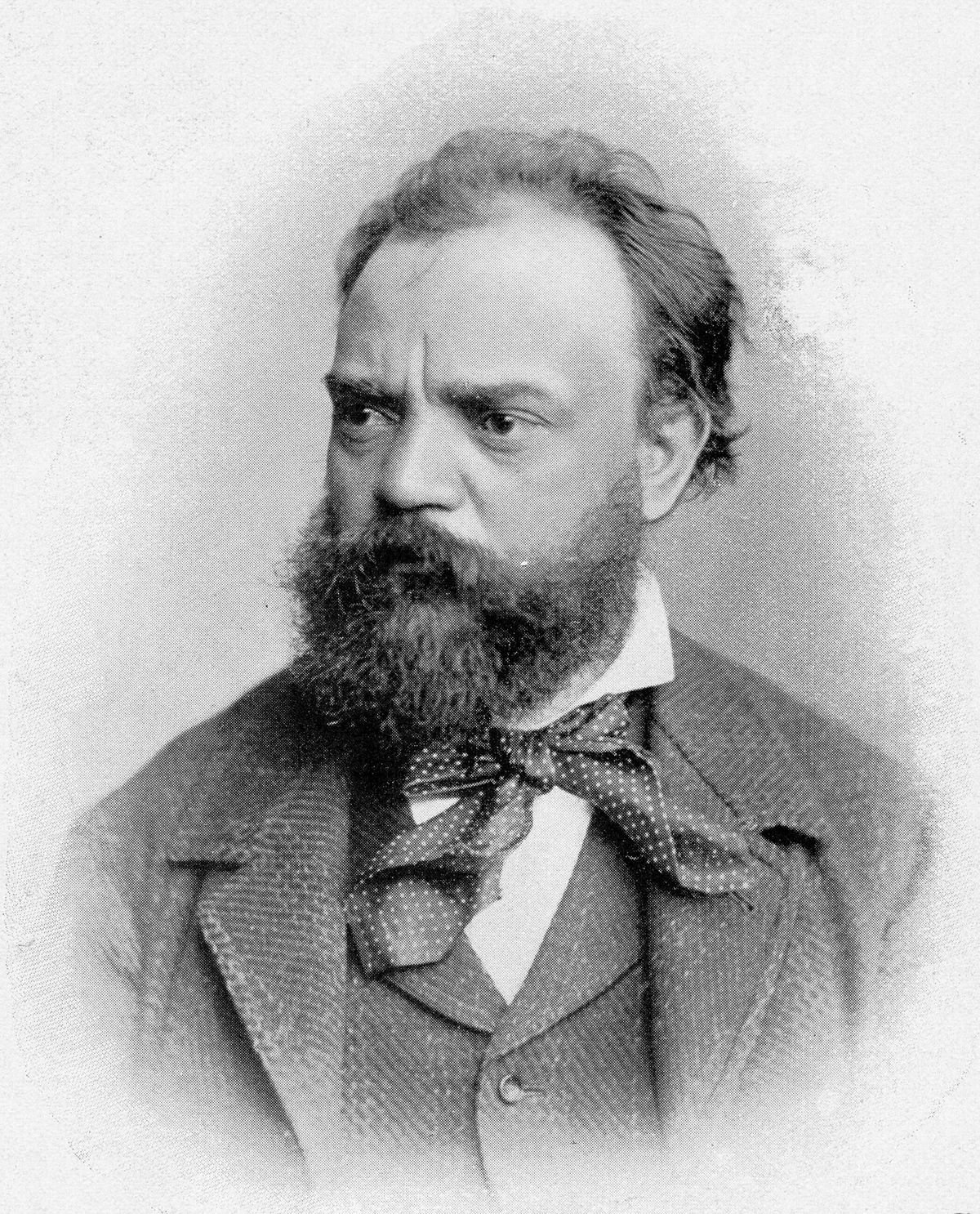
Composer: born September 8, 1841, Nelahozeves, near Kralupy in Bohemia (now the Czech Republic); died May 1, 1904, Prague
Work composed: 1892-1893 in New York City
World premiere: Anton Seidl led the New York Philharmonic on December 16, 1893, at Carnegie Hall.
Instrumentation: 2 flutes (1 doubling piccolo), 2 oboes, English horn, 2 clarinets, 2 bassoons, 4 horns, 2 trumpets, 3 trombones, tuba, timpani, cymbals, triangle, and strings.
Estimated duration: 40 minutes
Antonín Dvořák began his Ninth Symphony in December 1892, shortly after he arrived in America, and completed it the following May. During his three-year sojourn in New York, Dvořák explored the city, watched trains and large ships arrive and depart, fed pigeons in Central Park, and met all kinds of people. Late in 1892, Dvořák wrote to a friend back home, “The Americans expect great things of me. I am to show them the way into the Promised Land, the realm of a new, independent art, in short, a national style of music! … This will certainly be a great and lofty task, and I hope that with God’s help I shall succeed in it. I have plenty of encouragement to do so.”
Dvořák was also introduced to a great deal of American folk music, including Native American melodies and Negro spirituals. However, he did not quote any of them in the Ninth Symphony. Dvořák explained, “The influence of America can be readily felt by anyone with ‘a nose.’” That is, hints of the uniquely American flavor of this music are discernable throughout, as Dvořák made use of the syncopated rhythms, repeated patterns, and particular scales common to much of America’s indigenous music. But the Ninth Symphony is not a patchwork of previously existing materials, and all the melodies in the Ninth Symphony are Dvořák’s own (including the famous English horn solo in the Largo, which was later given the title “Goin’ Home,” with accompanying text, by one of Dvořák’s New York composition students, a young Black composer and baritone named Harry Burleigh).
“I have simply written original themes embodying the peculiarities of Indian music, and, using these themes as subjects, have developed them with all the resources of modern rhythms, harmony, counterpoint, and orchestral color,” Dvořák explained. As for the title, “From the New World,” Dvořák intended it as an aural picture postcard to be mailed back to friends and family in Europe and meant simply “Impressions and Greetings from the New World.”
At the premiere, the audience applauded every movement with great enthusiasm, especially the Largo, which they cheered without pause until Dvořák rose from his seat and took a bow. A critic writing for the New York Evening Post spoke for most when he wrote, “Anyone who heard it could not deny that it is the greatest symphonic work ever composed in this country … A masterwork has been added to the symphonic literature.”
© Elizabeth Schwartz
NOTE: These program notes are published here by the Modesto Symphony Orchestra for its patrons and other interested readers. Any other use is forbidden without specific permission from the author, who may be contacted at www.classicalmusicprogramnotes.com

Program Notes: Haas conducts Wijeratne & Tchaikovsky
Notes about:
Beethoven’s Coriolan Overture, op. 62
Wijeratne’s Tabla Concerto
Tchaikovsky’s Symphony No. 4 in F minor, op. 36
Program Notes for May 6 & 7, 2022
Haas conducts Wijeratne & Tchaikovsky
Ludwig Van Beethoven
Coriolan Overture, op. 26
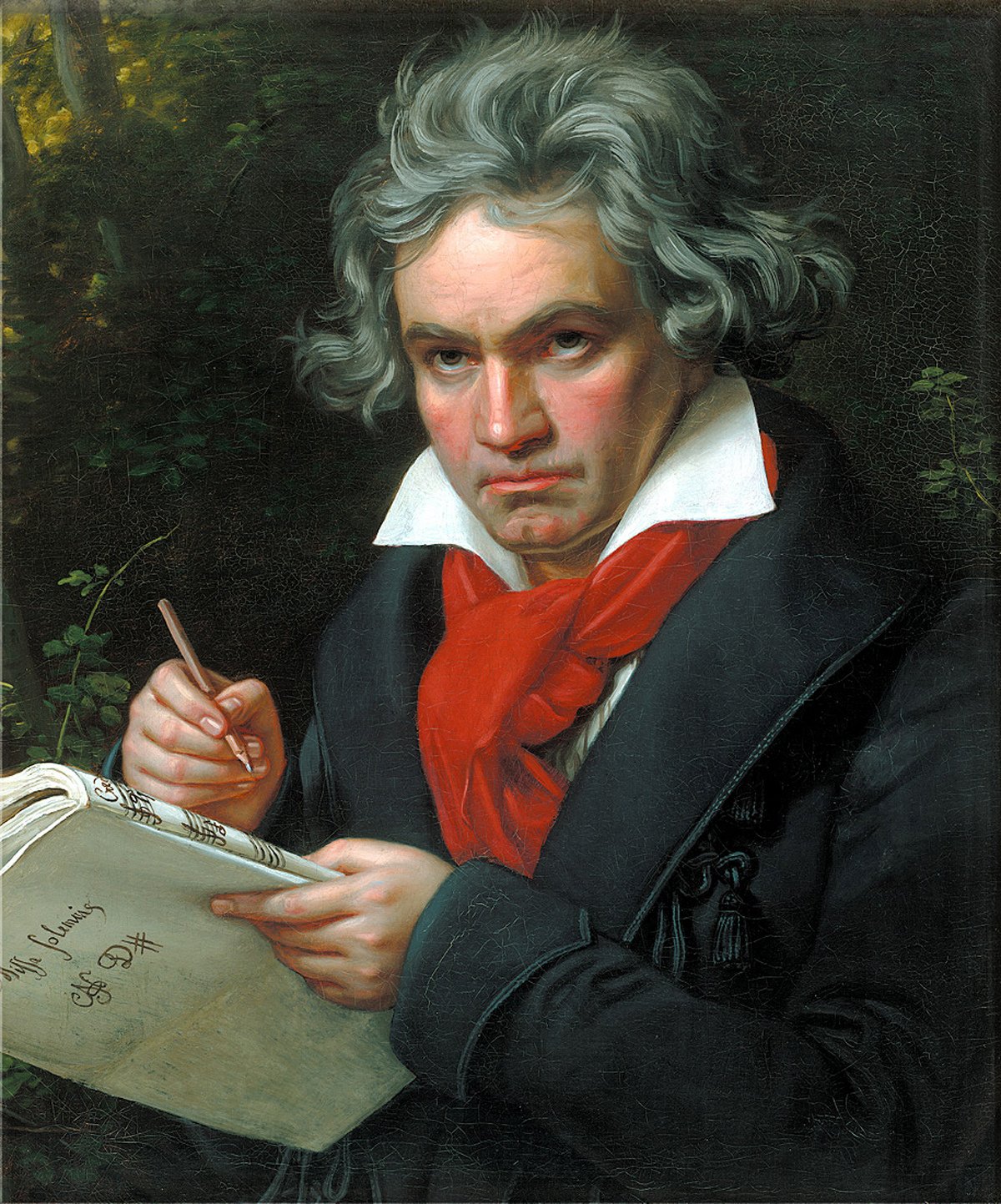
Composer: born December 16, 1770, Bonn, Germany; died March 26, 1827, Vienna
Work composed: 1807
World premiere: Beethoven conducted a private concert in the Vienna palace of his patron, Prince Lobkowitz, in March 1807, in a performance that also included premieres of his Symphony No. 4 and Piano Concerto No. 4.
Instrumentation: 2 flutes, 2 oboes, 2 clarinets, 2 bassoons, 2 horns, 2 trumpets, timpani, and strings
Estimated duration: 8 minutes
Most overtures serve as instrumental introductions to operas or plays. Ludwig van Beethoven’s Coriolan Overture, although inspired by his countryman Heinrich Joseph Collin’s play about the Roman general Gaius Marcius Coriolanus, was a purely orchestral work from its inception. Unfortunately for Collin, his play, unlike Shakespeare’s on the same subject, was not well received in its initial run in 1804, nor its revival three years later.
In Collin’s play, a hubristic Coriolanus declares war on his hometown of Rome, which had exiled him for his inattention to its plebeian citizens. Enraged, Coriolanus enlists the help of Rome’s most fearsome enemies, the Volsci, to storm the city. As Coriolanus approaches at the head of the Volscian armies, Roman officials sue for peace, to no avail. Coriolanus’ wife, Volumnia, along with his mother and his two sons, also beg him to cease fighting. Coriolanus is moved by his family’s entreaties and, overcome with shame at his dishonorable behavior, literally falls on his sword (this differs from Shakespeare’s ending, in which Coriolanus is murdered).
The dramatic elements of Coriolanus’ story inspired Beethoven’s musical imagination. The music traces an emotional arc, contrasting Coriolanus’ fury and bellicosity with Volumnia’s quiet, forceful pleas for peace.

Dinuk Wijeratne
Concerto for Tabla & Orchestra
Composer: born 1978, Sri Lanka
Work composed: 2011, commissioned by Symphony Nova Scotia
World premiere: Recorded live by the CBC, February 9th, 2012 at the Rebecca Cohn Auditorium, Halifax, Nova Scotia, featuring Ed Hanley (Tabla) & Symphony Nova Scotia conducted by Bernhard Gueller.
*The Tabla Concerto was twice a finalist for the Masterworks Arts Award (2012, 2016).
Instrumentation: 2 flutes (2nd doubling piccolo), 2 oboes (2nd doubling cor anglais), 2 clarinets in B♭ (2nd doubling bass clarinet), 2 bassoons, 2 horns in F, 2 trumpets in B, 1 trombone, timpani, 2 percussion, harp, strings
Duration: 27 minutes
Composer’s original program notes:
Canons, Circles
Folk song: ‘White in the moon the long road lies (that leads me from my love)’
Garland of Gems
While the origins of the Tabla are somewhat obscure, it is evident that this ‘king’ of Indian percussion instruments has achieved global popularity for the richness of its timbre, and for the virtuosity of a rhythmically complex repertoire that cannot be separated from the instrument itself. In writing a large-scale work for Tabla and Symphony Orchestra, it is my hope to allow each entity to preserve its own aesthetic. Perhaps, at the same time, the stage will be set for some new discoveries.
While steeped in tradition, the Tabla lends itself heartily to innovation, and has shown its cultural versatility as an increasingly sought-after instrument in contemporary Western contexts such as Pop, Film Music, and World Music Fusion. This notion led me to conceive of an opening movement that would do the not-so-obvious by placing the Tabla first in a decidedly non-Indian context. Here, initiated by a quasi-Baroque canon in four parts, the music quickly turns into an evocation of one my favourite genres of electronic music: ‘Drum-&-Bass’, characterised by rapid ‘breakbeat’ rhythms in the percussion. Of course, there are some North-Indian Classical musical elements present. The whole makes for a rather bizarre stew that reflects globalisation, for better or worse!
A brief second movement becomes a short respite from the energy of the outer movements, and offers a perspective of the Tabla as accompanist in the lyrical world of Indian folk-song. Set in ‘dheepchandhi’, a rhythmic cycle of 14 beats, the gently lilting gait of theTabla rhythm supports various melodic fragments that come together to form an ephemeral love-song.
Typically, a Tabla player concluding a solo recital would do so by presenting a sequence of short, fixed (non-improvised) compositions from his/her repertoire. Each mini-composition, multi-faceted as a little gem, would often be presented first in the form of a vocal recitation. The traditional accompaniment would consist of a drone as well as a looping melody outlining the time cycle – a ‘nagma’ – against which the soloist would weave rhythmically intricate patterns of tension and release. I wanted to offer my own take on a such a recital finale, with the caveat that the orchestra is no bystander. In this movement, it is spurred on by the soloist to share in some of the rhythmic complexity. The whole movement is set in ‘teentaal’, or 16-beat cycle, and in another departure from the traditional norm, my nagma kaleidoscopically changes colour from start to finish. I am indebted to Ed Hanley for helping me choose several ‘gems’ from the Tabla repertoire, although we have certainly had our own fun in tweaking a few, not to mention composing a couple from scratch.
© Dinuk Wijeratne 2011
Notes from the Conductor, Paul Haas:
As a conductor, I’m always on the lookout for great new music. I love that feeling of discovery, especially when I can share it with orchestra musicians and a whole auditorium full of audience members. And Dinuk’s Tabla Concerto is one of the best pieces I’ve ever come across: full of life, emotion, and color.
The first time I ever programmed it (4 years ago in Thunder Bay, Canada) I wanted the Tabla Concerto to end the entire concert, and I needed it to leave the audience ecstatic. There was a stumbling block, though: the third movement (the written ending) of the Tabla Concerto is admittedly wonderful and down-to-earth, and the soloist sings in addition to playing the tablas. But it doesn’t end with that true excitement and momentum I was looking for. From my perspective, it’s almost impossible to end a concert with it, especially if you want the audience so excited they jump out of their seats.
But somehow I knew this was the right piece to close with. So I thought and thought, and eventually it hit me. Dinuk’s Tabla Concerto actually IS the perfect closer, but only if you do the first two movements, and in reverse order. So we started with the second movement, and then we ended with the first movement. And it was sensational. So sensational, in fact, that I begged Dinuk to let me conduct it this way for you, tonight. So that we can end the first half of our evening together with that same feeling of excitement we achieved in Thunder Bay.
Dinuk agreed, and the rest is history. I can’t wait to share his incredible music with you.

Pyotr Ilyich Tchaikovsky
Symphony No.4 in F minor, Op. 36
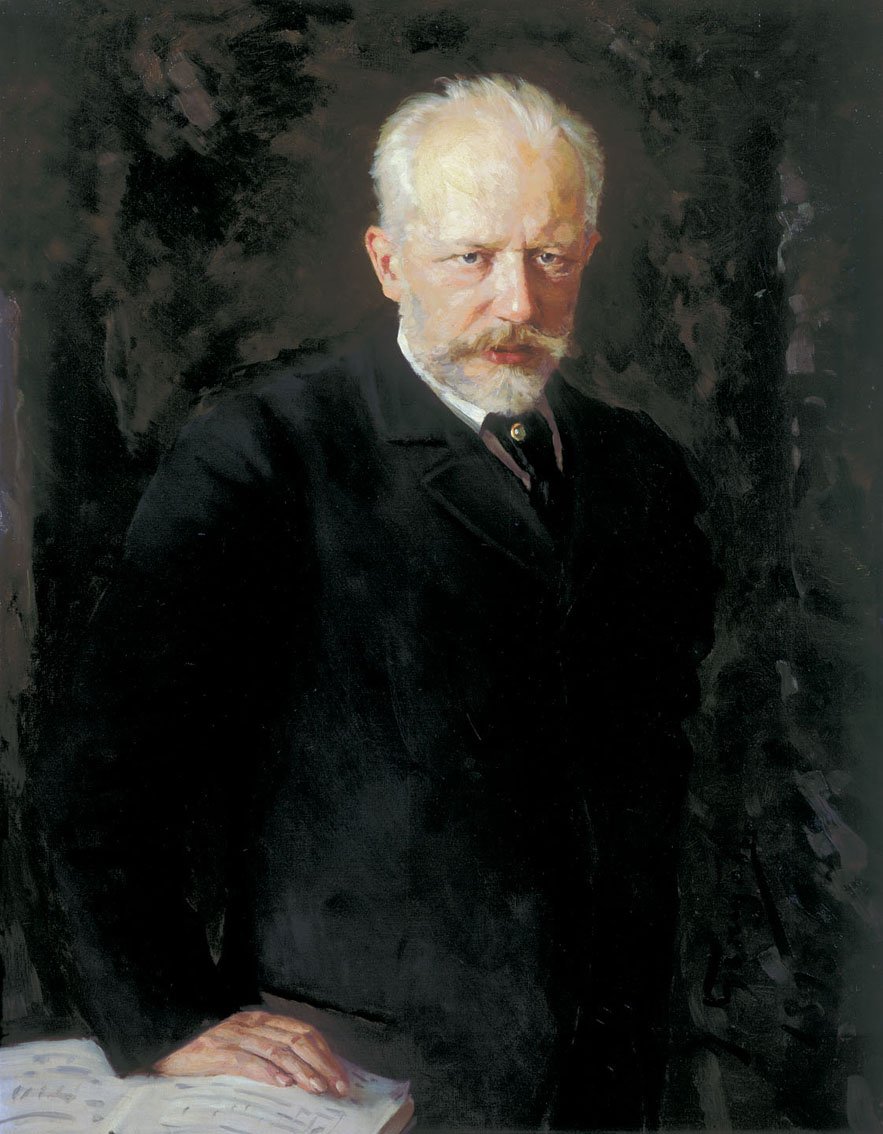
Composer: born May 7, 1840, Kamsko-Votinsk, Viatka province, Russia; died November 6, 1893, St. Petersburg
Work composed: 1877-78. Dedicated to Nadezhda von Meck
World premiere: Nikolai Rubinstein led the Russian Musical Society orchestra on February 22, 1878, in Moscow
Instrumentation: piccolo, 2 flutes, 2 oboes, 2 clarinets, 2 bassoons, 4 horns, 2 trumpets, 3 trombones, tuba, timpani, bass drum, cymbals, triangle, and strings.
Estimated duration: 44 minutes
When a former student from the Moscow Conservatory challenged Pyotr Ilyich Tchaikovsky about the “program” for his fourth symphony, the composer responded, “Of course my symphony is programmatic, but this program is such that it cannot be formulated in words. That would excite ridicule and appear comic … In essence, my symphony is an imitation of Beethoven’s Fifth; i.e., I imitated not the musical ideas, but the fundamental concept.”
In December 1876, Tchaikovsky began an epistolary relationship with Mrs. Nadezhda von Meck, a wealthy widow and ardent fan of Tchaikovsky’s music. Mme. von Meck offered to become Tchaikovsky’s patron on the condition that they never meet in person; the introverted Tchaikovsky agreed. Soon after von Meck first wrote to Tchaikovsky, he began the Fourth Symphony. As he worked, Tchaikovsky kept von Meck informed of his progress. He dedicated the Fourth Symphony “to my best friend,” which simultaneously paid tribute to von Meck and insured her privacy.
Six months later, Tchaikovsky encountered Antonina Ivanova Milyukova, a former Conservatory student obsessed with her one-time professor. She sent Tchaikovsky several impassioned letters, which alarmed him; eventually Milyukova threatened to kill herself if Tchaikovsky did not return her affection. This untenable situation, combined with Tchaikovsky’s tortured feelings about his sexual orientation and his desire to silence gossip about it, led to a hasty, ill-advised union. Tchaikovsky fled from Milyukova a month after the wedding (their marriage officially ended after three months, although they were never divorced) and subsequently suffered a nervous breakdown. He was unable to compose any music for the next three years.
Beginning with the Fourth Symphony, Tchaikovsky launched a musical exploration of the concept of Fate as an inescapable force. In a letter to Mme. von Meck, Tchaikovsky explained, “The introduction is the seed of the whole symphony, undoubtedly the central theme. This is Fate, i.e., that fateful force which prevents the impulse to happiness from entirely achieving its goal, forever on jealous guard lest peace and well-being should ever be attained in complete and unclouded form, hanging above us like the Sword of Damocles, constantly and unremittingly poisoning the soul. Its force is invisible and can never be overcome. Our only choice is to surrender to it, and to languish fruitlessly.”
The Fate motive blasts open the symphony with a mighty proclamation from the brasses and bassoons. “One’s whole life is just a perpetual traffic between the grimness of reality and one’s fleeting dreams of happiness,” Tchaikovsky wrote of this movement. This theme returns later in the movement and at the end of the fourth, a reminder of destiny’s inescapability.
The beauty of the solo oboe that begins the Andantino beckons, and the yearning countermelody of the strings surges with surprising energy before it subsides. In the Scherzo, Tchaikovsky departs from the heaviness of the previous movements with pizzicato strings. Tchaikovsky described this playful movement as a series of “capricious arabesques.”
As in the first movement, the Finale bursts forth with a blaze of sound. Marked Allegro con fuoco (with fire), the music builds to a raging inferno. Abruptly, Fate returns and the symphony concludes with barely controlled frenzy, accented by cymbal crashes.

© Elizabeth Schwartz
NOTE: These program notes are published here by the Modesto Symphony Orchestra for its patrons and other interested readers. Any other use is forbidden without specific permission from the author, who may be contacted at www.classicalmusicprogramnotes.com
Program Notes: Meyer conducts Prokofiev & Brahms
Notes about:
Golijov’s Sidereus
Prokofiev’s Piano Concerto No. 3 in C major, Op. 26
Brahms’ Symphony No. 1 in C minor, Op. 68
Program Notes for April 1 & 2, 2022
Meyer conducts Prokofiev & Brahms
Osvaldo Golijov
Sidereus
Composer: born December 5, 1960, La Plata, Argentina
Work composed: 2010; co-commissioned by 36 orchestras to honor the career of Henry Fogel, former President and CEO of the League of American Orchestras.
World premiere: Mei-Ann Chen led the Memphis Symphony Orchestra at the Cannon Center for the Performing Arts in Memphis, TN, on October 16, 2010.
Instrumentation: 2 flutes, 2 oboes, English horn, 2 clarinets, bass clarinet, 2 bassoons, contrabassoon, 2 horns, trumpet, piccolo trumpet, trombone, bass trombone, tuba, timpani, and strings
Estimated duration: 9 minutes
Since 2000, when Osvaldo Golijov’s La Pasión según San Marcos (St. Mark Passion) premiered, he and his music have been at the forefront of the contemporary music world; The Boston Globe hailed La Pasión as “the first indisputably great composition of the 21st century.” Golijov has also received acclaim for other groundbreaking works such as his opera Ainadamar; the clarinet quintet The Dreams and Prayers of Isaac the Blind; several works for Yo-Yo Ma and the Silk Road Ensemble; vocal music for soprano Dawn Upshaw; and scores he has written for the films of Francis Ford Coppola. In the fall of 2021, Golijov’s latest work, Um Dia Bom, for the string quartet Brooklyn Rider, premiered in Boston. Golijov is currently the Loyola Professor of Music at College of the Holy Cross, where he has taught since 1991.
The title Sidereus comes from the 17th-century Italian astronomer Galileo Galilei, whose 1610 treatise Sidereus Nuncius (Starry Messenger) described his detailed telescopic observations of the surface of the moon. “With these discoveries, the moon was no longer the province of poets exclusively,” Golijov said in an interview. “It had also become an object of inquiry: Could there be water there? Life? If there was life, then the Vatican was scared, because, as Cardinal Bellarmino wrote to Galileo: How were the people there created? How would their souls be saved? What do we do about Adam? Wasn’t he supposed to be the first man? How do we explain the origin of possible life elsewhere? What about his rib? It’s the duality: the moon is still good for love and lovers and poets, but a scientific observation can lead us to entirely new realizations.”
Two years after its premiere, composer and critic Tom Manoff heard the Eugene Symphony perform Sidereus, and noticed an uncanny resemblance between it and Barbeich, a solo work for accordion by Michael Ward-Bergeman. In his blog, Manoff accused Golijov of plagiarism. A number of other well-known critics latched on to the story, and a major controversy ensued.
As it happens, Golijov and Ward-Bergeman are friends and long-time creative collaborators, and some of the music in both Barbeich and Sidereus comes from deleted sections of a film score the two men had co-written. “Osvaldo and I came to an agreement regarding the use of Barbeich for Sidereus,” Ward-Bergeman explained. “The terms were clearly understood, and we were both happy to agree.”

SErgei Prokofiev
Piano Concerto No. 3 in C major, Op. 26
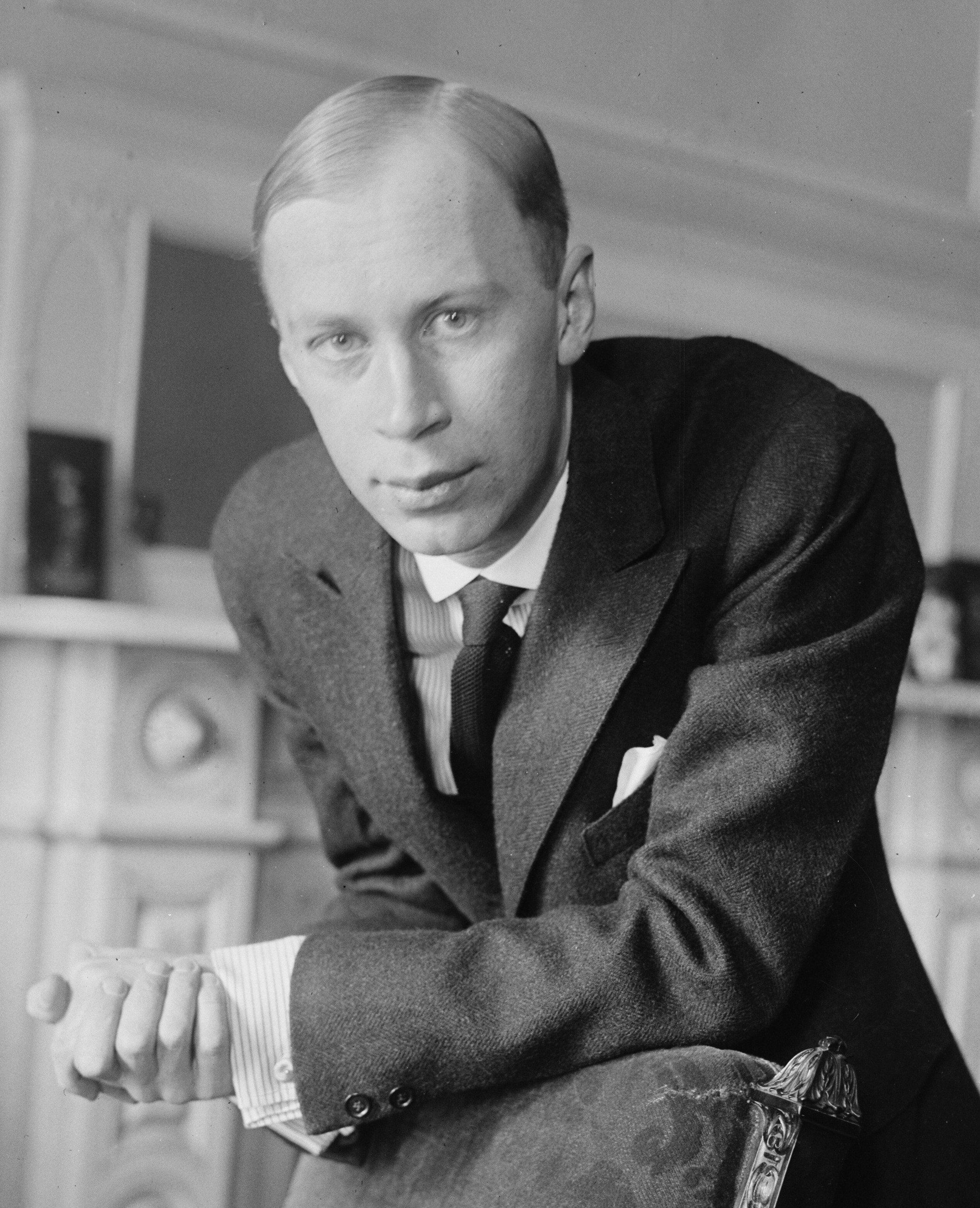
Composer: April 27, 1891, Sontsovka, Bakhmutsk region, Yekaterinoslav district, Ukraine; died March 4, 1953, Moscow
Work composed: 1916-21; dedicated to poet Konstantin Balmont.
World premiere: Frederick Stock led the Chicago Symphony with the composer at the piano on December 16, 1921.
Instrumentation: solo piano, 2 flutes (1 doubling piccolo), 2 oboes, 2 clarinets, 2 bassoons, 4 horns, 2 trumpets, 3 trombones, timpani, bass drum, castanets, cymbals, tambourine, and strings.
Estimated duration: 28 minutes
American journalist: “What is a classical composer?”
Sergei Prokofiev: “He is a mad creature who composes work incomprehensible to people of his own generation. He has discovered a certain logic, as yet unknown to others, so that they cannot follow him. Only later do the roads that he has pointed out, if they are good ones, become understandable to those around him.”
In his memoirs, Sergei Prokofiev said he “wished to poke a little fun at the Americans,” when asked the question quoted above in a 1927 interview he gave in New York. Prokofiev’s tongue-in-cheek response was more accurate than he intended, however, particularly with regard to his own music and how it was received by American audiences.
Prokofiev composed in a patchwork style, jotting down fragments of themes in a notebook as they came to him. Prokofiev kept these musical diaries for years, and often referred to them when he composed. Several of Prokofiev’s musical ideas for the Third Piano Concerto had been gestating since 1913, including the delicate melody that forms the basis for the Andantino theme and variations. Like a quilt design fashioned from many unrelated patches, Prokofiev’s Third Piano Concerto is an artful arrangement of musical ideas that evolve into a unified sound collage. Prokofiev put the finishing touches on the third concerto during the summer of 1921, while he was living in St. Brevin-les-Pins, on the northwest coast of France.
The Andante-Allegro contrasts the languid opening clarinet melody with the piano’s ebullient energy. The final theme, a rapidly ascending stampede of thirds in the piano, was one of the first fragments Prokofiev wrote almost a decade earlier. The theme of the Tema con variazioni (Theme with variations) is a lilting, rhythmic melody first heard in the winds; the five variations that follow are, by turns, wistfully elegant, agitated, stormy, mysterious, and frenzied. Prokofiev characterized the Allegro ma non troppo as an “argument” between piano and orchestra, full of “caustic humor … with frequent differences of opinion as regards key.” After much musical bickering, the concerto ends with a blazing coda.
The exuberant, brash Piano Concerto No. 3 drew thunderous applause from American audiences but rather tepid reviews. After the premiere, one Chicago paper described it as “a plum pudding without the plums.” Later concerts in New York produced similar reactions; Prokofiev’s observation about the “certain logic” of contemporary composers proved prescient. Three years after the end of WWI, which disrupted all societal and cultural conventions, audiences were receptive to Prokofiev’s post-war explorations of new sonorities, but critics, often more conservative than their readers, were not. Discouraged by the lackluster American reviews of his music, Prokofiev departed for Europe. In 1932, he made his first recording, playing the Third Concerto with the London Symphony Orchestra. This recording helped make the Third Piano Concerto one of Prokofiev’s most popular works.

Johannes Brahms
Symphony No. 1 in C minor, Op. 68
Composer: born May 7, 1833, Hamburg; died April 3, 1897, Vienna
Work composed: Brahms began working on his first symphony in 1856 and returned to it periodically over the next 19 years. He wrote the bulk of the music between 1874 and 1876.
World premiere: Otto Dessoff led the Badische Staatskapelle in Karlsruhe, on November 4, 1876.
Instrumentation: 2 flutes, 2 oboes, 2 clarinets, 2 bassoons, contrabassoon, 4 horns, 2 trumpets, 3 trombones, timpani and strings.
Estimated duration: 42 minutes
““There are fewer things heavier than the burden of a great potential.” ”
In 1853, Robert Schumann wrote a laudatory article about an unknown 20-year-old composer from Hamburg named Johannes Brahms, whom, Schumann declared, was the heir to Beethoven’s musical legacy. Schumann wrote, “If [Brahms] directs his magic wand where the massed power in chorus and orchestra might lend him their strength, we can look forward to even more wondrous glimpses into the secret world of the spirits.” At the time Schumann’s piece was published, Brahms had composed several chamber pieces and works for piano, but nothing for orchestra. The article brought Brahms to the attention of the musical world, but it also dropped a crushing weight of expectation onto his young shoulders. “I shall never write a symphony! You have no idea how it feels to hear behind you the tramp of a giant like Beethoven,” Brahms grumbled.
Because Brahms took almost 20 years to complete what became his Op. 68, one might suppose its long gestation stemmed from Brahms’ possible trepidation about producing a symphony worthy of the Beethovenian ideal. This assumption, on its own, does Brahms a disservice. Daunting though the task might have been, Brahms also wanted to take his time. This measured approach reflects the high regard Brahms had for the symphony as a genre. “Writing a symphony is no laughing matter,” he remarked.
Brahms began sketching the first movement when he was 23, but soon realized he was handicapped by his lack of experience composing for an orchestra. Over the next 19 years, as he continued working on Op. 68, Brahms wrote several other orchestral works, including the 1868 German Requiem and the popular 1873 Variations on a Theme by Haydn (aka the St. Anthony Variations). The enthusiastic response that greeted both works bolstered Brahms’ confidence in his ability to handle orchestral writing. In 1872, Brahms was offered the conductor’s post at Vienna’s Gesellschaft der Musikfreunde (Society of Friends of Music). This opportunity to work directly with an orchestra gave Brahms the invaluable first-hand experience he needed. 23 years after Schumann’s article first appeared, Brahms premiered his Symphony No. 1 in C minor. It was worth the wait.
Brahms’ friend, the influential music critic Eduard Hanslick, summed up the feelings of many: “Seldom, if ever, has the entire musical world awaited a composer’s first symphony with such tense anticipation … The new symphony is so earnest and complex, so utterly unconcerned with common effects, that it hardly lends itself to quick understanding … [but] even the layman will immediately recognize it as one of the most distinctive and magnificent works of the symphonic literature.”
Hanslick’s reference to the symphony’s complexity was a polite way of saying the music was too serious to appeal to the average listener, but Brahms was unconcerned; he was not trying to woo the public with pretty sounds. “My symphony is long and not exactly lovable,” he acknowledged. The symphony is carefully crafted; one can hear Brahms’ compositional thought processes throughout, especially his decision to incorporate several overt references to Beethoven. The moody, portentous atmosphere of the first movement, and the short thematic fragments from which Brahms spins out seemingly endless developments, are all hallmarks of Beethoven’s style. Brahms also references Beethoven by choosing the key of C minor, which is closely associated with several of Beethoven’s major works, including the Fifth Symphony, Egmont Overture, and Piano Concerto No. 3. And yet, despite all these deliberate nods to Beethoven, this symphony is not, as conductor Hans von Bülow dubbed it, “Beethoven’s Tenth.” The voice is distinctly Brahms’, especially in the inner movements.
The tender, wistful Andante sostenuto contrasts the brooding power of the first movement. Brahms weaves a series of dialogues among different sections of the orchestra, and concludes with a duet for solo violin and horn. In the Allegretto, Brahms slows down Beethoven’s frantic scherzo tempos. The pace is relaxed, easy, featuring lilting themes for strings and woodwinds. The finale’s strong, confident horn solo proclaims Brahms’ victory over the doubts that beset him during Op. 68’s long incubation. Here Brahms also pays his most direct homage to Beethoven, with a majestic theme, first heard in the strings, that closely resembles the “Ode to Joy” melody from Beethoven’s Ninth Symphony. When a listener remarked on this similarity, Brahms snapped irritably, “Any jackass could see that!”

© Elizabeth Schwartz
NOTE: These program notes are published here by the Modesto Symphony Orchestra for its patrons and other interested readers. Any other use is forbidden without specific permission from the author, who may be contacted at www.classicalmusicprogramnotes.com
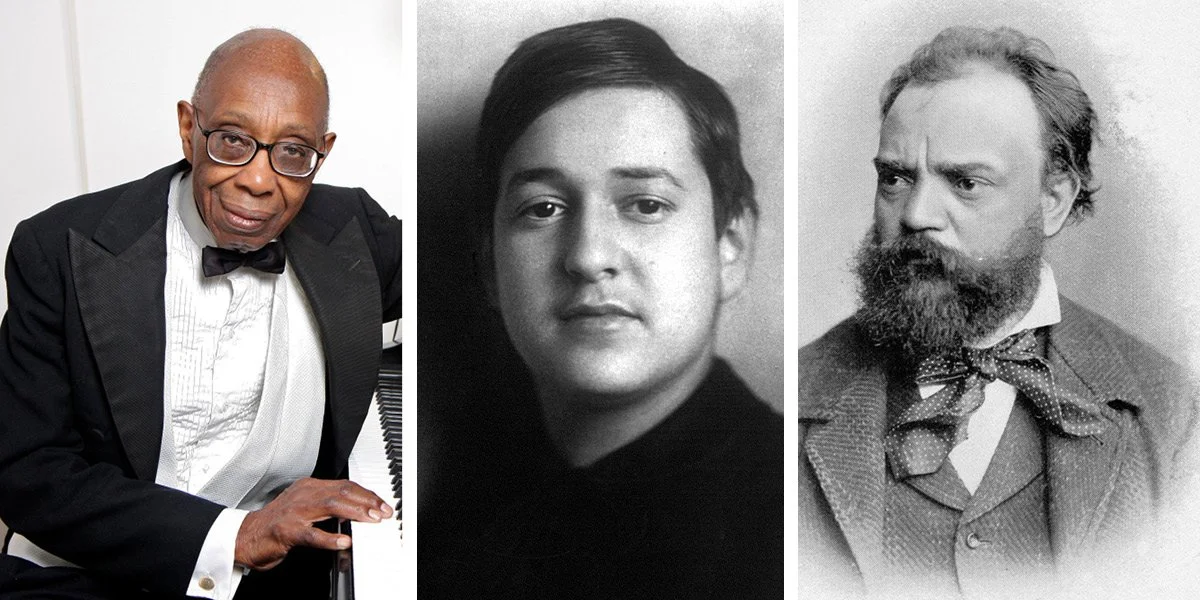
Program Notes: Korngold & Dvorak
Notes about:
George Walker’s Lyric for Strings
Erich Korngold’s Concerto in D major for Violin
Antonin Dvorak’s Symphony No. 8
Program Notes for Korngold & Dvorak
George Walker
Lyric for Strings

Composer: b. June 22, 1922, Washington, D.C.; died August 23, 2018, Montclair, NJ
Work composed: 1946. Dedicated “to my grandmother.”
World premiere: 1946. Seymour Lipkin led a student orchestra from the Curtis Institute of Music in a radio concert.
Instrumentation: string orchestra
Estimated duration: 6 minutes
For most of a century, despite the systemic pervasive racism he encountered, George Theophilus Walker sustained three successful careers in performance, composition, and teaching. After graduating from Oberlin Conservatory, Walker attended the Curtis Institute, becoming the first Black student to earn an Artist’s Diploma in piano and composition. At Curtis, Walker studied piano with Rudolf Serkin and composition with Gian Carlo Menotti. Walker continued his education at the Eastman School of Music, where he earned a D.M.A. in composition, the first Black composer to do so. In the 1950s, Walker traveled to Paris to study composition with the influential composition teacher Nadia Boulanger.
Walker’s life list of accomplishments includes many more “firsts:” he was the first Black instrumentalist to play a recital in New York’s Town Hall; the first Black soloist to perform with the Philadelphia Orchestra under Eugene Ormandy, and the first Black instrumentalist to obtain major concert management, with National Concert Artists. In 1996, Walker became the first Black composer to win the Pulitzer Prize in Music for his Lilacs for Voice and Orchestra, a setting of Walt Whitman’s poem, “When Lilacs Last in the Dooryard Bloom’d.” In 2000, Walker was elected to the American Classical Music Hall of Fame, the first living composer so honored.
Like Samuel Barber’s Adagio for Strings, Walker’s Lyric for Strings – initially titled Lament for Strings – began as a movement for string quartet. Walker wrote his String Quartet No. 1 in 1946 as a graduate student at the Curtis Institute. He dedicated the Lament to his grandmother, who had died the previous year. The quartet premiered on a live radio performance of Curtis’ student orchestra in 1946, and the following year received its concert premiere at the National Gallery of Art in Washington, D.C.
Walker subsequently gave the second movement a new title, Lyric for Strings, and as a stand-alone piece, it quickly became one of the most regularly programmed works by a living composer. Melodies interweave among the instruments, and the pensive atmosphere reflects both the composer’s anguish at the passing of his beloved grandmother, as well as the joy her memory evokes. The serene melodies and lush harmonic underpinnings suggest an expressive but never mawkish sense of love and loss.
Erich Wolfgang Korngold
Violin Concerto in D major, Op. 35

Composer: born May 29, 1897, Vienna; died November 29, 1957, Hollywood, CA
Work composed: 1937-1945. Commissioned by violinist Bronisław Huberman. Dedicated to Gustav Mahler’s widow, Alma Mahler-Werfel.
World premiere: February 15, 1947. Vladimir Golschmann led the St. Louis Symphony with Jascha Heifetz as soloist.
Instrumentation: solo violin, 2 flutes (1 doubling piccolo), 2 oboes (1 doubling English horn), 2 clarinets, bass clarinet, 2 bassoons (1 doubling contrabassoon), 4 horns, 2 trumpets, trombone, timpani, bass drum, cymbals, glockenspiel, vibraphone, xylophone, celesta, harp, and strings.
Estimated duration: 24 minutes
Erich Korngold was a man out of time. Had he been born a century earlier, his romantic sensibilities would have aligned perfectly with the musical and artistic aesthetics of the 19th century. Instead, Korngold grew up in the tumult of the early 20th century, when his tonal, lyrical style had been eclipsed by the horrors of WWI and the stark modernist trends promulgated by fellow Viennese composers Arnold Schoenberg, Alban Berg, and Anton Webern.
Korngold’s prodigious compositional talent emerged early. At age ten, he performed his cantata Gold for Gustav Mahler, whereupon the older composer called him “a genius.” When Korngold was 13, just after his bar mitzvah, the Austrian Imperial Ballet staged his pantomime The Snowman. In his teens, Korngold received commissions from the Leipzig Gewandhaus Orchestra; pianist Artur Schnabel performed Korngold’s Op. 2 Piano Sonata on tour, and Korngold also began writing operas, completing two full-scale works by age eighteen. At 23, Korngold’s opera Die tote Stadt (The Dead City) brought him international renown; it was performed in 83 different opera houses.
But by the 1920s, composers had fully embraced modernism. The music of Korngold’s contemporaries bristled with dissonance, unexpected rhythms, and often little that resembled a recognizable melody. Korngold’s music reflected an earlier, bygone era, and his unabashed Romanticism was dismissed as hopelessly out of date. Fortunately for Korngold, around this same time a new forum for his lush expressiveness emerged: film scores. In 1934, director Max Reinhardt invited Korngold to write a score for his film of A Midsummer Night’s Dream. Korngold subsequently moved to Hollywood, where he spent the next dozen years composing scores for 18 films, including his Oscar-winning music for Anthony Adverse (1936), and The Adventures of Robin Hood starring Errol Flynn, Olivia de Havilland, and Claude Rains (1938).
While some composers and critics, then as now, regard film music as less significant than works written for the concert hall, Korngold did not. “I have never drawn a distinction between music for films and for operas or concerts,” he stated, and his violin concerto bears this out. The concerto is a compilation of themes from several Korngold scores, including Another Dawn (1937), Juárez (1939), Anthony Adverse, and The Prince and the Pauper (1937). Korngold’s Violin Concerto has been a favorite of both violinists and audiences everywhere since its premiere, although the New York Sun famously dismissed it as “more corn than gold.”
It was a running joke in the Korngold family that every time their family friend Bronisław Huberman saw Korngold, the Polish violinist would demand, “Erich! Where’s my concerto?” At dinner one evening in Korngold’s house in Los Angeles, Korngold responded to Huberman’s mock-serious question by going to his piano and playing the theme from Another Dawn. Huberman exclaimed, “That’s it! That will be my concerto. Promise me you’ll write it.” Korngold complied, but it was Jascha Heifetz, another child prodigy, who gave the first performance. In the program notes for the premiere, Korngold wrote, “In spite of its demand for virtuosity in the finale, the work with its many melodic and lyric episodes was contemplated rather for a Caruso of the violin than for a Paganini. It is needless to say how delighted I am to have my concerto performed by Caruso and Paganini in one person: Jascha Heifetz.”
Antonín Dvořák
Symphony No. 8 in G Major, Op. 88 [aka No. 4]
Composer: born September 8, 1841, Nelahozeves, near Kralupy (now the Czech Republic); died May 1, 1904, Prague
Work composed: Dvořák wrote the Symphony No. 8 between August 26 and November 8, 1889, at his country home, Vysoká, in Bohemia. The score was dedicated “To the Bohemian Academy of Emperor Franz Joseph for the Encouragement of Arts and Literature, in thanks for my election [to the Prague Academy].”
World premiere: Dvořák conducted the first performance in Prague on February 2, 1890.
Instrumentation: 2 flutes (1 doubling piccolo), 2 oboes (1 doubling English horn), 2 clarinets, 2 bassoons, 4 horns, 2 trumpets, 3 trombones, tuba, timpani ,and strings.
Estimated duration: 36 minutes
From its inception, Antonín Dvořák’s Symphony in G major was more than a composition; in musical terms it represented everything that made Dvořák a proud Bohemian. Trouble started when Dvořák’s German publisher, Fritz Simrock, wanted to publish the symphony’s movement titles and Dvořák’s name in German translation. This might seem like an unimportant detail over which to haggle, but for Dvořák it was a matter of cultural life and death. Since the age of 26, Dvořák had been a reluctant citizen of the Austro-Hungarian Empire, ruled by the Hapsburg dynasty. Under the Hapsburgs, Czech language and culture were vigorously repressed. Dvořák, an ardent Czech patriot who resented the Germanic norms mandated by the Empire, categorically refused Simrock’s request.
For his part, Simrock was not especially enthusiastic about publishing Dvořák’s symphonies, which didn’t sell as well as Dvořák’s Slavonic dances and piano music. Simrock and Dvořák also haggled over the composer’s fee; Simrock had paid 3,000 marks for Dvořák’s Symphony No. 7, but inexplicably and insultingly offered only 1,000 for the Eighth Symphony. Outraged, Dvořák offered his Symphony No. 8 to the London firm Novello, which published it in 1890.
The G Major symphony broke new ground from the moment of its premiere. Op. 88 was, as the composer explained, meant to be “different from the other symphonies, with individual thoughts worked out in a new way.” This “new way” refers to Dvořák’s musical transformation of the Czech countryside he loved into a unique sonic landscape. Within the music, Dvořák included sounds from nature, particularly hunting horn calls and birdsongs played by various wind instruments. Biographer Hanz-Hubert Schönzeler observed, “When one walks in those forests surrounding Dvořák’s country home on a sunny summer’s day, with the birds singing and the leaves of trees rustling in a gentle breeze, one can virtually hear the music.”
Serenity floats over the Adagio. As in the first movement, Dvořák plays with tonality; E-flat major slides into its darker counterpart, C minor. Dvořák was most at home in rural settings, and the music of this Adagio evokes the tranquil landscape of the garden at Vysoká, Dvořák’s country home. In a manner similar to Beethoven’s Pastoral Symphony, the music suggests an idyllic summer’s day interrupted by a cloudburst, after which the sun reappears, striking sparkles from the raindrops.
During a rehearsal of the trumpet fanfare in the last movement, conductor Rafael Kubelik declared, “Gentlemen, in Bohemia the trumpets never call to battle – they always call to the dance!” After this opening summons, cellos sound the main theme. Quieter variations on the cello melody feature solo flute and strings, and the symphony ends with an exuberant brassy blast.
© Elizabeth Schwartz
NOTE: These program notes are published here by the Modesto Symphony Orchestra for its patrons and other interested readers. Any other use is forbidden without specific permission from the author, who may be contacted at www.classicalmusicprogramnotes.com
Enrich Your Concert Experience